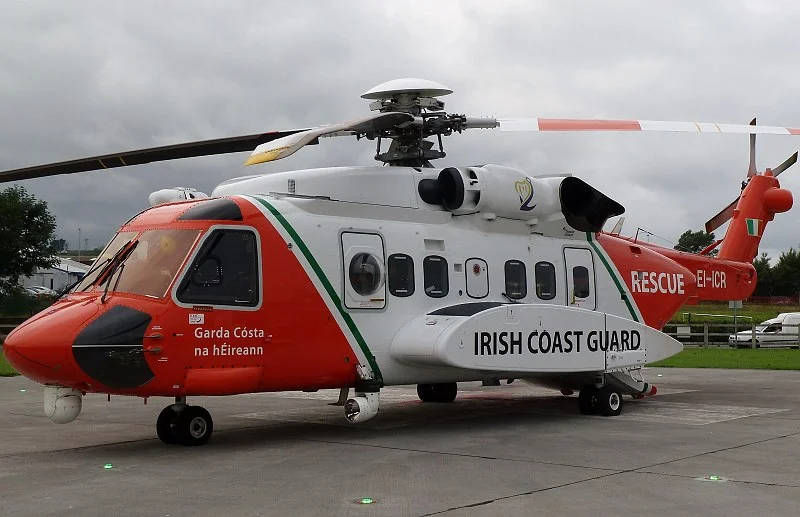

2017 Irish Coast Guard Rescue 116 crash
It was just before midnight on 13 March 2017 when Rescue 116, a Sikorsky S-92 helicopter of the Irish Coast Guard, lifted off from Dublin and turned west. Two hundred and fifty kilometres out into the Atlantic, a fisherman had lost part of his thumb and needed evacuation to hospital. Rescue 118 from Sligo was going out to lift him. Rescue 116 was going to provide communications relay - a supporting role, on a route the crew had flown before. On board were Captain Dara Fitzpatrick, Chief Pilot Mark Duffy, winch operator Paul Ormsby, and winch man Ciaran Smith. None of them would come home.
The Approach to Blacksod
Rescue 116 was scheduled to refuel at Blacksod Lighthouse on the Mullet Peninsula before continuing the mission. Approaching from the southeast in the early hours of 14 March, the helicopter was tracking a route at 200 feet above the sea - a low altitude, but one consistent with how the crew had been trained to approach this stretch of coast in poor visibility. Nine and a half nautical miles west of Blacksod, in their path, stood Blackrock Island: a 70-metre column of basalt rising out of the Atlantic, topped by a small white lighthouse, often shrouded in mist. The route guidance the crew was using did not show Blackrock as an obstacle. They did not see it in time.
Four Names
Captain Dara Fitzpatrick was a senior pilot with years of search-and-rescue experience and a three-year-old son. Chief Pilot Mark Duffy was alongside her in the cockpit. In the back were winch operator Paul Ormsby and winch man Ciaran Smith, the two crew whose job was to go down on the cable into whatever weather and sea state a rescue required. These were people who chose careers that put them in danger so that other people - injured fishermen, stranded sailors, hikers caught out in the mountains - would not have to face that danger alone. They were doing exactly that on the night Rescue 116 went down.
The Search at Sea
Captain Fitzpatrick was recovered from the sea in a critical condition and brought to Mayo University Hospital, where she was pronounced dead later that day. The search for the other three crew became one of the largest and longest the Irish state has ever mounted. The Commissioners of Irish Lights sent the ILV Granuaile, a multifunctional vessel with dynamic positioning and a helicopter platform. The Marine Institute deployed its work-class ROV Holland 1 from the deck of the Granuaile in Galway harbour. The Naval Service sent the LE Samuel Beckett, which assumed command as on-scene coordinator. Fishing boats from Mayo, Donegal, and beyond joined the effort. Sister of one of the missing crew made an emotional public appeal to the Donegal fishing community. Mark Duffy's body was recovered from the helicopter wreckage on 26 March. Paul Ormsby and Ciaran Smith were never found.
We're Gone
The flight data recorder, when it was recovered from the seabed, contained the final cockpit communications. Among them was a phrase that became the title of the preliminary report's coverage in the Irish press: 'We're gone.' There were no mechanical anomalies. The aircraft was functioning normally. The crew was experienced and well-trained. What failed was something larger - the systems and procedures that were meant to ensure their route guidance accurately reflected the obstacles in their path.
Twelve Contributory Factors
The final report from the Air Accident Investigation Unit, published in November 2021 after four and a half years of inquiry, identified twelve contributory factors leading to the crash. The report was sharply critical of the management and organisational systems behind the search-and-rescue contract. Blackrock Island was not listed in the route's obstacle database. Risk assessments had not identified the hazard. Training had not flagged it. The crew of Rescue 116, in other words, had been let down by every layer of the system designed to keep them safe.
What Remains
Captain Dara Fitzpatrick's funeral was held in Glencullen, County Dublin, on 18 March 2017, with a Coast Guard helicopter giving top cover over the church. Mark Duffy's funeral followed at the end of the month. For the families of Paul Ormsby and Ciaran Smith, who never recovered remains to bury, there has been no comparable closure. The Coast Guard service those four crew belonged to continues - other helicopters fly other missions from Dublin, Waterford, Shannon, and Sligo - and every crew that goes out now does so under procedures rewritten in the long shadow of what happened at Blackrock. On the island itself, a small white lighthouse goes on flashing its warning to the sea.
From the Air
The crash site is at Blackrock Island, 54.067°N, 10.320°W, 9.5 nautical miles west of Blacksod on the Mullet Peninsula. The island rises 70 metres above sea level and is often shrouded in mist. Approaches from the southeast at low altitude should treat Blackrock as a primary hazard. Ireland West Airport Knock (EIKN) is about 50 nm to the east; Donegal (EIDL) lies to the north. Pilots overflying the area are encouraged to maintain awareness of all named offshore obstacles - the Rescue 116 inquiry highlighted how an island missing from a route database can have catastrophic consequences.
Nearby Stories
- Louisburgh, County Mayo 3.1 km away
- Ballycroy 4.4 km away
- Inishturk 20 km away
- Action of 7 May 1794 31 km away
- Lissadell House 82 km away
- The Laki Eruption: The Volcano That Changed World History 1160 km away
- The Northern Lights: The Sky Show That Vikings Thought Was Bridge to the Gods 1272 km away
- Sao Miguel 2101 km away