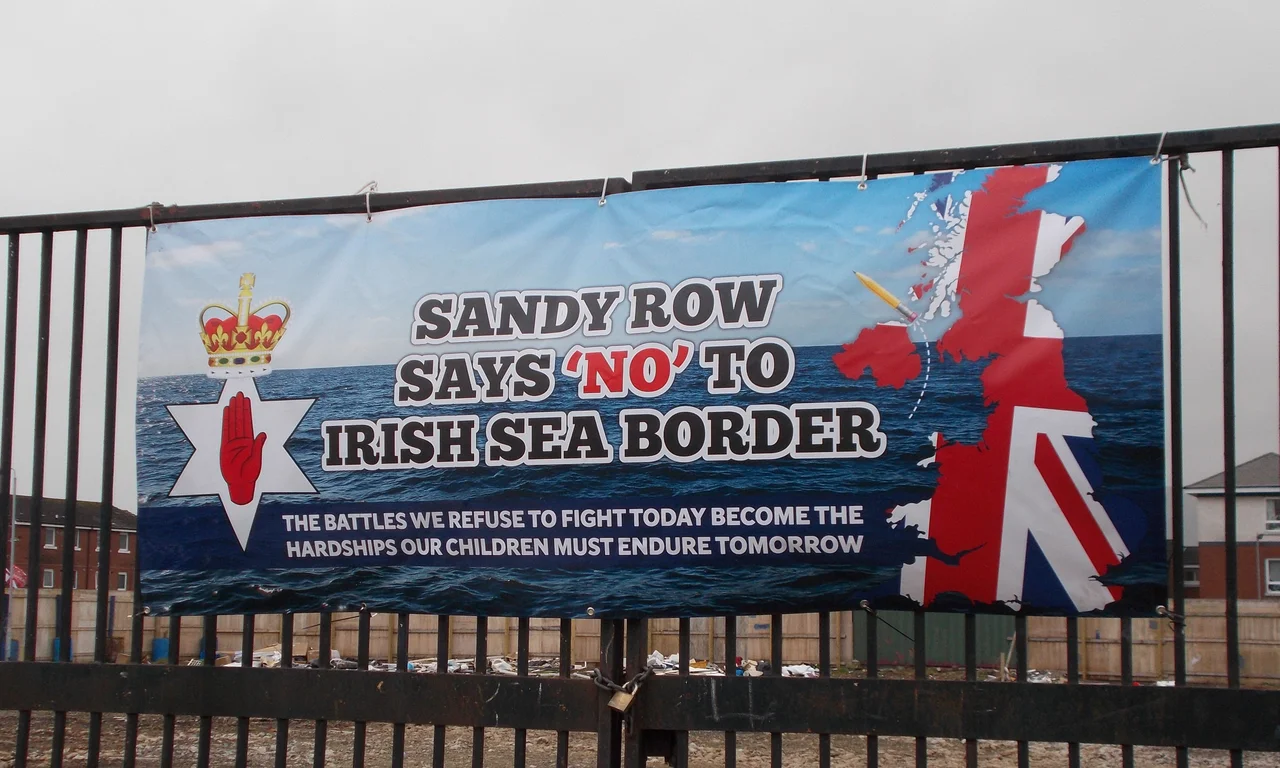

2021 Northern Ireland riots
On the night of 7 April 2021, a hijacked Belfast bus burned at the junction of Lanark Way and Shankill Road. A Belfast Telegraph photographer was assaulted and his cameras smashed. Across the peace line, rioters threw petrol bombs to either side. Many of the young people doing the throwing had been born after the Good Friday Agreement. They were rioting in streets their parents had wanted them never to need to know. The 2021 disturbances are sometimes dismissed as a brief flare; in fact they ran from 30 March in Waterside, Derry to a final flickering on 9 April when respect for the death of Prince Philip caused loyalist organisers to postpone protests for one evening before the violence faded.
A Border Inside the Country
The immediate trigger of the riots was the Northern Ireland Protocol, the part of the Brexit withdrawal agreement that placed a customs border down the Irish Sea between Great Britain and Northern Ireland. To unionists and loyalists, who define themselves by their connection to Britain, the protocol felt like an internal frontier inside the United Kingdom: lorries from Liverpool inspected as if they were arriving in a foreign country. A port worker in Larne had to relocate his family after receiving a loyalist death threat in March 2021. The Loyalist Communities Council withdrew its support for the Good Friday Agreement. Into this charged moment came the funeral of former IRA intelligence chief Bobby Storey, which had drawn around 2,000 people in apparent breach of COVID-19 restrictions. When prosecutors declined to charge any of the 24 Sinn Féin politicians who attended, loyalist anger had a focus.
Waterside
The riots began in the unionist Tullyally estate in Waterside, on the east bank of the Foyle in Derry, on 30 March. By 4 April children as young as twelve were throwing masonry, fireworks, and petrol bombs at PSNI officers; fire crews trying to put out vehicle fires were attacked as well. Disorder outside a nursing home on Nelson Drive caused, in the police's words, untold fear and distress to elderly residents. Twelve officers were wounded across the four nights, suffering injuries to heads, legs, and feet. By 5 April youths were gathering at the site of a burning car in Sperrin Park. Youth workers blamed the closure of community centres under pandemic restrictions; older loyalists blamed the protocol; the children themselves were doing what children in many small estates have always done when adults give them an excuse: setting fire to things in front of an audience.
Bombs Across the Peace Line
On 2 April the violence reached the Sandy Row area of south Belfast. PSNI officers were attacked with bricks, bottles, fireworks, and petrol bombs; eight people were arrested, the youngest of them thirteen. By 7 April rioting reached the Lanark Way gate in the peace wall between the Shankill and the Falls. The hijacked bus burned. Rioters on both sides of the wall hurled petrol bombs over it. On 8 April the PSNI deployed water cannons in west Belfast for the first time in six years; nineteen officers and a police dog were injured. The Ulster Volunteer Force was reported to have ordered Catholic families out of a Newtownabbey housing estate, which one journalist described as a form of 21st-century ethnic cleansing. In Carrickfergus loyalist roadblocks kept police out of estates. In Newtownabbey thirty petrol bombs were thrown at police in a single night.
A Death and a Pause
The riots ended, in part, by accident. Prince Philip, Duke of Edinburgh, died on 9 April. Loyalist organisers urged followers to postpone protests as a mark of respect to the royal family. Most did. There were still attacks that night in Tiger's Bay and New Lodge in north Belfast and a road block burning in Coleraine, but the heat had gone. In total, around 88 police officers had been injured. No protesters had been killed. Compared to 1969, when seven died in Belfast in three days, or to 1972, when fourteen civilians were killed in Derry in a single afternoon, the 2021 riots produced relatively small numbers. The worry was different. The bus burning at the Lanark Way gate was an image from another decade. The children throwing the bombs had not lived through the worst years. The grievances pulling them into the street had been re-shaped by Brexit but in their basic geometry, Protestant against Catholic, peace line as horizon, the streets of west Belfast looked horribly familiar.
What the Riots Argued
The 2021 disturbances were small by the standards of the Troubles and significant by the standards of the peace that followed. They argued, quietly, that the Good Friday Agreement of 1998 had stopped a war without resolving its underlying disputes; that economic neglect and post-Brexit constitutional anxiety could still mobilise crowds in working-class neighbourhoods; that youth services lost during COVID-19 had taken with them a steadying hand; and that the peace lines, far from being obsolete, were still doing real work. After the riots ended, community workers in both communities started new dialogue programmes. The Lanark Way gate still closes at night. The Sandy Row banner that had loomed over the south Belfast disturbances was eventually replaced with a more conciliatory message. Whether what happened in April 2021 was a last gasp or a warning shot remains, in 2026, an open question.
From the Air
The 2021 riots centred on Derry's Waterside (around 54.99 degrees north, 7.29 degrees west) and Belfast, with disturbances also in Newtownabbey, Carrickfergus, and Coleraine. Derry sits at the bend of the Foyle just south of Lough Foyle; the Waterside neighbourhood is on the east bank, opposite the walled old city. The nearest controlled airport to Derry is City of Derry (EGAE) just outside the city; Belfast's events centred on the Lanark Way interface between the Falls and Shankill in west Belfast, with Belfast International (EGAA) and Belfast City (EGAC) as the nearest airports. From cruise the long fjord of Lough Foyle to the north of Derry and the dense urban grid of Belfast wedged between Cave Hill and Belfast Lough are unmistakable.
Nearby Stories
- Portrush Lifeboat Station 1.9 km away
- Main Street, Letterkenny 2.1 km away
- Inishowen 6 km away
- Rosguill 6.3 km away
- County Tyrone 7.1 km away
- St Patrick's College, Maghera 9.6 km away
- St Patrick's Purgatory 11 km away
- Coalisland Canal 17 km away