_1.jpg)
Abbey of Saint Winnoc
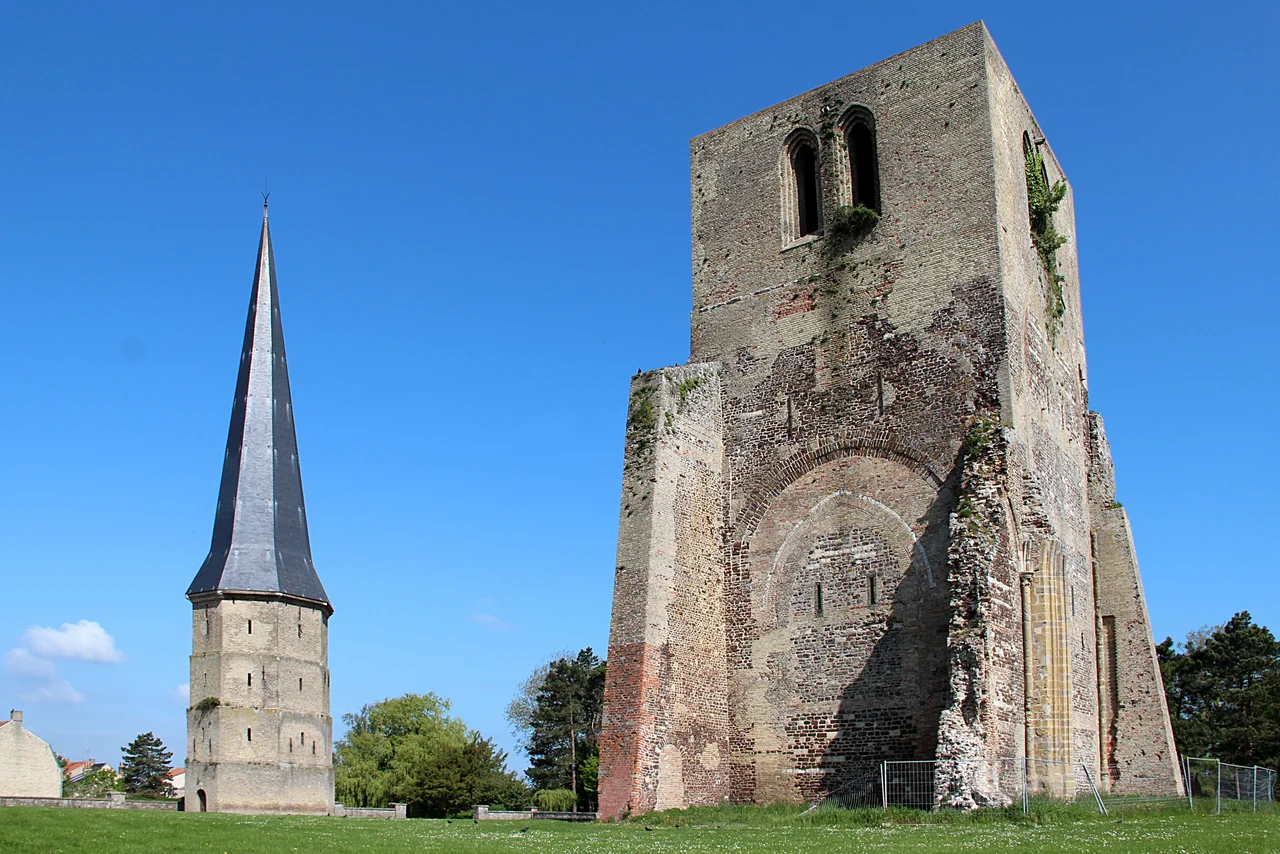
Most of a monastery is gone now. The cloisters, the dormitories, the great Benedictine church rebuilt with Baroque generosity in the 1750s, the scriptorium, the abbot's lodgings - all of it dismantled and carted away after the French Revolution dissolved the house in 1798. But two brick towers still rise over the hilltop town of Bergues. They were not preserved out of piety. They were preserved because sailors out in the North Sea, navigating up the coast from Dunkirk and Calais, had been using them as daymarks for centuries - a pair of vertical lines on the horizon that meant Bergues, and from Bergues you could find home. The Revolution could close a monastery but it could not redraw a coastline. So the towers stayed. Today they are all that remain of one of medieval Flanders' richest abbeys.
A Welshman in Flanders
Saint Winnoc, after whom this abbey is named, was almost certainly a real person, though most of what survives about him is hagiography. He was a missionary monk - by the most common tradition, of Welsh or Breton origin - who came to seventh-century Flanders in the wake of the great Irish-Frankish evangelisation of the Low Countries. He settled at Wormhout, a village inland from Dunkirk, and built a small monastic community there under the patronage of the great Abbey of Saint-Bertin at Saint-Omer to the south. After his death his relics drew pilgrims, and that meant money, and that meant trouble. In 899, Baldwin II - Margrave of Flanders, son of Charlemagne's heir-line by marriage - had Winnoc's body moved to Bergues, where it would be safer behind walls and closer to the centre of Flemish power. Around 1020 his great-grandson Baldwin IV moved the relics again, into a new church, and in 1022 turned the whole foundation into a Benedictine abbey. For its first half-century its abbots all came from Saint-Bertin - this was very much a daughter-house of the great Aa-valley monastery.
Rich Off Pilgrims and Cloth
Medieval Bergues was a wealthy town on the great trade roads of Flanders, and the abbey of Saint Winnoc grew rich with it. Count Baldwin gave it land and tithes; it began minting its own coins; it held a yearly market at Wormhout; and, in a calculation any modern marketing executive would recognise, it acquired more relics to draw more pilgrims. The bones of Oswald of Northumbria - the Anglo-Saxon king and martyr - and of Lewina, a more obscure female saint, joined Winnoc's in the abbey's collection. The monks commissioned a written narrative of Winnoc's miracles, the medieval equivalent of a tourism brochure. By the eleventh and twelfth centuries the abbey was one of the great Flemish foundations, with abbots who served as bishops and one - Gerard de Hamericourt, abbot from 1535 - who became the first bishop of Saint-Omer.
Fire, and Fire Again
In 1083 fire destroyed the abbey. It took fifty years to rebuild. The new church was consecrated in 1133. In 1288 the monks began enlarging the choir, work that ran into the early fourteenth century. In 1558, during the religious wars of the Reformation, fire damaged the buildings again. The community kept going - shaken, rebuilt, smaller each time. In the eighteenth century, after another two centuries, the monks undertook a great Baroque reconstruction between 1753 and 1770. They could not have known they were rebuilding for the last time. Twenty-eight years later, the Revolution arrived from Paris with its decrees on the suppression of monasteries, and in 1798 the abbey was closed, sold, and dismantled. The last abbot, Benoit Vandeweghe, had in 1789 presided over the assembly of clergy of Bailleul that drew up its cahier de doleances - the list of complaints they would carry to the Estates General. He had asked for reform. He got abolition.
Daymarks Against the Sea
What was spared, and why, tells you something about how France worked at the end of the eighteenth century. The Pointed Tower - the medieval one, a beautiful Gothic structure - and the Square Tower of the abbey were not knocked down for stone. They stayed because the maritime authorities needed them. The North Sea is a flat, dangerous coast, with shifting sandbars and tidal currents that have killed sailors since prehistory. The towers of Bergues are visible from far out to sea, and ships approaching from England or the Channel could line up on them and know where they were. The same towers that had marked a place of prayer became, in the secular Republic, a navigational aid - listed on charts, painted in pilots' manuals. The monks were gone but the bells were silent only metaphorically; sailors looking up at the towers still spoke to them, in a sense, asking the question every sailor asks the land: where am I, and how do I get home? Today the towers stand in a quiet park in central Bergues, and a small museum tells what is known of the abbey. The hill on which they sit is one of the few elevations in West Flanders - which is why the medieval town was built there, and why the towers were worth keeping.
From the Air
50.9681 N, 2.4386 E, in the historic centre of the small walled town of Bergues, 10 km south of Dunkirk. The two surviving abbey towers - the medieval Pointed Tower and the larger Square Tower - rise from a small park. Bergues itself is unmistakable from the air: a small, perfectly oval star-fort town surrounded by Vauban-era walls and water-filled moats. Recommended viewing altitude: 1,500 to 3,000 feet. Nearest airport: Calais-Dunkerque (LFAC), 10 km west. Lille (LFQQ) is 60 km southeast.
Nearby Stories
- Site John McCrae 4.7 km away
- Atlantic Wall Open Air Museum 5.9 km away
- 2008 Channel Tunnel fire 11 km away
- Battle of the Downs 19 km away
- Courrieres Mine Disaster 24 km away
- MV Tricolor 25 km away
- Le Paradis Massacre 26 km away
- Cléon 155 km away