
Site John McCrae
On the morning of May 3, 1915, a Canadian field-surgeon climbed into the back of an ambulance wagon parked on the western bank of the Ypres Canal and began writing. The day before, he had buried his friend. The day before that, he had been working for seventeen straight days inside dugouts cut into the canal embankment, the gunfire never pausing for more than sixty seconds. The poem he wrote that morning - fifteen lines, three stanzas, beginning "In Flanders fields the poppies blow" - would become the most-recited war poem in the English language. The dugouts where Lieutenant Colonel John McCrae worked are still here, halfway between Ypres and Boezinge, reinforced into concrete bunkers in 1917 and preserved ever since.
The Canal That Held
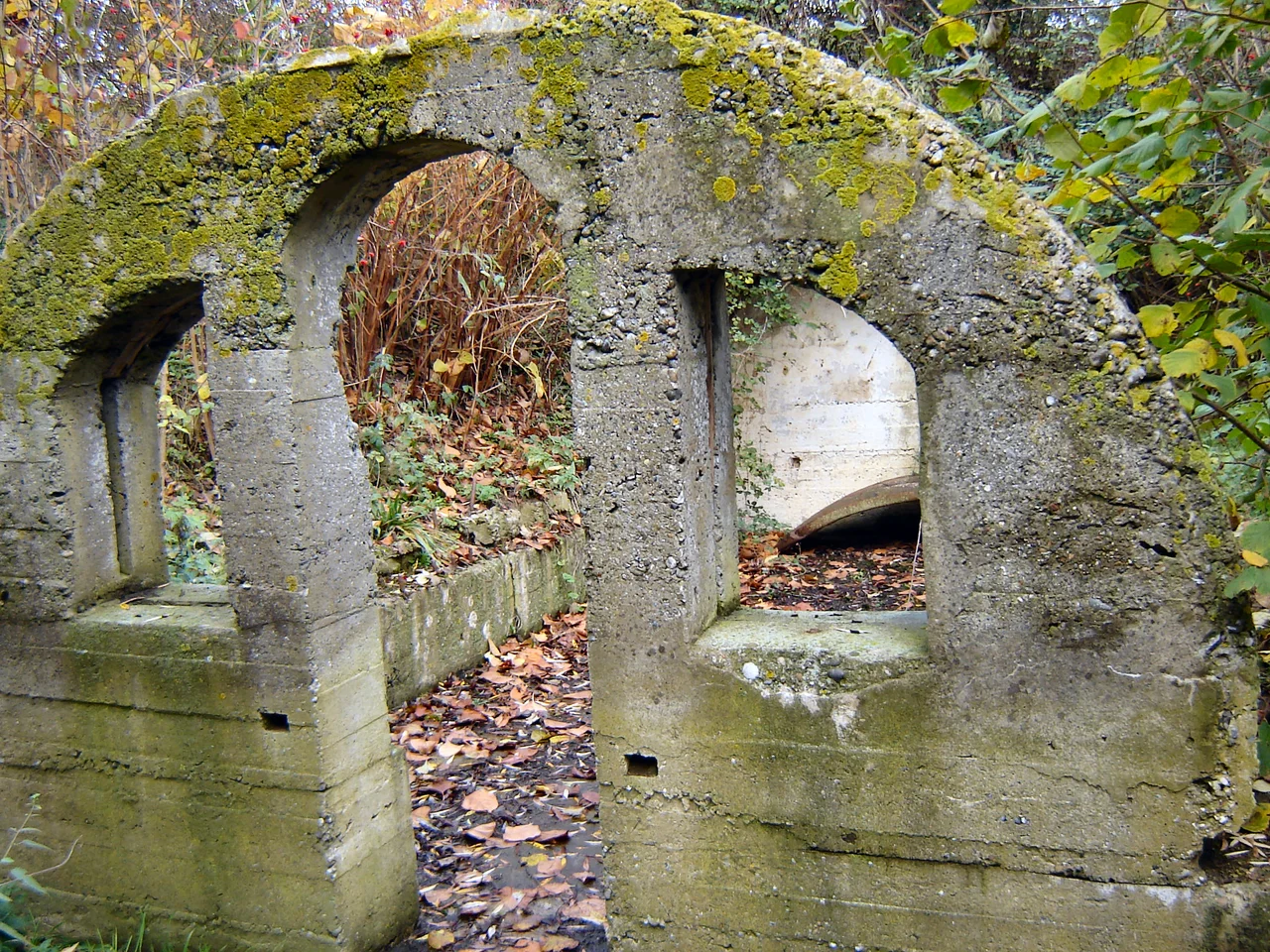
The Ieperlee was a working waterway before the war: a slim canal cut through low Flemish farmland, connecting Ypres northward to the sea. In the spring of 1915 it became something else entirely - the seam between two front lines. To the south, the British and French held the Ypres Salient, that infamous bulge of Allied territory thrust eastward into German guns. To the north, Belgian troops held the Yser Front. Where the two armies met, the western canal bank turned into a vast medical staging ground. The British carved dugouts straight into the embankment, then ran narrow-gauge railway lines down to camps to evacuate the wounded. By 1917 the original mud-and-timber holes had been rebuilt as a chain of concrete rooms - the bunkers that still squat beside the towpath today, low and grey and stubbornly intact.
Seventeen Days Without Boots
McCrae arrived at the canal bank in late April 1915, during the Second Battle of Ypres. On April 22, German forces had released chlorine gas against French colonial and Canadian positions just east of Ypres - one of the first large-scale chemical attacks in modern warfare. The Canadian line held for over two weeks. McCrae's dressing station took the casualties. In a letter to his mother, he described the experience as a nightmare: for seventeen days and seventeen nights, he wrote, none of them had taken off their clothes, nor even their boots, except occasionally. Gunfire and rifle fire "never ceased for sixty seconds." Behind it all, he wrote, was "a terrible anxiety lest the line should give way."
Alexis Helmer
Lieutenant Alexis Helmer was a close friend of McCrae's, a 22-year-old officer in the 2nd Battery of the 1st Brigade, Canadian Field Artillery. On May 2, 1915, Helmer was killed by a German shell. There was no chaplain available, so McCrae - a physician, not a clergyman - performed the burial service himself, reading from memory. The grave was marked with a small wooden cross in the dressing station cemetery just south of the bunkers. Within days, that grave was destroyed by further shelling, and Helmer's body was lost. The cemetery itself, now called Essex Farm, survives a few steps from the bunkers, with 1,204 men commemorated. McCrae noticed something the morning after Helmer's burial: red poppies were already pushing up through the disturbed earth around the new graves. The next day, May 3, he wrote the poem.
What McCrae Did Not Live to See
McCrae never came home. He was promoted, transferred to a larger hospital at Boulogne, and continued treating casualties through the worst years of the war. In January 1918 he died of pneumonia and meningitis, almost certainly worsened by exhaustion and the years he had spent in damp dugouts. He was 45. He never knew that "In Flanders Fields" would be quoted on coins, that schoolchildren across the Commonwealth would memorize it, or that the red Flanders poppy would become the international symbol of remembrance for the war dead - a symbol traceable, in the end, to what he saw growing beside Helmer's grave. The poem is engraved on a stone tablet a short walk from where he wrote it, set into the same canal bank that held the line.
Walking the Site Today
The memorial site is unfussy. A path runs from the road through grass and trees, past the concrete bunkers - you can step inside the low rooms, where the temperature drops several degrees and the walls still bear casting marks from the wartime concrete pours. Eastward, a raised earthen dyke parallels the canal; on top of it stands a stone memorial to the 49th (West Riding) Infantry Division. Hidden in the trees to the north are the curved concrete ruins of emergency shelters the Belgian government built for displaced civilians during the war - prefabricated arches, half-buried in earth and grown over. The In Flanders Fields memorial itself is east of the bunkers: a simple stone with the poem and McCrae's portrait. There is no entry fee, no gift shop, no guide. The wind off the polder still blows across the same field.
From the Air
Site John McCrae lies at 50.872°N, 2.873°E, on the western bank of the Ieperlee canal between Ypres and Boezinge. The site is a few kilometers north of EBFN (Koksijde) and around 30 km southeast of EBOS (Ostend). At low cruising altitude in clear weather, the canal traces a thin silver line southward from the coast to Ypres; the memorial sits where that line meets a small cluster of trees and the white headstones of Essex Farm Cemetery, immediately west of the Diksmuidseweg (N369).
Nearby Stories
- Battle of the Lys and the Escaut 7.3 km away
- Abbey of Saint Winnoc 9 km away
- Ostend 9.5 km away
- Courrieres Mine Disaster 24 km away
- MV Tricolor 30 km away
- Battle of Schooneveld 31 km away
- Belgium 71 km away
- Royaumont Abbey 164 km away