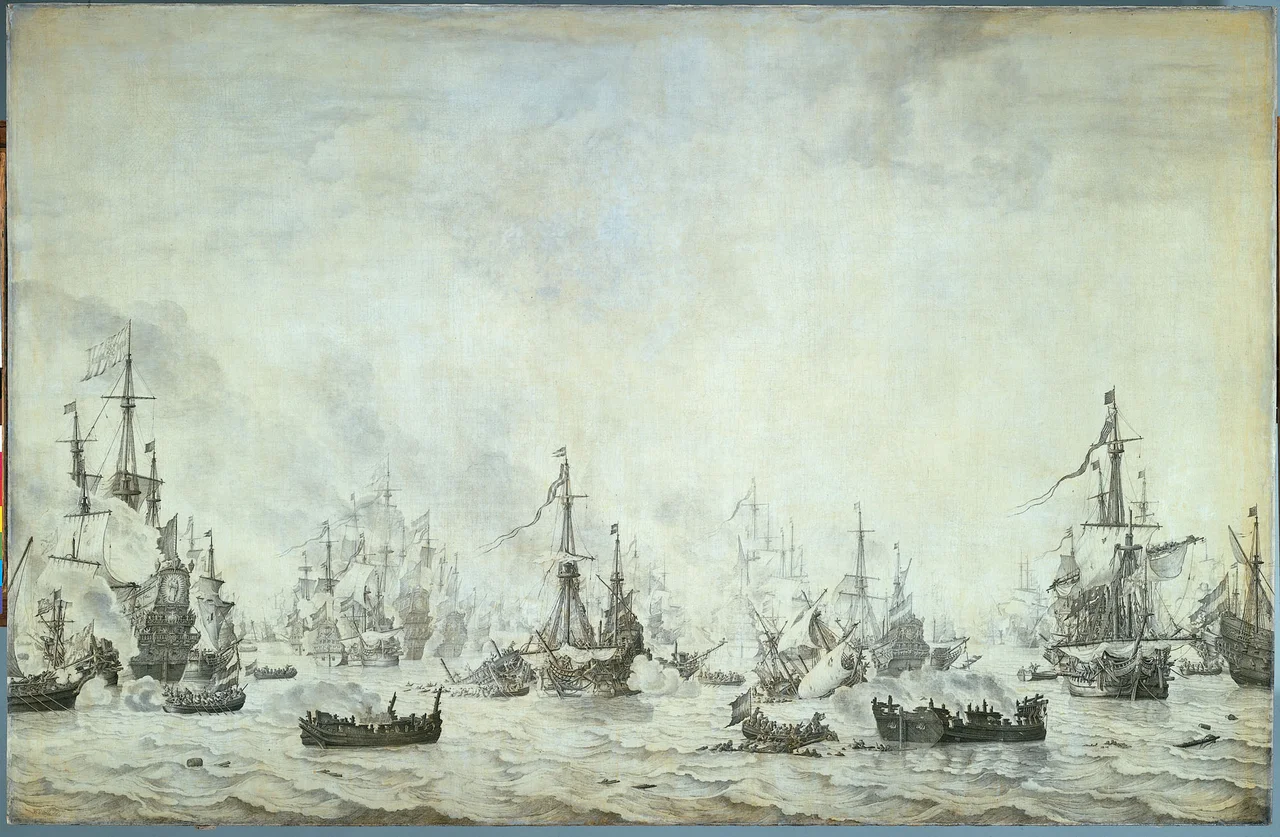

Battle of the Downs
Spanish chief minister Olivares wanted his prestige back. By August 1639 he had assembled the largest fleet Spain had sent into northern waters in a generation - fifty warships, thirty transports, three million escudos in silver, nine thousand reinforcements for the Army of Flanders. The fleet was to fight its way through the Dutch blockade and remind Europe that Habsburg sea power still mattered. Six weeks later, what was left of it was burning, beached, or running for Dunkirk through the fog. The Battle of the Downs, fought on 21 October 1639 in the narrow anchorage between Dover and Deal, ended Spain's bid to recover the Channel - and watched the Spanish century end in a thousand small fires on the water.
The English Road
Olivares had a logistical problem. The overland Spanish Road, which for decades had funneled tercios from Italy through the Alps to the war in Flanders, had been cut in December 1638 when a French-backed army took Breisach. Spain's other option was the English Road - a quiet arrangement with Charles I's neutral England under which men and money landed at Dover and were ferried across to Dunkirk in small, fast boats. The English Road kept Flanders supplied, but it did not restore prestige. So Olivares stripped galleys from the Mediterranean, hired transports from Germany and England, and gave the command to Antonio de Oquendo, an admiral fresh from victory over the Dutch at Abrolhos in Brazil. The orders were not just to deliver the reinforcements. They were to find Maarten Tromp's Dutch fleet, and beat it.
The Half-Moon Falls Apart
The two fleets met in mid-September. Tromp had only seventeen ships - badly outnumbered by Oquendo's fifty - but he had something the Spanish admiral did not: a column. While Oquendo arranged his fleet in the traditional half-moon, Tromp drew his ships into line of battle, one of the first major actions in which the tactic appears, and attacked. Oquendo, fixated on repeating his Abrolhos trick of crushing the enemy flagship in single combat, peeled his own ship out of the formation to chase Tromp. Some Spanish captains followed. Others did not. The half-moon disintegrated. The Spanish flagship sailed past Tromp's stern when she should have raked it, then tried to board the next Dutch ship in the line and missed. By the time Oquendo realized what was happening, he was downwind and being broadsided by nine Dutch ships at once. He saved himself by ordering the whole fleet back into half-moon - which let Tromp escape, and let Oquendo run for the safest hole he could find.
Five Weeks at Anchor
That hole was the Downs - the anchorage off Deal, sheltered from open sea by the great sandbank of the Goodwin Sands, and protected by the strict neutrality of King Charles I. An English squadron under Vice-Admiral John Pennington watched from inshore. Tromp's fleet, growing daily as the Dutch admiralties hired every armed merchantman they could find, settled in to wait. By the end of October he had ninety-five ships and twelve fireships. The Spanish, slipping fast Dunkirker frigates out at night around the Goodwins, managed to ferry roughly three thousand troops and all the silver across to Flanders. Tromp's patience wore thin. On 13 October two of his captains made an offer that has bewildered historians ever since: Tromp would supply the Spanish with five hundred barrels of gunpowder if Oquendo would sail out and fight. Oquendo declined. A week later the wind shifted, and Tromp stopped asking permission.
Fireships in the Anchorage
On 21 October an easterly wind gave Tromp the weather gage. He sent thirty ships under Witte de With to screen Pennington's English squadron and prevent any interference, and pushed in among the Spanish with fireships leading. Some Spanish captains, watching the blazing hulks drift down on them, drove their own ships ashore on the English beach rather than burn. The English coastal population, in great numbers, came down to plunder the wrecks. The Portuguese flagship Santa Teresa - the biggest ship in the Spanish-Portuguese fleet, too large to maneuver in the cramped water - was set alight by a single fireship. Admiral Lope de Hoces was already dead from earlier wounds; the great ship burned with terrible loss of life. Oquendo escaped in fog with about ten Dunkirker frigates and reached his base. Of the thirty-eight ships that tried to break the blockade, roughly half were lost. Dutch sources record around seven thousand Spanish dead against perhaps a hundred of their own.
The End of Spanish Sea Power
Most of the Spanish soldiers, and almost all the silver, had already reached Flanders before the battle. Oquendo could - and did - claim that the mission's main objective had been achieved. But Europe was reading a different verdict. Spain had built that fleet over years; it could not be built again. A second Spanish armada sent against Dutch Brazil was destroyed three months later. The Spanish Habsburg empire, stretched across four wars at once, never recovered the will or the timber to challenge Dutch sea power in the north. Within a year the Portuguese revolted against Madrid. Within a decade the Eighty Years' War ended on Dutch terms. Tromp came home to ten thousand guilders and a hero's reception. Witte de With, who got one thousand, wrote anonymous pamphlets accusing Tromp of greed. The English, whose neutrality had been trampled by a Dutch fleet inside their own anchorage, kept King Charles I's wounded prestige to themselves. Within three years he would have a civil war on his hands. The line of battle, tested off the Downs, would dominate European naval war for the next two centuries.
From the Air
Anchorage centered at 51.20N, 1.50E, in the Downs - the sheltered water between Deal and the Goodwin Sands off the Kent coast. Visible from cruising altitude as the curving Kent shoreline between Dover and Ramsgate; the Goodwin Sands show as a discoloration in the water roughly six miles offshore at low tide. Nearest airports: Lydd (EGMD) southwest, Manston (EGMH, retired) just inland. Heavy commercial traffic in the adjacent Dover Strait.
Nearby Stories
- 2008 Channel Tunnel fire 5.5 km away
- Chilham Castle 6.6 km away
- Dungeness Lighthouse 8.9 km away
- MV Tricolor 16 km away
- Blockhaus d'Éperlecques 17 km away
- Kursaal Amusement Park 23 km away
- Clacton Pier 43 km away
- Southern Bight 81 km away