
Blockhaus d'Éperlecques
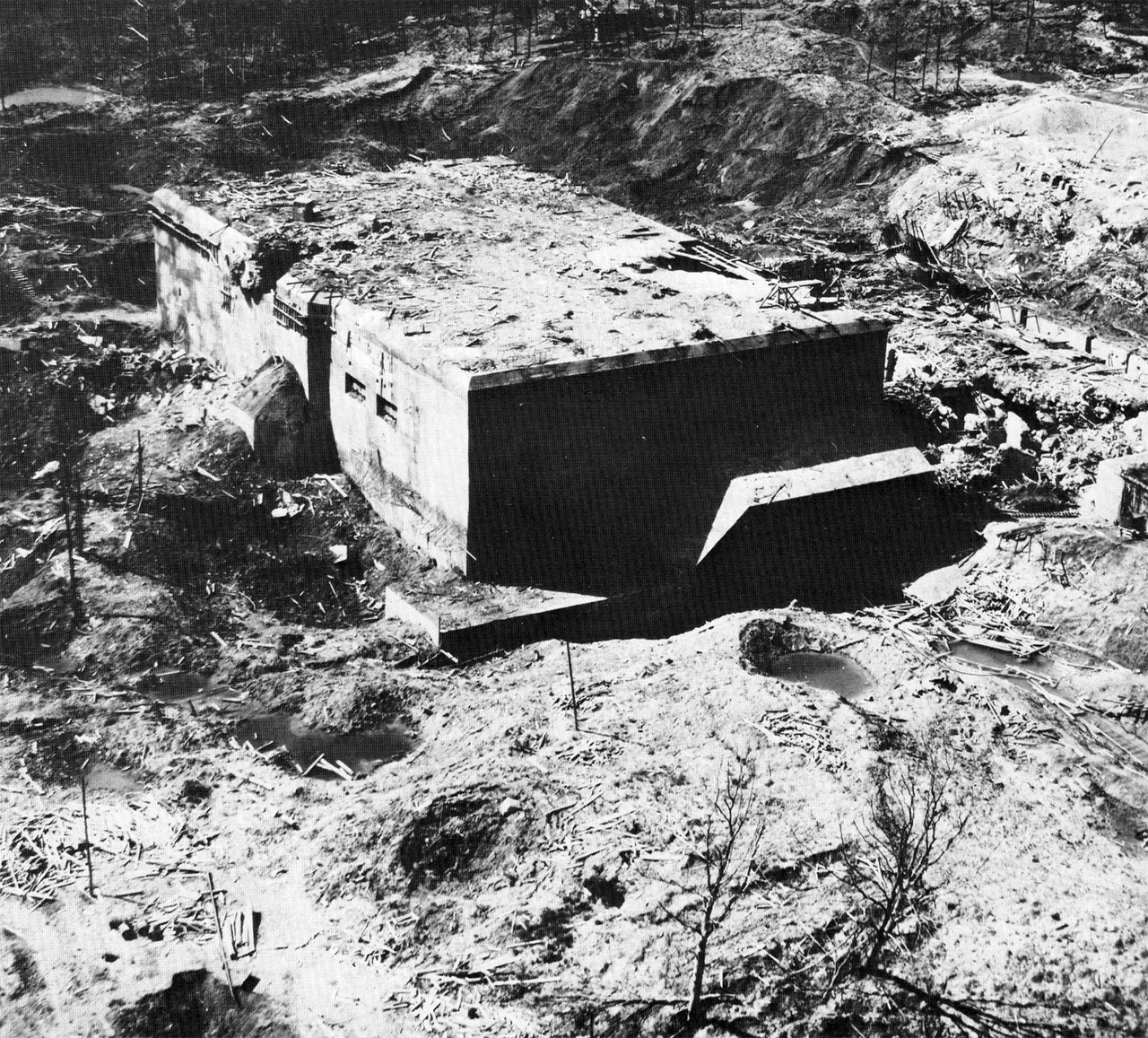
The German engineer Werner Flos had an idea. To protect the bunker from Allied bombing, build it from the roof down. Cast the concrete slab flat on the ground first, five metres thick, weighing 37,000 tons, then jack it slowly upward and grow the walls underneath. By the time the British arrived, the roof would already be in place, and the building would be invulnerable. Flos was wrong about one thing only. He did not know that 200 kilometres away, Barnes Wallis was designing a bomb that could shake the earth.
Wonder Weapon, Real Problem
By 1942, Adolf Hitler had decided that the A-4 ballistic missile, later renamed the V-2, was the Wunderwaffe that would turn the war. There was a chemistry problem. The rocket burned alcohol with liquid oxygen, and the oxygen evaporated so quickly that it had to be made close to the launch site or lost in transit. The whole occupied territory in 1941 produced only 215 tons of liquid oxygen a day, while each V-2 launch needed 15 tons. Walter Dornberger, head of the missile program at Peenemunde, sketched a solution: build huge bunkers, like the submarine pens on the Atlantic coast, that combined a missile assembly hall, a fuel plant, and a launch pad in one bombproof package. Albert Speer approved two of them. One was to be built on the Cotentin Peninsula near Cherbourg. The other, codenamed Kraftwerk Nord West (Northwest Power Plant), would rise in the forest of Eperlecques near Saint-Omer, 195 kilometres from London.
Thirty-Five Thousand Men in Twelve-Hour Shifts
Eperlecques would need 200,000 tons of concrete and 20,000 tons of steel. To put up that much in a few months, Organisation Todt drove its workforce in twelve-hour shifts of 3,000 to 4,000 men at a time, around the clock, seven days a week, lit at night by giant floodlights. The non-German labourers lived in two camps near Eperlecques officially called Zwangsarbeitslager 62, Forced Labour Camp 62. The total number of forced workers who passed through Watten is generally given as roughly 35,000. They were French and Belgian political prisoners. They were eastern European civilians swept up by the SS. They were Soviet prisoners of war. The conditions were brutal, especially for the easterners, who were treated as the most expendable workforce on site; for them, getting injured or sick was the equivalent of a death sentence, since they would be left to die or transported back to the concentration camps they had come from. Escape attempts were punished by execution. There were up to three escapes a day, helped by the French resistance. The commandant of the camp was said to complain that it was easier to guard a sack of fleas. Every cubic metre of the bunker was bought with somebody's exhaustion. Many paid more than that.
The Bombers and the Tallboy
In April 1943 an Allied agent reported enormous trenches being excavated in the forest. On 16 May 1943 an RAF reconnaissance flight photographed something the photographic interpreters could not identify. Lord Cherwell, Churchill's scientific adviser, admitted he had little idea what these very large structures similar to gun emplacements were, but he believed that if it is worth the enemy's while to go to all the trouble of building them it would seem worth ours to destroy them. The bombing began in August. Only 35 percent of the bunker had been finished. Construction shifted to completing the southern half as a liquid oxygen plant rather than a launch site. Then on 25 July 1944, 617 Squadron RAF dropped Tallboys, the 5,400-kilogram earthquake bombs designed by Barnes Wallis, on Eperlecques. One bored through the roof and detonated underground, collapsing a section of the slab Flos had so carefully grown from the ground up. The Germans wryly renamed their own creation Beton Klumpen, Concrete Lump. On 18 July Hitler conceded that the bunker plan was finished. The liquid oxygen machinery was hauled away to the Mittelwerk in central Germany. Canadian forces captured the empty shell on 4 September 1944.
A Disney Bomb and an Atomic Scientist
Even after capture, no one was sure what Eperlecques had been for. The French atomic scientist Frederic Joliot-Curie inspected the bunker on 10 September 1944. The British engineer Sanders, peering at the large aluminium tanks that remained, guessed wrong: he decided it had been a hydrogen peroxide factory for V-1 fuel, ruled out liquid oxygen production, and concluded the site had no offensive role and need not be destroyed. The Allies then used Eperlecques as a test target. On 3 February 1945 a B-17 of the US Eighth Air Force dropped a Disney bomb, a concrete-piercing weapon with a rocket booster to double impact velocity, onto the bunker's wall. The results were inconclusive. The bomb embedded itself in the roof and was eventually extracted in January 2009, decades after the war it failed to win.
The Forest That Grew Back
After the war, the bunker reverted to private ownership. Pumps had stopped, the great cavernous basement had flooded, and the building was left to bats and damp. In 1973 the owners opened it to the public as Le Blockhaus d'Eperlecques. The site was declared a monument historique in 1986. The forest has regrown around it, but bomb craters still pock the floor between the trees. A V-1 sits on a display launch ramp. Interpretative trails lead through the woods to the open south wall, where a Tallboy's neat circular hole still shows in the concrete. In 2009 the museum received 45,000 visitors. Standing inside the servicing hall, which once would have held a railway line for V-2 transport, you feel the cold and the silence and you remember Werner Flos's idea: a roof grown upward from the ground. It was ingenious. It was not enough.
From the Air
The Blockhaus d'Eperlecques sits at 50.829°N, 2.184°E, in the Forest of Eperlecques about 5 km north of Saint-Omer and 40 km southeast of Calais. The related V-2 launch facility at La Coupole (Wizernes) lies 13 km south-southwest. The nearest airport is Calais-Dunkerque (LFAC), 35 km north-northwest; Lille-Lesquin (LFQQ) is 65 km southeast. The bunker is large enough (its concrete plate weighs 37,000 tons) to be visible from 3,000-5,000 feet on a clear day, especially when low sunlight throws shadows from the surrounding forest onto the slab's edges. Look for the rectangular concrete mass embedded in dense woodland.
Nearby Stories
- Site John McCrae 4.7 km away
- Atlantic Wall Open Air Museum 5.9 km away
- 2008 Channel Tunnel fire 11 km away
- Battle of the Downs 19 km away
- Courrieres Mine Disaster 24 km away
- MV Tricolor 25 km away
- Le Paradis Massacre 26 km away
- Cléon 155 km away