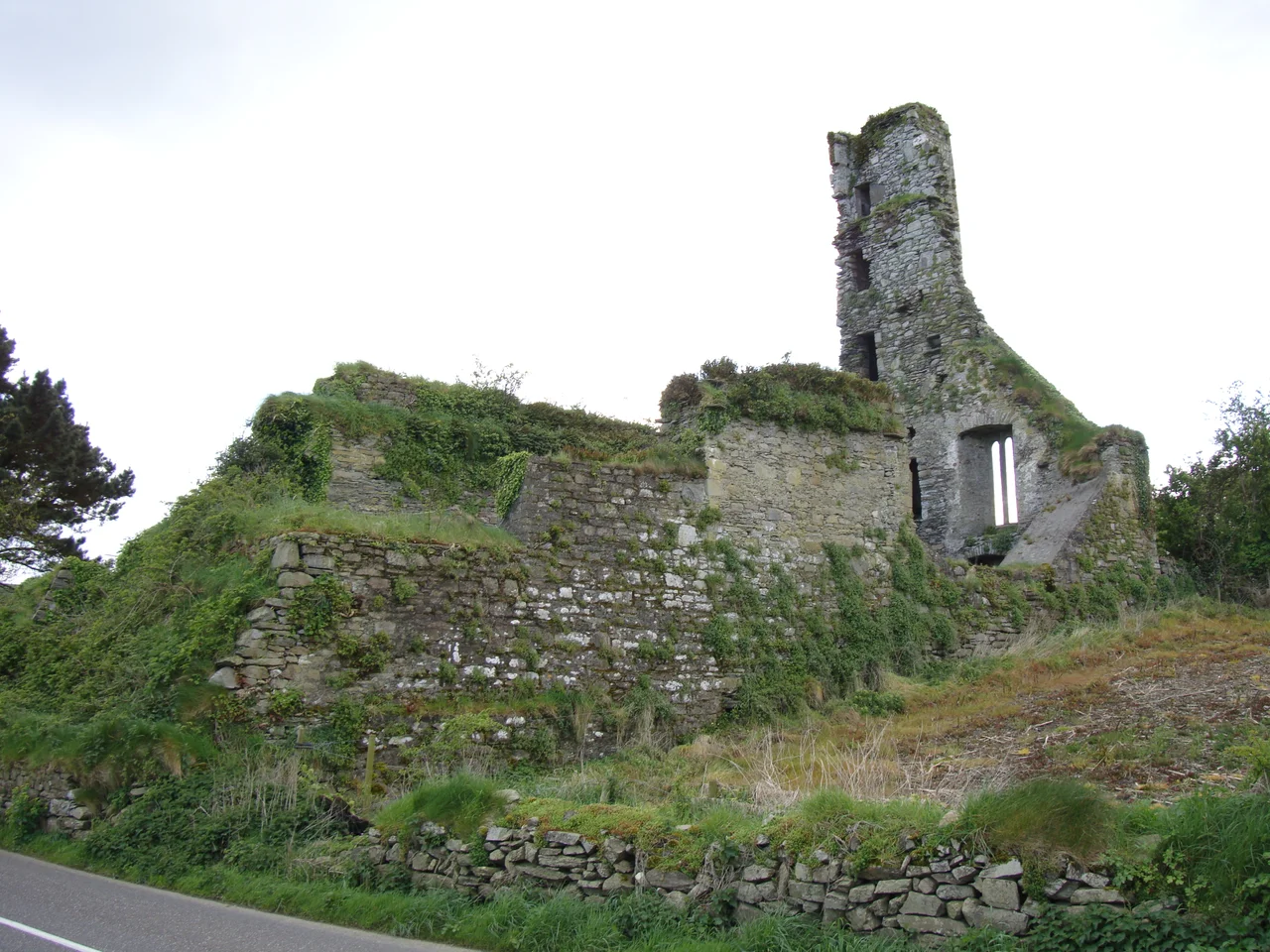

Abbeymahon Abbey
Cistercian monks chose their sites with care. The order's founding rule, written in 12th-century Burgundy, prescribed remote valleys beside fresh-flowing streams, where the brothers could divert water for their fish ponds, mills, and washing. The site at Abbeymahon, on the estuary of the Argideen River in West Cork, broke that rule. Here the water was salt. The monks who built the new monastery in the 1270s had moved here from another site, and they chose tidal flats over the freshwater valley a Cistercian founder would have picked. Why they made that choice has never been fully explained. What survives - parts of a nave, choir, and transept arches - is too sparse to answer the question.
From Aghavanister to the Estuary
The original Cistercian abbey was founded in 1172 by Diarmait Mac Cormac Mac Carthaig, king of Desmond, in the townland of Aghavanister, less than two miles from the present ruin. The first monks came from Baltinglass in County Wicklow, one of the daughter houses of the great Mellifont Abbey that had brought the Cistercian order to Ireland in 1142. For about a century the monks remained at Aghavanister. Then, sometime before 1278, they moved. The new site sat on the estuary of the Argideen River, just over a mile southeast of Timoleague, on the road that would become the route to Courtmacsherry. The 1278 burial of Diarmait MacCarthaig, son of Domnall Cairbrech, is recorded as taking place at the 'new monastery,' which fixes the move as complete by that date. Whether the relocation was prompted by the need for new buildings, by political pressure, or by some advantage the estuary offered - access to the sea, perhaps, or to better grazing land - is no longer recoverable.
St Mary de Fonte Vivo
The abbey was known by several names in medieval documents: Abbeymahon, the Abbey of Sancto Mauro, and the Cistercian designation St Mary de Fonte Vivo - 'St Mary of the Living Spring.' The Sancto Mauro name is unlikely to commemorate Saint Maurus, a 6th-century disciple of Saint Benedict. It is more likely a corruption of an original name whose meaning has been lost - a not uncommon fate for medieval Irish placenames that passed through Latin, Norman French, and English on their way into the historical record. 'De Fonte Vivo' was the standard Cistercian formula for naming a house, evoking the order's preoccupation with running water. In this case the name was aspirational, not descriptive: the only living water at Abbeymahon was the tide.
The Reluctant Abbots
The General Chapter of the Cistercian order was held every year at Cîteaux in Burgundy, and every abbot was summoned to attend. The abbots of Abbeymahon did not attend. They were rebuked several times in the 13th century for failing to make the journey - which, given the geography and the economics, is hardly surprising. In the taxation assessment of 1302 to 1306, the income of the abbey was valued at £4 per year. The journey from West Cork to Burgundy, by land and sea, would have consumed the entire annual income and more. The annual income during the 15th and 16th centuries was still meagre, estimated at around £18, with a potential income of £34 in peacetime. The abbey was poor by Cistercian standards, but it persisted. Its abbots had local concerns and limited resources. Burgundy might as well have been on the moon.
Surviving the Dissolution
When Henry VIII broke with Rome and dissolved the English monasteries in the 1530s, the process spread to Ireland - but unevenly. Some Irish abbeys were suppressed quickly. Others survived for decades, sheltered by local lords whose Catholicism made them reluctant to enforce the new religious order. Abbeymahon was not dissolved until somewhere between 1570 and 1587 - more than three decades after the English Reformation began. It was likely protected by James de Barry, the 4th Viscount Buttevant, whose family wielded considerable power in this part of Cork. At the time of dissolution, the abbey had been functioning as the parish church 'since time immemorial,' and the rest of its buildings were being used by a local farmer. A Henrician survey listed Abbeymahon as the most valuable monastery in the Diocese of Ross - which says less about its absolute wealth than about how thoroughly Ross's other religious houses had already been stripped.
Stones in a Field
In 1568 the property was leased to the Viscount Buttevant. In 1584, the lease passed to Nicholas Walsh, Justice of Munster. In 1587, Walsh received a permanent grant 'forever' that added some additional placenames to the holding. After that the trail goes cold. The abbey passed into private hands, its stone was scavenged for local building, and the choir, nave, and transepts collapsed gradually into the ruin that survives today. What stands is fragmentary - arches with no walls between them, foundations marked by stones in grass. There are no doors. There are no windows. The lack of architectural detail makes it almost impossible to trace how the abbey evolved or how it was used at the end. The Argideen estuary still flows past. The tide still rises and falls beside the old foundations. The monks who picked this strange salt-water site have been gone for nearly five centuries, and the question of why they chose it has gone with them.
From the Air
Abbeymahon Abbey sits at 51.642 degrees north, 8.754 degrees west, on the estuary of the Argideen River just over a mile southeast of Timoleague in West Cork. From the air, the ruins are difficult to spot - small fragmentary stonework in a field beside the tidal estuary. Look for the Argideen River as it opens into Courtmacsherry Bay, with Timoleague Friary (a more substantial ruin) visible at the head of the estuary about 1.5 km to the northwest. Cork Airport (EICK) is approximately 40 km east-northeast. Recommended viewing altitude 2,000-4,000 feet for the estuary context. The estuary's character changes dramatically with the tide - high water fills the basin, low water exposes broad mudflats popular with wading birds.
Nearby Stories
- Ballymaloe House 1.3 km away
- Ballincollig Castle 2.8 km away
- Skibbereen 9.8 km away
- Ballyvourney 10 km away
- Ballycotton 27 km away
- HMHS Llandovery Castle 53 km away
- Wolfpack Prien 74 km away
- SM U-27 85 km away