
Aberffraw
On Saint Nicholas Day, 6 December 1331, a great sandstorm rolled out of the Irish Sea and swept across the southwest coast of Anglesey. It buried 186 acres of farmland between Aberffraw and Rhosneigr under several metres of dune sand. Whole families lost their homes in a single night and walked south to start over in the villages of Llanddwyn and Newborough. Among the buildings the storm covered was the rubble of what had been, until fourteen years earlier, the most politically important place in Wales: the royal court of the Kingdom of Gwynedd, the residence from which the medieval Princes of Wales ruled their kingdom. The court was already a ruin by then. Edward I's officials had taken it apart in 1317 for building stone, shipping the worked timber and dressed masonry across the Menai Strait to finish Caernarfon Castle - the English crown's monument to the conquest that had ended Welsh independence. The sand finished what the engineers had begun.
Cadwallon's Palace
There has been a settlement here since the Mesolithic - the Trwyn Du dig at Aberffraw Bay in 1977 turned up 7,000 flint tools and two axes from around 7,000 BC, deposited shortly after the last Ice Age. The Neolithic chambered tomb at Din Dryfol, three kilometres inland, dates from around 3,000 BC; Iron Age roundhouses sit along the banks of the nearby River Gwna. In Welsh mythology, Aberffraw is the wedding hall of Branwen daughter of Llyr, sister of the giant-king Bran the Blessed - the place where her brother Efnysien insulted the visiting Irish king Matholwch by mutilating his horses, an act that led to the war recounted in the Second Branch of the Mabinogi. The historical royal court was founded here in the 5th century by Cadwallon Lawhir ap Einion, who built a palace beside the small Afon Ffraw. The kings of Gwynedd ruled from Aberffraw until the 7th century, when Cadwallon ap Cadfan briefly moved the court inland to Caernarfon.
Rhodri the Great Comes Home
In 873, Rhodri Mawr - Rhodri the Great - rebuilt the palace at Aberffraw and moved the capital of Gwynedd back to the island where it had begun. Rhodri was the first ruler since the Roman period to control most of what is now Wales, and he established the cadet branch known as the Royal House of Aberffraw through his son Anarawd. Anarawd's direct descendants ruled Gwynedd for the next four centuries; they would eventually take the title Prince of Wales. The greatest of them - Llywelyn ab Iorwerth, Llywelyn the Great - re-established the royal household at Aberffraw in 1201, installing a personnel structure based on rules originally codified in 914 under Hywel Dda. The court at its height had a chief justice, a household priest, a bard, a chief huntsman, a cook, a doorkeeper, and dozens of other named offices. Llywelyn's grandson, Llywelyn ap Gruffudd, was the last native Prince of Wales; he died fighting Edward I in 1282. The court continued in nominal use under English rule for another thirty-five years, until Edward's officials finally pulled it down for materials in 1317.
Beach, Church in the Sea, and the Quiet Aftermath
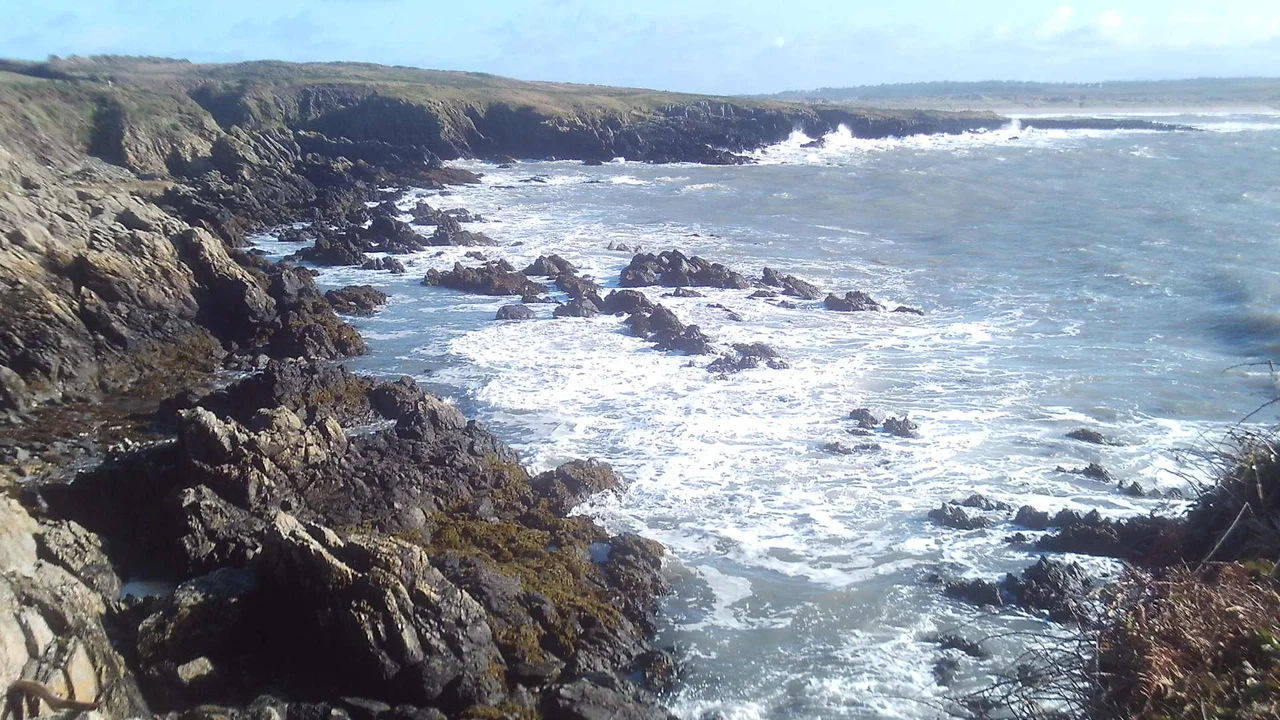
What remains today is a small village of about 600 people on the west bank of the Afon Ffraw, hosting a sandy Blue Flag beach, the great Aberffraw dune system - one of the largest in Britain and a Special Area of Conservation - and a small medieval church, St Beuno's, that dates from the 12th century and contains an early Welsh inscribed stone. Two kilometres west, on the tiny tidal island of Cribinau, sits St Cwyfan's Church - the famous Church in the Sea, perched alone on its rock and reachable only at low tide. A holiday cottage in the village called Llys Llywelyn occupies the site of a small heritage centre that once told the story of the Princes of Gwynedd; the centre's contents have moved to Llangefni, but a sculpture by the late Jonah Jones commemorating the medieval princes still stands at the site. By 1949 Aberffraw was called the poorest village in Anglesey. The Welsh language is still strong here - 67.5% spoke it fluently in the 2011 census, though the percentage has been slowly falling. The royal court is one fold in the sand; the village that grew up after it is still here, still speaking Welsh, still selling Berffro biscuits - a small shortbread named after the village's shortened local name - in the village shop.
From the Air
Aberffraw sits at 53.195N, 4.464W on the southwest coast of Anglesey, on the west bank of the Afon Ffraw where the river enters Aberffraw Bay. From the air the wide bay and the great pale sweep of the Aberffraw dunes are unmistakable. St Cwyfan's Church on the tidal island of Cribinau is visible 2 km west. Nearest airfield is RAF Valley (EGOV) 5 nm northwest; Caernarfon (EGCK) 11 nm east-southeast. The former WW2 grass airfield at RAF Bodorgan (closed 1945) lies 2 nm east of the village. Best viewed at lower altitudes (1,500-2,500 ft AGL) on a clear day to pick out the medieval village street pattern and the river mouth meandering through the dunes.
Nearby Stories
- Wakestock 1.7 km away
- Trefriw 3.8 km away
- Irish Sea 8.7 km away
- Irish Sea Bridge 20 km away
- East–West Interconnector 30 km away
- Machynlleth 36 km away
- HMS Tyler 41 km away
- New Brighton Lifeboat Station 54 km away