
Trefriw
Roman soldiers of the Twentieth Legion are said to have found the iron-rich spring first, drinking the water that bubbles up out of the limestone above the village. They built rough caves around it. Eighteen centuries later the water - so high in iron that nineteenth-century guidebooks called it 'inconceivably nasty and correspondingly efficacious' - is still pumped, bottled as Spatone, and sold around the world from a small factory just outside the village. Trefriw sits on the western slope of the glaciated Conwy valley, where the Afon Crafnant tumbles out of a hanging valley to meet the river, and the village curls around the joining point in a semicircle of stone houses, chapels, and the surviving working woollen mill.
Llywelyn's lodge, Siwan's church
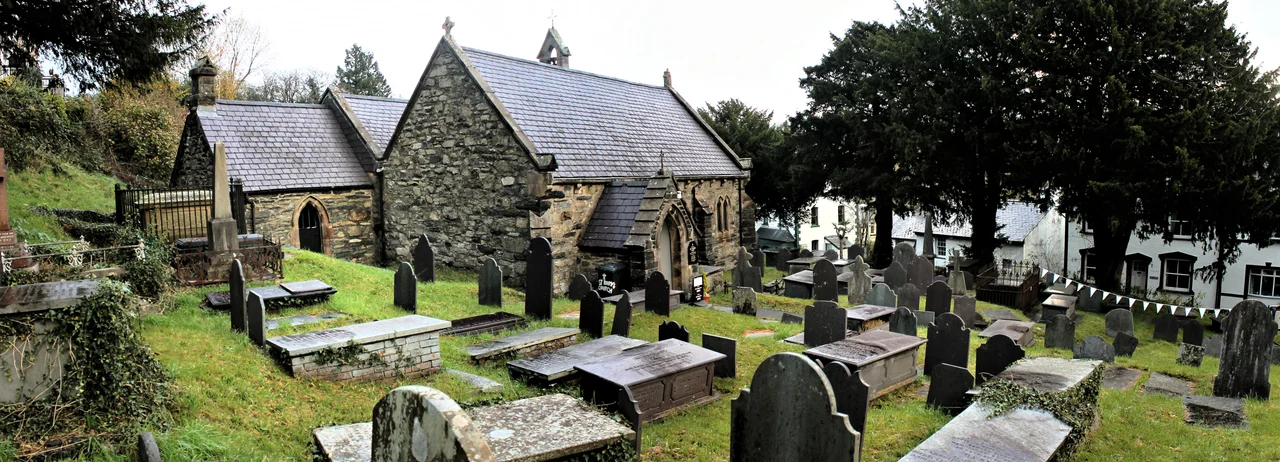
Llywelyn the Great - Prince of Gwynedd, the most successful Welsh ruler of his age - kept a hunting lodge here in the twelfth century, and reportedly preferred it to his palace at Aber. There is nothing of the lodge left to see; the site is now the Ebenezer Chapel on the main hill. In 1204 or 1205 Llywelyn married Siwan, the thirteen-year-old daughter of King John of England. The story Trefriw tells about her is small and human: she grew tired of the steep climb up to the old church at Llanrhychwyn, regarded by many as the oldest church in Wales, so around 1230 Llywelyn endowed a new church on the easier ground where St Mary's still stands. The chancel altar inside dates from the seventeenth century. The carved hexagonal pulpit is from 1633.
The largest inland port in Wales
Stand on the quay today and it is hard to believe what once happened here. In the early nineteenth century Trefriw was Wales's largest inland port, the Conwy being tidal almost up to neighbouring Llanrwst. At peak, in 1862, more than sixteen thousand tons of cargo moved through. Out went slate from the Gwydir Forest quarries, wool, oak, hides, sulphur from the Cae Coch mine. In came wine ordered by the gentry, coal, lime fertiliser. From 1847 paddle steamers carried tourists up from Conwy: the St Winifred, the New St George, Queen of the Conway, the Trefriw Belle, the King George. The trip took ninety minutes and cost a shilling and sixpence single. Passengers got ninety minutes in the village before the return run. Six steamers plied the route at the peak. The Second World War laid them up; they were beached above the Conwy bridges and eventually scrapped.
Inconceivably nasty
The Trefriw Wells Spa, half a mile north of the village, became one of the United Kingdom's most fashionable Victorian water cures. Dr Hayward of Liverpool declared it 'probably the best spa in the United Kingdom.' Baddeley's guidebook offered the immortal verdict: 'inconceivably nasty and correspondingly efficacious.' The water's medicinal effect was not Victorian wishful thinking - modern clinical trials confirmed it works as an iron supplement, and that is essentially what Spatone is sold as now. The Wells closed to the public in 2011 and became a pure production facility. The Spa baths and Roman caves are quiet today, but for over a century they pulled invalids, asthmatics, and the merely curious up the Conwy valley by train and steamer.
Mill, harp, and chapel
Thomas Williams bought the woollen mill in 1859 and his descendants still run it. A fifteenth-century fulling mill - a pandy - had stood there long before; the cottage industry it grew out of dated back centuries. The Welsh chapel tradition is everywhere in the village: the Ebenezer at the bottom of Crafnant Road, the Peniel up School Bank, the old First Independent built to look like an ordinary house so as not to offend its Anglican neighbours and now serving as the village hall. The village also produced Dafydd Jones, an eighteenth-century poet who set up what some claim was the first printing press in Wales, and Mary Owen, who was born here in 1803, moved to Anglesey, and died in 1911 at the age of one hundred and eight - briefly the oldest person in Britain. A photograph survives, taken in her last year, captioned 'The Oldest Subject in Great Britain.'
Floods and futures
Living next to the Conwy has always meant living with floods. In February 2004 the village was largely cut off for three days when the river burst over the cob. The Environment Agency has since rebuilt the defences, moving the cob back to give the river a wider channel and threading new flood walls through the recreation ground and the Glyn Farm caravan site. The English visitors who once arrived by steamer for the spa now come by car: Betws-y-Coed is ten minutes south, the coast thirty minutes north, the lakes of Llyn Crafnant and Llyn Geirionydd a short walk above the village. The woollen mill still runs. The water of the Crafnant still turns its turbines. The chapels are quieter than they were. The Welsh language survives in roughly half of households, the village's name still arguing between 'homestead on the hill' and 'wound' - a reference, some say, to the healing waters.
Flight Context
Trefriw sits at 53.151 north, 3.825 west, on the western slope of the Conwy valley at the edge of Snowdonia National Park. The village clings to the slope where the Crafnant valley joins the main river. Best viewed at 1,500 to 3,000 ft AGL flying north or south along the Conwy valley. Nearest airfields are Caernarfon (EGCK) twelve miles west, RAF Valley (EGOV) on Anglesey, and Hawarden (EGNR) east toward Chester. Look for the long roofs of the woollen mill near the river crossing and the spire of St Mary's Church on the lower ground.
From the Air
53.151°N, 3.825°W. Edge of Snowdonia National Park, western slope of the Conwy valley. Best viewed at 1,500-3,000 ft AGL. Nearest airports: EGCK Caernarfon, EGOV Valley, EGNR Hawarden.
Nearby Stories
- Menai Strait 1.2 km away
- Battle of Ewloe 7 km away
- New Brighton Lifeboat Station 7.7 km away
- Butlin's Pwllheli 7.7 km away
- Battle of Oswestry 9.1 km away
- Cymer Abbey 22 km away
- Celtic Array 39 km away
- New Brighton Lighthouse 43 km away