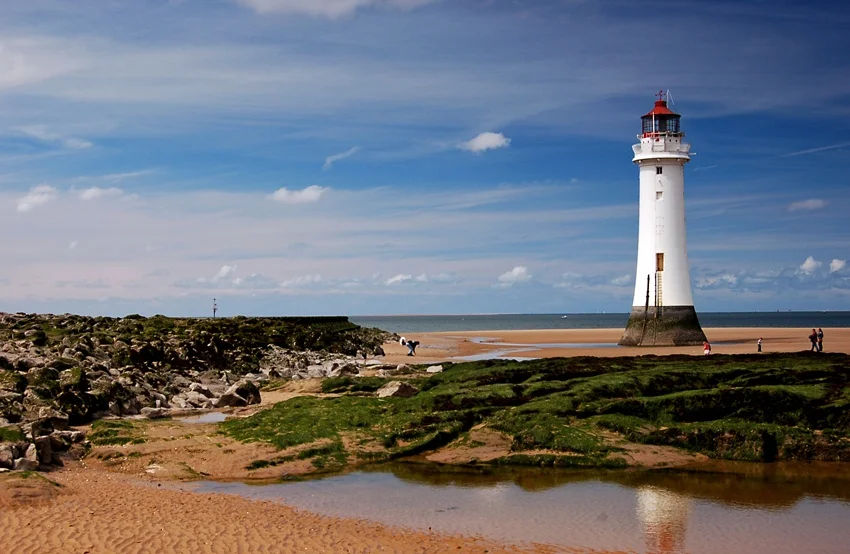

New Brighton Lighthouse
The trick was the joints. When John Foster Jr drew up plans for a new lighthouse on Perch Rock in 1827, he reached back seventy years to John Smeaton's Eddystone Light and borrowed its secret: blocks of granite cut to interlock with one another, held by dovetail joints and marble dowels rather than mortar that the sea could chew away. Foster's masons quarried the granite on Anglesey, shipped it across the bay, and built up a tower modelled on the trunk of an oak. Ninety-five feet tall, painted white with a red iron lantern, it was first lit in 1830. For a hundred and forty-three years afterward, two white flashes and a red one marked the way home for everything that came up the Mersey to Liverpool.
The Perch That Came First
Before the granite tower there was a perch, a name that the lighthouse still carries locally. From 1683 onwards a timber tripod stood on the rock, supporting a lantern that some keeper had to row out to and refill in any weather the Irish Sea cared to throw at the estuary. It was a desperate arrangement that survived as long as it did only because shipping traffic into Liverpool was modest. By the early nineteenth century the port had become one of the busiest in the world, and tripods that needed daily maintenance were no longer good enough. The perch was replaced by something the sea could not break.
Thirty Argand Lamps
The original light source was wonderfully Victorian: thirty Argand oil lamps mounted on a three-sided revolving array, ten lamps to each face, with a red glass screen fitted across one of them. The whole apparatus turned by clockwork, producing the characteristic two-whites-then-a-red signature that mariners memorised. The same clockwork mechanism tolled three bells mounted under the gallery, the fog signal for nights when the lamps were swallowed in haze. Imagine the keeper's life inside that small stone column: trimming wicks, winding the mechanism, climbing the spiral stair to check the array, listening to the bells he had set in motion ring out across the dark water.
Decommissioned, Not Forgotten
In October 1973 modern navigational aids, radar and electronic beacons, made the Perch Rock light redundant, and the lamps were extinguished. The fog bells and lighting apparatus came out, but the building itself remained extraordinarily intact. Most disused lighthouses lose their character to conversion or neglect. This one kept its proportions, its red lantern, its dovetailed granite. The Perch Rock Lighthouse Charity took on its care, restored and repainted it in 2001, and fitted an LED system that scrolled the names of every person lost at sea, including all 1,517 people who died when the Titanic went down. A second LED relighting in 2015, funded through the Coastal Revival scheme, brought back the old characteristic of two white flashes followed by a red one, visible from land if no longer from the sea.
Walking to the Door
Perch Rock dries out at low tide. Visitors who watch the calendar and the tide tables can walk across the sand from New Brighton beach to the base of the lighthouse, past the squat sandstone walls of Fort Perch Rock built in the Napoleonic era to defend Liverpool from a French invasion that never came. The tower's doorway sits twenty-five feet above the rock, designed that way so that storm-driven seas could not reach it; reaching the door now requires a ladder, which is why public access is limited and why most photographers content themselves with the view from the promenade. The whole composition, white tower beside red-brick fort against the changing colours of the Mersey, is one of the great seaside compositions on the English coast, and it is why Wirral residents call this Grade II* listed building one of their landmarks.
What You See from the Bay
Sailors approaching from Liverpool Bay still use Perch Rock as a visual fix, the way they did when its lamps burned. The Mersey channel curves inside the rock, and the contrast between the white tower and the brown sandstone of the fort is unmistakable in any visibility. New Brighton itself spreads behind them, the long promenade that gave the town its name in 1830 when developers hoped it would become a northern rival to Sussex's Brighton. The lighthouse is older than the resort. It watched the town go up, watched it boom in the Victorian era, watched it fade, and watches still.
From the Air
Coordinates 53.4443 N, 3.0423 W on Perch Rock at the confluence of the Mersey and Liverpool Bay. Recommended viewing altitude 1,500 to 2,500 feet to pick out the white tower beside the brick fort. Nearest airports: Liverpool John Lennon (EGGP) 13 nautical miles southeast, Hawarden (EGNR) 16 nautical miles south, Blackpool (EGNH) 28 nautical miles north. The lighthouse stands at the river entrance; the Wallasey shore stretches west toward Hoylake. Photographers favour low afternoon sun from the southwest, which lights the white masonry against the open bay.
Nearby Stories
- Blackpool Pleasure Beach 4.4 km away
- Whalley Abbey 4.8 km away
- Worsley 5.4 km away
- Second Battle of Middlewich 7.7 km away
- Chester Zoo 7.9 km away
- Llanrwst 23 km away
- Abergele Rail Disaster 27 km away
- Sea Lion Rocks railway station 73 km away