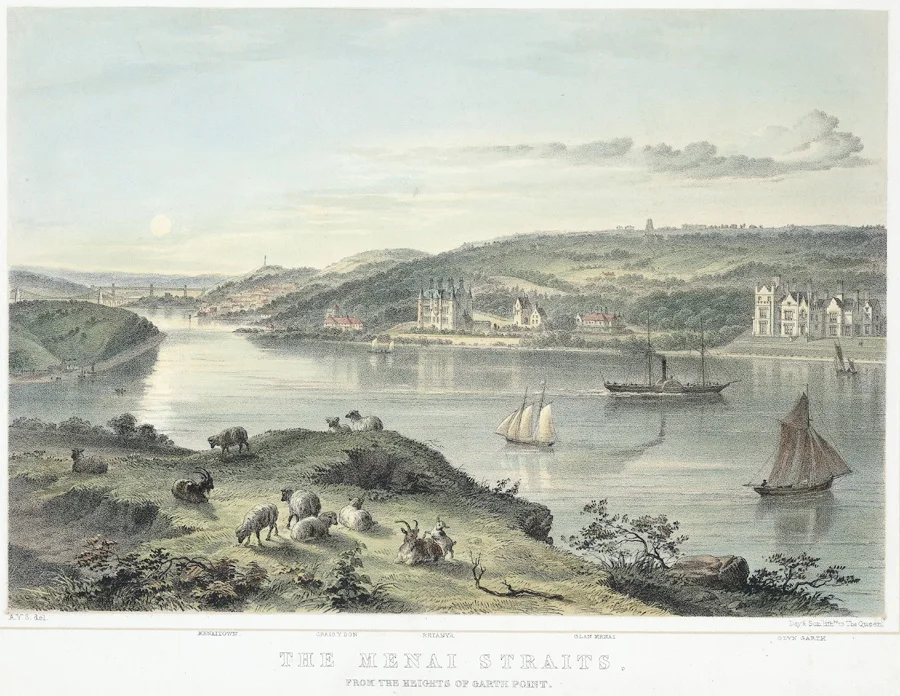

Menai Strait
When Thomas Telford finished his Menai Suspension Bridge in January 1826, he had built the first major suspension bridge in the world. Nothing on the scale of his 176-metre span, hanging 30 metres above tidal water, had ever been attempted before. Across that bridge, for the first time in human history, mail coaches could roll from London to the port of Holyhead on Holy Island without a ferry. The Menai Strait - the narrow tidal channel that has separated Anglesey from the Welsh mainland for ten thousand years - had been bridged. The bridge is still there. It is still in use. And it is one of two extraordinary structures the strait demanded from the engineers who tried to cross it.
The Tide That Confuses Itself
The Menai Strait runs about 25 kilometres from southwest to northeast, widening from just 400 metres between Fort Belan and Abermenai Point at its southern end to 7.5 kilometres between Puffin Island and Penmaenmawr at its northern mouth. Its tides do something genuinely strange. A rising tide pushes in from the southwest first, and water flows northeast through the strait as the level rises. But the same tide flows around Anglesey to the north, and after a few hours it starts pushing back into the strait from the northeast end - meeting the original flow somewhere in the middle. The directions then reverse while the water keeps rising. Slack water between the bridges tends to occur about an hour before high or low tide. This is not the kind of tide a sailor reads from a table. It is the kind that requires the local knowledge of the harbour pilots, who have understood it for centuries and still respect it.
The Swellies and the Bridges
Between the two bridges, the strait pinches between rocks and reefs into a stretch the pilots call the Swellies - a tidal race of overfalls, whirlpools, and races that can run at almost five knots at springs. Theoretically the Swellies are fordable at low water spring tides, when the depth may drop below half a metre. In practice the current makes a crossing extremely difficult, and dozens of vessels have been wrecked here. Telford's Menai Suspension Bridge of 1826 vaulted high above the worst of it, carrying the A5 from London to Holyhead - the most important coach road in Wales. Twenty-four years later Robert Stephenson finished the Britannia Bridge for the railway, opened in 1850, a 461-metre wrought-iron tubular bridge that carried trains inside great rectangular boxes. After a catastrophic fire in 1970 the tubes were lost; the rebuild between 1970 and 1972 made the bridge a two-level structure that now carries both the North Wales Coast Line below and the A55 dual carriageway above.
Salt and Sponges
The strait's biology is as unusual as its hydraulics. Sheltered from ocean waves but flushed twice daily by powerful tides, the seabed presents one of the richest benthic ecologies in northern Europe. The channel reaches 15 metres deep in places. Currents can exceed seven knots in the strongest tidal races. The bottom is exceptionally rich in sponges - a fact that helped justify Bangor University's School of Ocean Sciences locating at Menai Bridge on the Anglesey shore, and the strait's designation as a special area of conservation with marine components. On land, the slopes are home to the critically endangered Menai Whitebeam, a species of rowan found nowhere else on earth; the entire population numbers about thirty mature plants. Halen Mon - sea salt made by evaporating Menai Strait water - sells in fine restaurants worldwide. For centuries the tides funnelled fish through fish weirs built along both shores; eight of those medieval weirs are now scheduled monuments.
The Bridge That Won't Be Built
Since 2007 the Welsh Government had been planning a third Menai crossing to relieve chronic congestion on the older two. The Britannia carries enormous traffic for a 1850s railway bridge with a 1970s road deck bolted on top. Plans, consultations, and route corridors came and went. On 14 February 2023 the Welsh Government cancelled the project. Deputy minister for climate change Lee Waters cited the need to reduce car dependency, the environmental cost, and the visual impact of a third structure across one of the most photographed views in Wales. Financing trouble was acknowledged later as a further factor. For now, every car, lorry, train, and bicycle that crosses to and from Anglesey still does so on a bridge designed by Thomas Telford in the 1820s or by Robert Stephenson in the 1840s - two structures that have outlasted three centuries of expectation.
From the Air
The Menai Strait centres on approximately 53.18°N, 4.23°W, running 25 km from Fort Belan in the southwest to Puffin Island in the northeast. Caernarfon Airport (EGCK) sits at the southwest end of the strait, and RAF Valley (EGOV) lies 25 km to the west on Anglesey. The two famous bridges - Telford's suspension bridge (1826) at Menai Bridge town and Stephenson's Britannia Bridge (1850/1972) about 2 km southwest - are unmistakable from the air. Snowdonia rises dramatically to the south and east. Best viewed at 2,000 to 5,000 feet on a clear day with both bridges and the Swellies tidal race clearly visible between them.
Nearby Stories
- Wakestock 1.7 km away
- Trefriw 3.8 km away
- Irish Sea 8.7 km away
- Irish Sea Bridge 20 km away
- East–West Interconnector 30 km away
- Machynlleth 36 km away
- HMS Tyler 41 km away
- New Brighton Lifeboat Station 54 km away