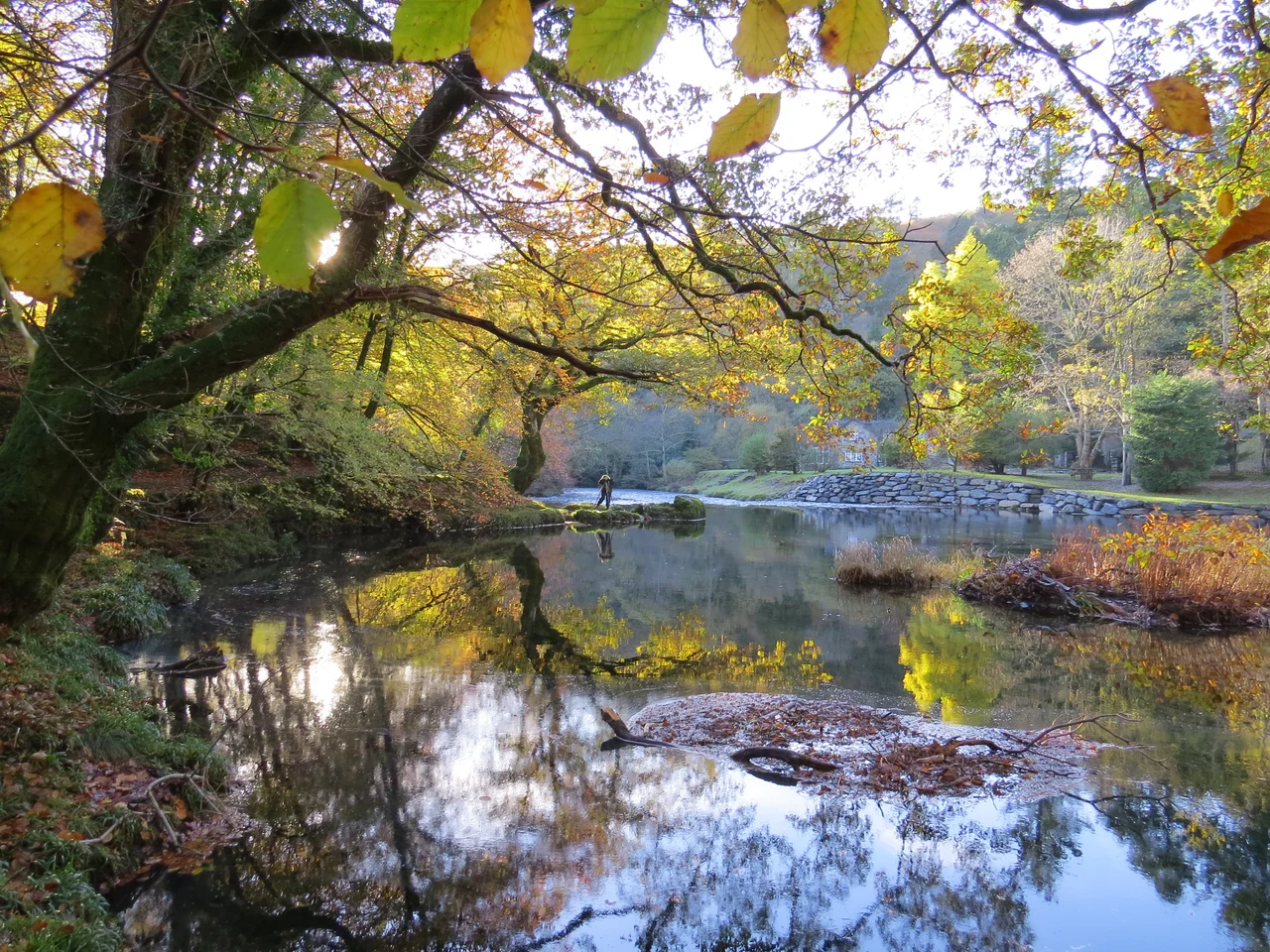

Aberglaslyn Pass
The Devil built the bridge. That was the deal: he would raise the stones across the gorge of the Afon Glaslyn, and in payment he would receive the soul of the first living creature to cross it. When the work was finished he walked up to the inn called Y Delyn Aur, the Golden Harp, to tell the magician Robin Ddu his side of the bargain was complete. Robin came down to inspect the new bridge with a hot loaf of bread in his hands and a stray dog padding behind him, hopeful for crumbs. Robin pretended to doubt the bridge's strength. The Devil, insulted, demanded that the magician test it with the loaf. Robin threw the loaf out across the stones. The dog ran after it. The Devil had his first soul: a dog's. He left the gorge in a rage. The bridge still stands at the south end of the Aberglaslyn Pass, the narrowest and most dramatic gorge in Snowdonia.
The Magician and the Bread
Versions of the Devil-built bridge story attach to nearly every old crossing in Britain, Brittany, and Switzerland, so the Aberglaslyn tale is part of a wide European folk pattern. What makes the local version interesting is that Robin Ddu was a real person. Robin Ddu ap Siencyn Bledrydd of Anglesey, Black Robin, lived around 1450 and was a poet of some standing, with about ninety of his pieces preserved on manuscripts. He had a reputation as a prophetic poet and seems to have cultivated a parallel reputation as a sorcerer. Welsh tales attach him to several places. The Aberglaslyn story may have grown up after his lifetime, but the man himself wrote poetry that you can still read. The bridge today is called Pont Aberglaslyn and sits in the parish of Nantmor about a mile south of Beddgelert.
Sea, River, and the Cob
Two centuries ago the Aberglaslyn Pass was tidal. Before William Madocks built the great embankment called The Cob across the Traeth Mawr estuary at Porthmadog in 1812, the sea reached as far inland as Pont Aberglaslyn at high tide. Small boats came up the Glaslyn to the foot of the bridge. Medieval travellers between South Wales and Caernarfon or Bangor preferred to cross overland here via Beddgelert rather than face the long voyage around the Llyn Peninsula. The Cob ended all of that. The Traeth Mawr was drained, the salt marshes became farmland, and the Glaslyn became a freshwater river all the way to the sea. The fisherman's path along the gorge, which had been the coastal route, fell out of use as roads improved and slowly disappeared into the woodland.
Three Tunnels and a Railway
The Welsh Highland Railway threaded a narrow-gauge line through the Aberglaslyn Pass between 1906 and 1922, blasting three tunnels through the steep flank of the gorge so that small trains could run from Dinas, near Caernarfon, down to Porthmadog. The line was always uneconomic. It closed in 1937 and the rails were torn up in 1941 for the war effort. The trackbed and tunnels remained, in time of the receiver, and walkers found them. For sixty years the abandoned railway formation through the gorge was one of the best footpath walks in Snowdonia: three dark tunnels, dramatic rock cuttings, embankments above the river. Then in the 1990s the Ffestiniog Railway company began reassembling the Welsh Highland for tourist trains, and the trackbed had to be reclaimed. The walkers fought back, with mixed success. Engineers stabilised the overhanging rocks, the fisherman's path was rebuilt as an alternative footpath, a new footbridge was thrown across the river at Bryn-y-felin in 2003, and a replacement girder bridge appeared in 2006. By August 2007 the railway had been relaid through the pass. Steam trains now run again where, for sixty years, walkers had the place to themselves.
What the Gorge Holds
The Aberglaslyn Pass is short - less than two miles between Beddgelert and the open ground at Bryn-y-felin - but it concentrates an unusual amount of Welsh landscape into that distance. The river runs fast and deep, broken by boulders, kayakable in high water for those who know what they are doing. Steep wooded slopes climb on both sides, oak and rhododendron above the water. The road from Beddgelert to Porthmadog runs along the eastern bank, the railway above it, the fisherman's path on the western bank, the new footbridge linking the two systems at the far end. Sygun Copper Mine, a 19th-century mine reopened as a show cave, sits in the hillside just to the north near Beddgelert and offers tours through the old workings. From the air the pass reads as a sharp green V driven through the mountains north of Porthmadog, the Glaslyn glinting silver along its floor, the road and railway tracing the contours, the rock walls steep enough that the Devil could believe a man might fall to him from them. The dog got across the bridge first.
From the Air
The Aberglaslyn Pass runs north-south at approximately 53.00 degrees N, 4.09 degrees W between Beddgelert and Bryn-y-felin in Snowdonia, Gwynedd. The gorge floor is around 50 ft elevation but the surrounding peaks - Moel Hebog, Moel-y-Dyniewyd, the Snowdon massif - rise sharply to 2,500-3,500 ft within a few miles. Best appreciated at 2,500-3,500 ft AGL to clear surrounding terrain. The Welsh Highland Railway runs through the pass on a narrow gauge; watch for steam plume and trains. The Glaslyn estuary and Porthmadog/The Cob lie 3 nm to the south. Nearest airfields: Caernarfon (EGCK) 8 nm to the north, Llanbedr disused on the coast to the south, Welshpool (EGCW) far to the east.
Nearby Stories
- Barmouth 1.6 km away
- Beaumaris Castle 3.1 km away
- Trearddur Bay Lifeboat Station 3.9 km away
- Rhuddlan Castle 4.6 km away
- Tudweiliog 12 km away
- Battle of Maes Moydog 16 km away
- Ruthin Castle 19 km away
- HMS Whirlwind (R87) 51 km away