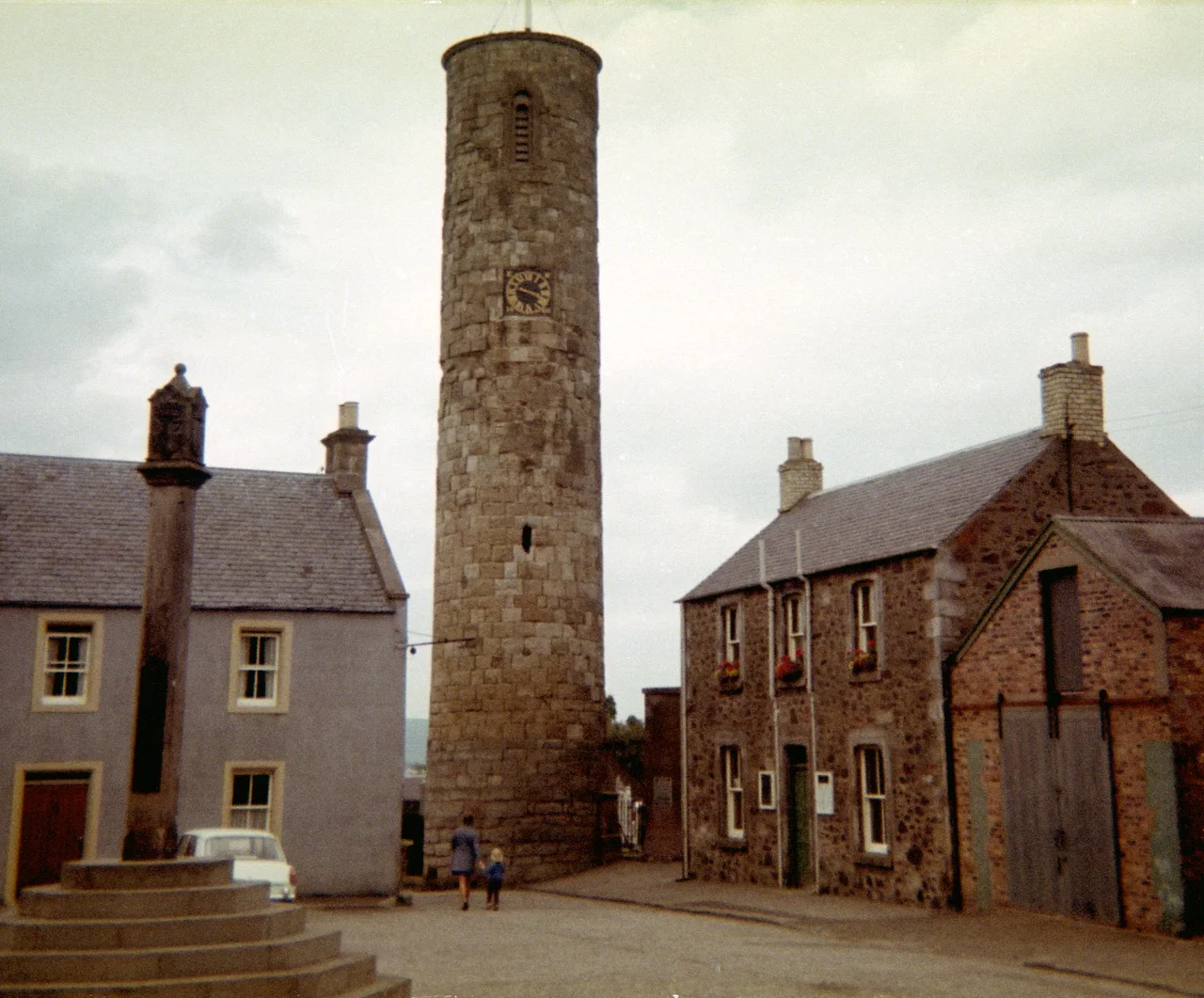

Abernethy Round Tower
There are exactly two of them in Scotland. Round, tapering, hollow, built of sandstone to a pattern that belonged to Irish monasteries before it crossed the sea - the round tower at Abernethy and its twin at Brechin Cathedral are the only survivors of a building tradition that flourished briefly in medieval Scotland and then vanished. At 22.5 metres high, with walls more than a metre thick, the Abernethy tower has watched over the village graveyard since the eleventh century. A plaque at its base marks something else entirely: the spot where in 1072 Malcolm III of Scotland paid homage to William the Conqueror, six years after Hastings, in the Treaty of Abernethy.
An Irish Idea in Scottish Stone
Round towers were an Irish invention. From the ninth century onwards, monasteries across Ireland built tall, narrow, free-standing stone towers next to their churches - probably for storage of valuables, as belfries, and as places of refuge during Viking raids. Dozens still stand in Ireland today. Almost none were ever built outside it. Scotland has two. The Abernethy tower probably dates from the eleventh or early twelfth century, which puts it in the late period of Irish round tower construction, and it is contemporary with the Augustinian and Culdee religious community that once stood here. Look closely at the masonry and you can see the change of stone roughly twelve courses up - evidence that the tower was built in two distinct phases, the lower portion possibly older.
Six Floors and a Ladder
The tower originally had six wooden floors connected by ladders. Each floor was a single circular room, accessible only from the one below. A modern iron spiral staircase now lets visitors climb to the viewing platform at the top, where the Tay estuary opens out to the east and the Ochil Hills roll southward. The diameter at ground level is 4.57 metres, tapering to 3.96 metres at the top. The walls are 1.07 metres thick, made of sandstone quarried locally. The tower stands within the cemetery of St Bride's parish church - itself a nineteenth-century replacement for a sequence of older churches stretching back to the Pictish foundation associated with Saint Brigid of Kildare.
The Pictish Stone and the Iron Jougs
At the base of the tower, fixed to the outside wall, is an incomplete Pictish symbol stone - a fragment of a much older sculpture from the period when Abernethy was a major political and religious centre of the Pictish kingdom. Below it, attached to the same wall, hangs an iron jougs - the medieval pillory used to publicly shame offenders. The juxtaposition is jarring and characteristic: a thousand years of Scottish history pressed against a single wall. The tower also acquired a clock in 1868, bearing the initials of Queen Victoria, and a flagpole topped with a salmon finial - a nod to the river that runs through the village and the fish that once made it prosperous.
Where a King Knelt
Five years after the Norman Conquest, William the Conqueror had a problem to the north. Malcolm III of Scotland had been sheltering English exiles and raiding into Northumbria. In 1072 William marched an army to Abernethy - then a significant religious centre - and Malcolm met him here. The Treaty of Abernethy that followed required Malcolm to acknowledge William as his lord, hand over his son Duncan as a hostage, and expel the English exiles he had been sheltering. It was the first formal submission of a Scottish king to an English one. The plaque on the tower marks the spot. The arrangement did not last, of course - Malcolm soon returned to raiding northern England, and Scottish kings continued to chafe at English overlordship for the next six hundred years - but for a moment in 1072, on this small patch of ground beside the river, the politics of medieval Britain crystallized at the foot of an Irish-style stone tower in a Pictish village.
From the Air
The Abernethy Round Tower stands at 56.333 north, 3.312 west, in the centre of Abernethy village on School Wynd. From the air the 22.5-metre sandstone column is a distinctive vertical landmark on the northern edge of the Ochil Hills, beside St Bride's parish church and graveyard. The wider setting includes the confluence of the River Earn with the River Tay just north of the village, and the Firth of Tay opening east toward the North Sea. Best appreciated from 1,500 to 3,000 feet for a clear view of the tower itself. Dundee Riverside (EGPN) lies roughly 14 nm east-northeast. Edinburgh (EGPH) is about 33 nm south.
Nearby Stories
- Drummond Castle 0.4 km away
- St Andrews 0.8 km away
- Aberfeldy 2.2 km away
- Yellowcraig 2.7 km away
- Fordell Castle 3 km away
- Battle of Sauchieburn 3.2 km away
- Battle of Dun Nechtain 3.3 km away
- Airlie Castle 13 km away