
Abrau-Dyurso
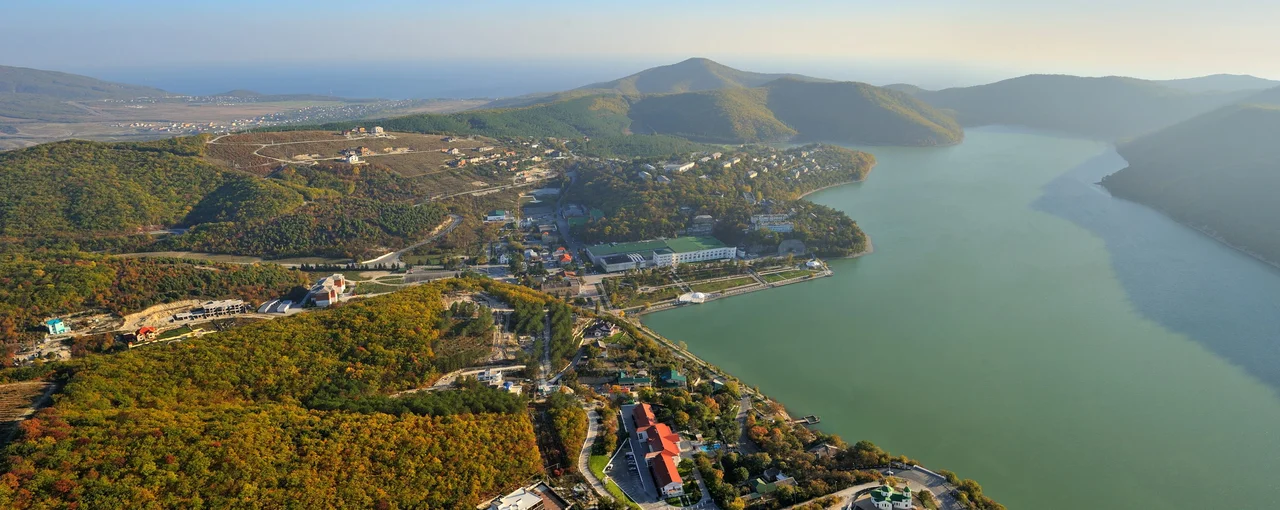
Follow the road west out of Novorossiysk, up over dry limestone hills, and it appears without warning: a dark, still lake cupped in the mountains, with a village of pale winery buildings terraced along its edge. This is Abrau-Dyurso, and its whole reason for existing rests on a single, improbable ambition - that Russia should make its own champagne. Not merely wine, but the coiled, effervescent kind that until then meant France. The cellars carved into these hillsides were dug for the Tsar's table, and more than a century of revolution, flight, and reinvention later, the corks still pop here in numbers that would stun the imperial household that started it all.
A Cellar for the Crown
The settlement was founded on 25 November 1870 as a royal winery, meant to supply the Tsar's household with wine. For two decades the ambition outran the results. Then, in 1891, the crown appointed Prince Lev Golitsyn as Surveyor of Imperial Vineyards - the same visionary who had built the celebrated Crimean estates of Massandra and Novy Svet. Golitsyn did what no Russian had managed before: he brought over a team of skilled winemakers from France and set them loose on these Black Sea slopes. The gamble worked. By 1897 the champagne cellars beneath Abrau-Dyurso held more than 13,000 bottles, aging in the cool dark exactly as they would in Champagne itself. A patch of southern Russia had learned to make the wine of celebration.
The Bubbles Outlast the Empire
The Revolution of 1917 swept away the world that had built Abrau-Dyurso. The imperial patron was gone, and the French specialists fled the country. What they could not take with them was what they had taught. Their Russian apprentices stayed on and kept the cellars working, and through the entire Soviet era the village kept producing sparkling wine - now bottled under the frankly unpoetic name Sovetskoye Shampanskoye, 'Soviet Champagne,' a democratic fizz for a state that had abolished aristocrats but not, apparently, the wish to toast. The transformation says something quietly remarkable: a luxury conjured for a single royal table survived the fall of the monarchy that created it, and became a pleasure of the many.
Lake, Vine, and a Sudden Flood
Abrau-Dyurso sits at the heart of what is now Russia's most important wine-growing region, and the setting is half the magic. Lake Abrau - the largest lake in all of Krasnodar Krai - lies mirror-flat below the vineyards, a karst lake with no outlet whose very origin is still debated, lending the place an air of mild mystery. The rhythm here is agricultural and old: rows of vines climbing the sun-warmed slopes, cellars breathing cool air, a museum of sparkling wines on the winery grounds for those who come to learn how the bubbles are born. Nature has not always been gentle. In August 2002, an earth dam upstream on the nearby Dyurso River gave way, tearing through grape fields in the valley and killing two people - a reminder that this soft, green corner sits in rugged, unpredictable country.
Still Pouring
By 2005 the winery was turning out 5,800,000 bottles of sparkling wine a year - an output that dwarfs those first thirteen thousand bottles the Tsar's cellar-masters were so proud of. Visitors today can walk the tunnels where the wine matures, taste at the lakeside, and stand where a French crew and their Russian pupils built something that refused to die. Abrau-Dyurso is that rare place whose founding purpose never changed: it was made to produce sparkling wine, and it has done so, through empire and republic alike, for over 150 years. Few villages can claim a single, unbroken vocation. Fewer still can pour you a glass of it.
From the Air
Abrau-Dyurso lies at 44.70°N, 37.60°E, about 14 km west of Novorossiysk on the shore of Lake Abrau. From altitude the dark oval of Lake Abrau set in pale Caucasus hills, with the Black Sea just beyond to the south and the port of Novorossiysk to the east, marks the spot. Nearest airports are Anapa (Vityazevo) Airport (ICAO URKA) and Gelendzhik (URKG).
Nearby Stories
- Soviet Destroyer Smyshlyony 13 km away
- Taman 29 km away
- Taman Peninsula 29 km away
- Soviet Hospital Ship Armenia 211 km away
- Battle of the Tanais River 251 km away
- Livadia Palace 262 km away
- Beriev 282 km away
- Abkhazia 292 km away