.jpg)
Abu Simbel Phoenician graffiti
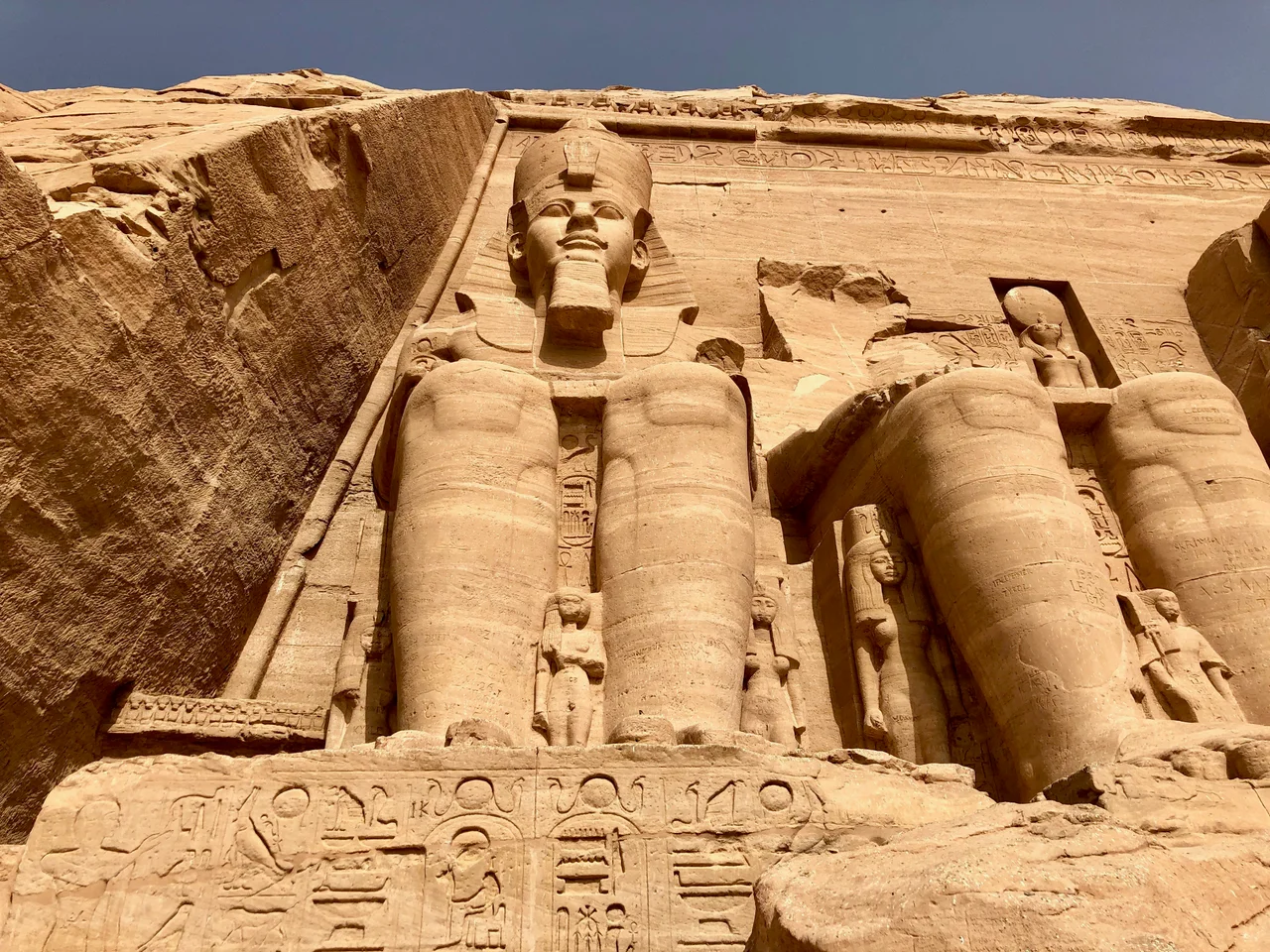
Look at the legs of the giant statues at Abu Simbel and you can read the oldest tourist graffiti in the world. The four colossi of Ramses II stand twenty meters high, gazing east across what was once the Nile and is now Lake Nasser. Somewhere around 593 BCE, a group of Phoenician soldiers and Greek mercenaries passed by on campaign, stood at the feet of a god-king who had been dead for six centuries, and did what travelers have always done: they carved their names. Those carvings survive, tiny letters scratched into sandstone legs, known today as the Abu Simbel Phoenician graffiti.
Noticed in 1845
The Frenchman Jean-Jacques Ampere, son of the physicist for whom the electrical unit is named, first spotted two of the inscriptions in 1845 during a voyage up the Nile. He copied what he saw and sent the copies to Louis Felicien de Saulcy, an early Orientalist scholar, who published a description. 'These inscriptions are designed in Phoenician letters of a large size,' de Saulcy wrote, noting that later hands had added 'parasitic lines drawn by an ignorant and barbaric hand' on top of the originals. The inscriptions were eventually catalogued as CIS I 111 through 113 in the Corpus Inscriptionum Semiticarum, the great nineteenth-century compilation of Semitic-language texts. They have been compared to the Phoenician graffiti found at Abydos, further downstream.
The Campaign of Psamtik II
The graffiti connect to one of the most consequential military operations of the Late Period. Around 593 BCE, the Egyptian pharaoh Psamtik II launched a campaign south into Kush, the Nubian kingdom that had once conquered Egypt and still controlled the upper Nile. Psamtik's army was not only Egyptian. It included Greek mercenaries from Ionia and Caria, and Phoenician contingents from the cities of the Levantine coast. When the multinational army paused at Abu Simbel, already a six-hundred-year-old monument, the soldiers carved their names into whatever stone was closest. The Greek inscription on the left shin of one colossus records the campaign of Psamtik II and names the commanders Potasimto (who led the foreign troops) and Amasis (who led the Egyptians), and is the most famous of the Abu Simbel graffiti. The Phoenician carvings, on the opposite leg of the facing colossus, speak across the Nile to their Greek companions.
Faces Across the Threshold
The specific geometry matters. Two pairs of colossi flank the entrance to the Great Temple. The four-line Phoenician graffiti known as CIS I 112 a through d sit on the outside of the right shin of Colossus 2. The five-line Ionic Greek inscription sits on the outside of the left shin of Colossus 1. The two texts face each other across the temple entrance, as if the Phoenician writers and the Greek writers deliberately chose to put their marks in eye contact. For two and a half thousand years they have stared at each other through the desert air, a silent conversation between two branches of Mediterranean civilization, frozen at the southern edge of a pharaoh's world.
What Graffiti Remembers
There is something touching about these inscriptions that runs against the grain of archaeology. Psamtik II's campaign failed to permanently break Kushite power, and his dynasty did not last much longer. The Phoenician cities themselves would fall to Alexander a few centuries later. The Greek colonies in Egypt would be absorbed by Rome. What remains are the names, scratched by soldiers who could not possibly have imagined that their casual act of self-assertion would outlast every empire they served. The Abu Simbel graffiti are also the oldest Phoenician inscriptions in Egypt, a piece of evidence for the long reach of Mediterranean trade and war. Some later hand added extra marks to the original carvings, perhaps trying to claim the stone. Scholars can still separate the ancient lines from the later interference.
Seen from Above
From the air the temple complex looks deceptively simple, a facade cut into a sandstone cliff above the blue sheet of Lake Nasser. The actual structure has been moved. In the 1960s, UNESCO sawed Abu Simbel into numbered blocks and reassembled it on higher ground to save it from the rising reservoir. The graffiti came with the stone. When visitors today photograph the colossi, they are standing in front of reassembled legs whose Phoenician inscriptions have now been relocated once, surviving a second displacement almost as dramatic as the original carving. Some messages travel further than their writers ever dreamed.
From the Air
Located at 22.34 N, 31.63 E on the west bank of Lake Nasser in southern Egypt, near the Sudanese border. Nearest airport: Abu Simbel Airport (ICAO HEBL), 2 km from the temple complex, with a 2,000-meter runway. Best viewed from lower altitudes on approach to HEBL; the temple facade faces east across the blue expanse of Lake Nasser, an unmistakable navigation landmark in otherwise featureless desert.
Nearby Stories
- Wadi Halfa Salient 8.8 km away
- Kulb 124 km away
- Temple of Dendur 126 km away
- Kulubnarti 154 km away
- Bi'r Tawīl 183 km away
- Bir Tawil 190 km away
- Aswan Dam 204 km away
- Kharga Oasis 289 km away