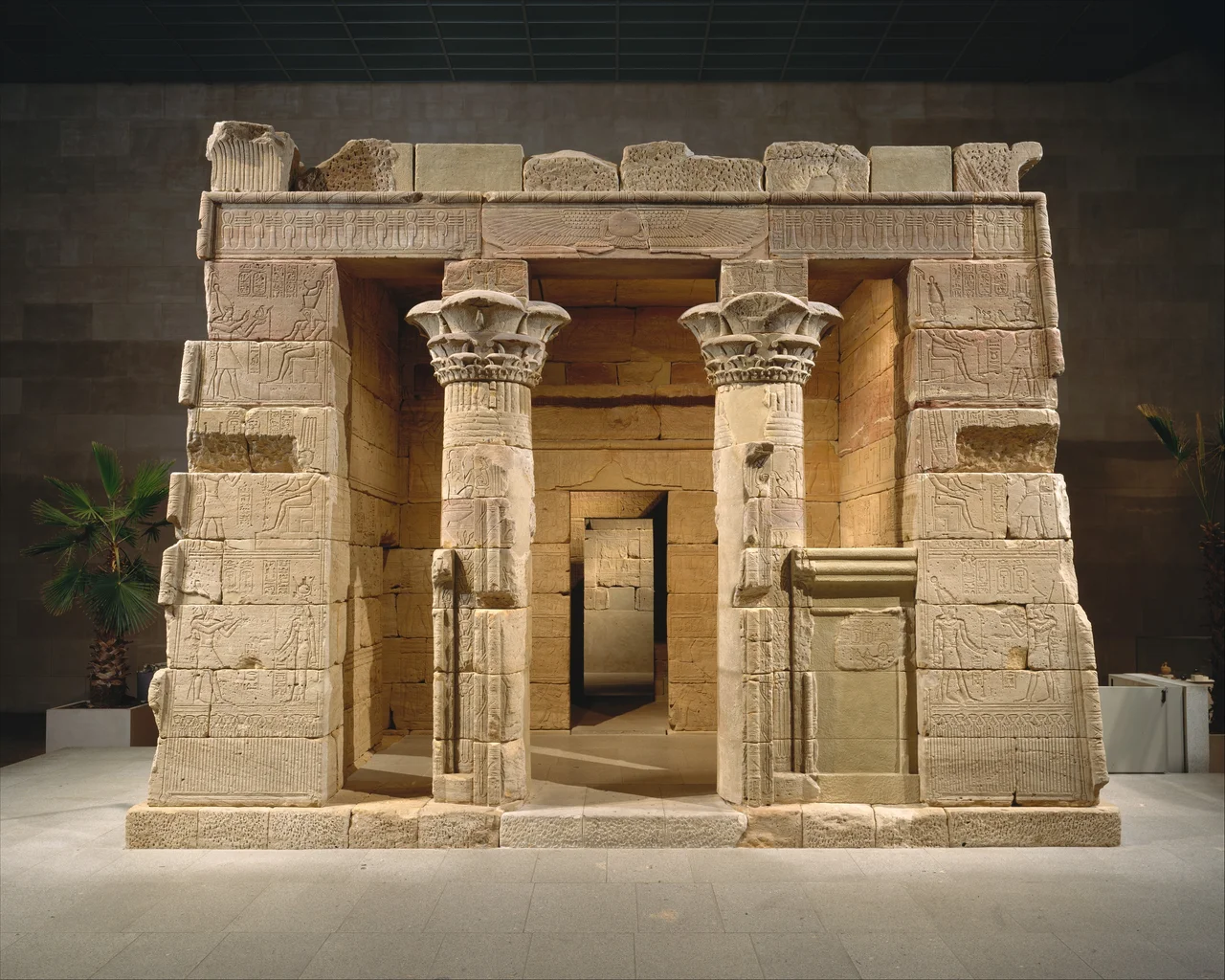

Temple of Dendur
It rains on the Temple of Dendur now, but only outside the glass. The sandstone shrine that once stood on the west bank of the Nile, eighty kilometers south of Aswan, sits today in a vast bright hall on Manhattan's Upper East Side, a wall of windows behind it angled toward the morning light to suggest the river it left behind. The Metropolitan Museum of Art keeps a reflecting pool at its feet in place of the Nile. Getting it here meant taking a two-thousand-year-old building apart, packing it into 661 crates, and sailing it across the Atlantic aboard a freighter. It is, by some distance, the most ancient thing most New Yorkers will ever stand next to.
A Temple for Two Drowned Brothers
Around 23 BC, the emperor Augustus had this temple raised in Roman-ruled Egypt, on the Nubian frontier in a place then called Tuzis. Egyptian craftsmen carved it in a style already thousands of years old, showing Augustus dressed as a pharaoh making offerings to Isis, Osiris, and Horus. But the temple honored two local figures as well: the Nubian brothers Peteese and Pihor, who were believed to have drowned in the Nile. In Egyptian belief, death by the river could lift a person toward the divine, and so the two were worshiped here as demigods. Their names survive in the carvings. Pedesi means 'he whom Isis has given,' and Pihor 'he who belongs to Horus.' The temple itself was always modest, barely thirteen meters long, built in three parts: a columned porch, an offering hall, and the inner sanctuary where the gods were believed to dwell. Hidden in the back wall is a small chamber, reached by pivoting a single block of stone, whose purpose no one has ever determined.
The Long Decline
The temple's first three thousand years were quieter than its last hundred. In the sixth century a Christian community turned it into a church, cut a doorway through a wall of Isis, and covered her reliefs in plaster, even thoughtfully reattaching her carved arm at a new angle when their door damaged it. After Nubia turned to Islam the church emptied, and villagers carried off bricks and stone for their own use. Then came the water. When the British raised the Aswan Low Dam in 1933, the temple spent nine months of each year submerged for three decades, and the last traces of ancient paint washed from its walls. The carvings survived; the color did not.
A Gift Between Nations
When the Aswan High Dam threatened to drown Lower Nubia for good, the world responded. The United States contributed sixteen million dollars to the UNESCO campaign that saved Abu Simbel and Philae from the rising lake. In gratitude, Egypt gave the Temple of Dendur to the American people in 1965. A fierce competition followed over where it should go: the Smithsonian wanted it on the Potomac, Boston wanted it on the Charles, but both riverside plans were rejected because the soft sandstone would crumble in the weather. In 1967 the temple was awarded to the Met, which built an entire new wing to shelter it. The exhibit opened on September 27, 1978, indoors, dry, and lit like the Nile at dawn.
The Marks Visitors Leave
Look closely at the stone and you can read the graffiti of twenty centuries. As early as 10 BC a visitor scratched an oath near the image of Pihor. Nineteenth-century travelers cruising the Nile added their own: a British naval officer, the future Rear Admiral Armar Lowry Corry, cut 'A L Corry RN 1817' beside the entrance, where it remains. The English writer Amelia Edwards, passing by sunset on her Victorian voyage upriver, called the little shrine 'an exquisite toy, so covered with sculptures, so smooth, so new-looking.' The temple has been an object of wonder, a place of worship, a church, a ruin, and a diplomatic gift. In its longest journey, it became a New Yorker.
From the Air
The temple now stands indoors at the Metropolitan Museum of Art, Gallery 131, near 40.78 N, 73.96 W on Fifth Avenue beside Central Park in Manhattan; nearest major airports are LaGuardia (ICAO KLGA), JFK (ICAO KJFK), and Newark (ICAO KEWR). Its original site lay at roughly 23.38 N, 32.95 E on the west bank of the Nile south of Aswan, Egypt, a location now beneath Lake Nasser; the nearest airport to the original site is Aswan International (ICAO HESN). From the air over Manhattan the Met's glass-walled Sackler-era wing reads as a sloped greenhouse along the park's eastern edge.
Nearby Stories
- Aswan Dam 27 km away
- Qasr Ibrim 71 km away
- Wadi Allaqi 100 km away
- Lake Nasser 118 km away
- Abu Simbel 160 km away
- Bir Tawil 181 km away
- Wadi El Gemal National Park 181 km away
- Kharga Oasis 248 km away