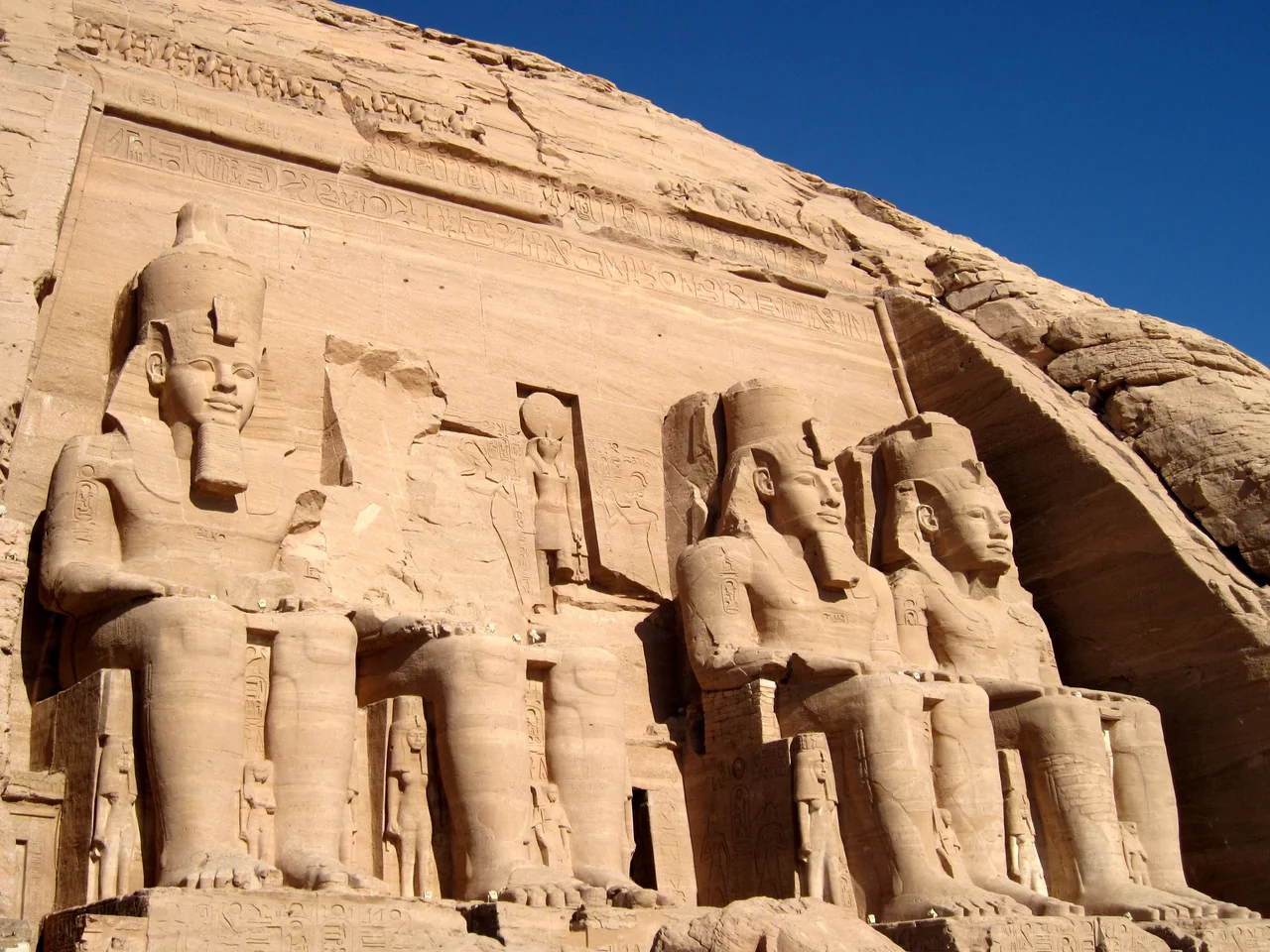

Abu Simbel
The reconstructed mountain is the trick most visitors never notice. When you arrive at Abu Simbel, walk up the ridge, and see the four colossal statues of Ramses II staring down at you from the sandstone cliff, what you are looking at is not a cliff at all. It is a dome. Inside, behind the facade, is something closer to a concrete basketball arena where the carved stone of a three-thousand-year-old temple has been reassembled block by numbered block. The outside looks like solid rock because that was the point. UNESCO engineers in the 1960s spent a decade solving a problem: how do you save a mountain-sized temple from drowning without giving up the illusion that it was carved from a mountain at all?
How to Get Here
Abu Simbel lies 280 kilometers south of Aswan and 40 kilometers north of the Sudanese border, deep in Upper Egypt. Most travelers come on the convoy buses that leave Aswan at dawn, a three-hour drive each way with a strict departure deadline of 4 PM for the return trip. Tour operators charge between 150 and 350 Egyptian pounds round-trip depending on season and negotiation. Independent car travel is restricted for security reasons, though cruise ships still make the trip up Lake Nasser from the Aswan Dam, arriving on a blue reservoir that did not exist before 1964. There is also a small airport, Abu Simbel Airport, with a 2,000-meter runway, built specifically to carry tourists once the temples were saved. Sit on the left side of the bus at dawn and you will see sunrise over the desert.
The Colossi and the Cliff
Four seated statues of Ramses II flank the entrance to the Great Temple, each twenty meters high, each wearing the double crown of Upper and Lower Egypt. An earthquake in antiquity sheared the head and torso off the statue immediately left of the entrance. When the engineers reassembled the temple in the 1960s they chose not to reattach the fallen pieces, leaving them at the feet of the broken colossus the way they had been found. At the legs of each king stand smaller figures of his family: his chief wife Nefertari Meritmut, his mother Mut-Tuy, his sons Amun-her-khepeshef and Ramesses, and his first six daughters. The archaeologists believe the immense scale was propaganda, an unmissable warning to any army sailing down the Nile from inner Africa about the power waiting for them at Egypt's southern border.
Inside the False Mountain
The temples originally stood further down the hillside, facing the Nile in the same relative positions they face Lake Nasser today. When the Aswan High Dam was built in the 1960s, the reservoir was going to drown them. Between 1964 and 1968, teams sawed both the Great Temple and the Small Temple of Nefertari into numbered sandstone blocks, carried them sixty meters higher, and reassembled them stone by stone. The Great Temple sits now under a domed concrete shell covered with sandstone to mimic the original cliff. Inside, if you step through a small door behind the reassembled chambers, you can see the dome for what it is: a twentieth-century engineering feat, hidden inside the appearance of a fourteenth-century-BC monument.
The Cooler Desert
Abu Simbel sits in one of the hottest and driest regions of Egypt, but it feels ten degrees cooler than Aswan because of the wind blowing across Lake Nasser. Summer days push past 40 degrees Celsius; winter days peak near 25 but nights can drop to 5, and the wind makes the cold feel sharper. November through February is the best time to visit. Pack warm layers even in winter. Rainfall is effectively nonexistent, though in August 2024 the Intertropical Convergence Zone drifted far enough north to threaten rain at Abu Simbel, a reminder that the climate here is shifting in ways no one fully predicts.
Staying Overnight
Most visitors do Abu Simbel as a day trip and fall asleep on the bus back to Aswan. Staying overnight is the better choice if you can manage it. The crowds thin after the convoy leaves, the light softens, and the sound-and-light show projects the temple's history onto its own walls in the cool desert evening. Five hotels serve the town, including the Nubian-run Eskaleh Lodge, which can arrange early-morning boat tours on Lake Nasser to catch sunrise on the colossi from the water. Prices are higher here than in Cairo because everything has to be trucked in. The reward is a view that no photograph prepares you for: colossal faces, the rising sun, and a reservoir that, two generations ago, was a valley of villages that had to be abandoned so the temples could be saved.
From the Air
Located at 22.34 N, 31.63 E on the west bank of Lake Nasser. Nearest airport: Abu Simbel Airport (ICAO HEBL), with a single 2,000-meter runway, a domestic field that hosts EgyptAir flights connecting Cairo and Aswan. The temples' facade faces east across the lake; from low approach the reassembled colossi are visible at the water's edge, with the artificial dome covering the rear of the Great Temple.
Nearby Stories
- Wadi Halfa Salient 8.8 km away
- Kulb 124 km away
- Temple of Dendur 126 km away
- Kulubnarti 154 km away
- Bi'r Tawīl 183 km away
- Bir Tawil 190 km away
- Aswan Dam 204 km away
- Kharga Oasis 289 km away