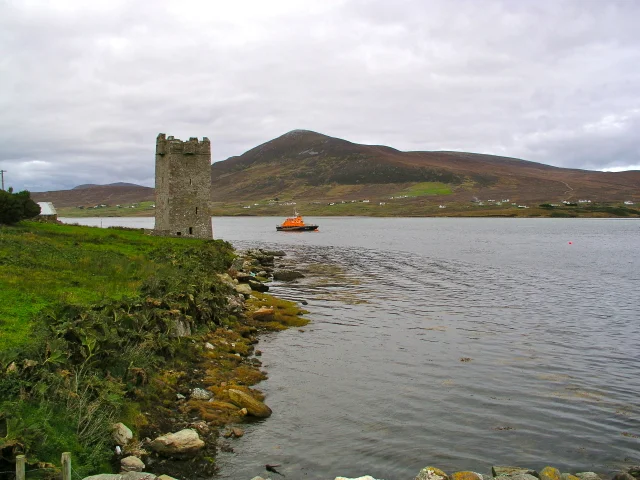

Achill Island Lifeboat Station
The lifeboat sits in the shadow of a fifteenth-century tower house. Carrickkildavnet Castle, built around 1429 by the O'Malley clan and later held by Grace O'Malley herself, looks south across Achill Sound from the same low ground where the Royal National Lifeboat Institution placed Achill Island's first lifeboat in August 1996. It is an arrangement that telegraphs a particular Mayo logic: the same Atlantic that demanded a stronghold here for one purpose six hundred years ago still demands one for another purpose today, and the new generation of guardians keep their gear less than a hundred metres from the old.
The Case for a Station
On 22 November 1995, the RNLI executive committee voted to place a lifeboat at Kildavnet on Achill Island for a one-year evaluation. The reasoning was straightforward and overdue: the nearest all-weather stations were 43 nautical miles to the north and 60 nautical miles to the south, leaving the long, exposed Mayo coastline of Clew Bay and Blacksod Bay without rapid response. A relief lifeboat called Soldian arrived to begin the evaluation. Within a few years the station was permanent, with crew facilities upgraded from temporary accommodation to a purpose-built boathouse completed in 2004 at a cost of just over six hundred thousand pounds.
Sam and Ada Moody
On 18 September 1999, the station's first permanent all-weather lifeboat was named in a ceremony at Kildavnet: 14-28 Sam and Ada Moody (ON 1240), funded from the bequest of the late Mrs Ada Moody. The boat has been on station ever since. The same ceremony announced the award of the RNLI Silver Medal to Coxswain Brian Patten - one of the highest honours the institution gives - along with Silver Medal Service Certificates for mechanic Stephen McNulty and crew members Thomas Kilbane, John Johnston, Raymond McKenna, Liam Fallon, and Edward Corrigan. The awards were for an early rescue that defined the station's reputation in its first months of operation.
Seventeen Hours Out
At eleven in the morning on 19 September 2013, Sam and Ada Moody launched to assist a fishing boat fifty-four miles west of Achill Island, its nets fouled in its own propellers. Conditions on arrival three hours later were described in the official log as challenging - force seven to eight winds, big seas. The crew rigged a tow and brought the disabled vessel back to harbour, arriving at seven the following morning. The lifeboat had been at sea for seventeen hours. This is the routine work of a small all-weather station: long passages, hard weather, the kind of endurance that doesn't make the news beyond the local paper.
A Yacht Without Power
On the evening of 23 May 2022, a lone yachtsman forty nautical miles west of Achill lost all power on his racing yacht - no communications, no ability to drop sail, no steering control. A fixed-wing aircraft located him; Sam and Ada Moody launched at half past eight and arrived on scene at eleven, with Sligo-based Rescue Helicopter 118 providing illumination. The lifeboat rigged a tow, brought the yacht to Clare Island by nine the next morning, and returned to base by ten - almost fourteen hours after setting out. The yachtsman was unharmed. The case is in some ways unremarkable, which is itself a measure of how the Achill station's first quarter-century has gone.
Castle and Boathouse
Look at the site from the air and the two structures read as a single statement about life on this coast: the four-storey stone tower of Carrickkildavnet on its low promontory, the modern boathouse and slipway a short walk away, and Achill Sound stretching north between Achill Island and the Corraun Peninsula. The water that O'Malley's galleys once controlled now carries Clare Island ferries, mussel boats, and the occasional yacht heading for Clew Bay. When the pager goes off in Kildavnet, the crew assembles at the boathouse and launches into a stretch of Atlantic that has not, in any meaningful sense, become less dangerous in the six centuries since the tower was built.
From the Air
Achill Island Lifeboat Station sits at 53.883°N, 9.945°W, on the southeast tip of Achill Island, immediately adjacent to Carrickkildavnet Castle. Best viewed from 1,500-3,000 feet AGL, with Achill Sound to the north and Clew Bay opening to the south. Ireland West Airport Knock (EIKN) is about 45 nm to the east. The station covers a wide search area including Clew Bay, Blacksod Bay, and the Atlantic west to about 50 nm offshore.
Nearby Stories
- Tully Cross 4.6 km away
- Binghamstown 6.7 km away
- Lough Mask Murders 6.8 km away
- Aughagower 13 km away
- Ballycastle, County Mayo 18 km away
- Action of 7 May 1794 36 km away
- RMS Carinthia (1925) 45 km away
- Inishtooskert 194 km away