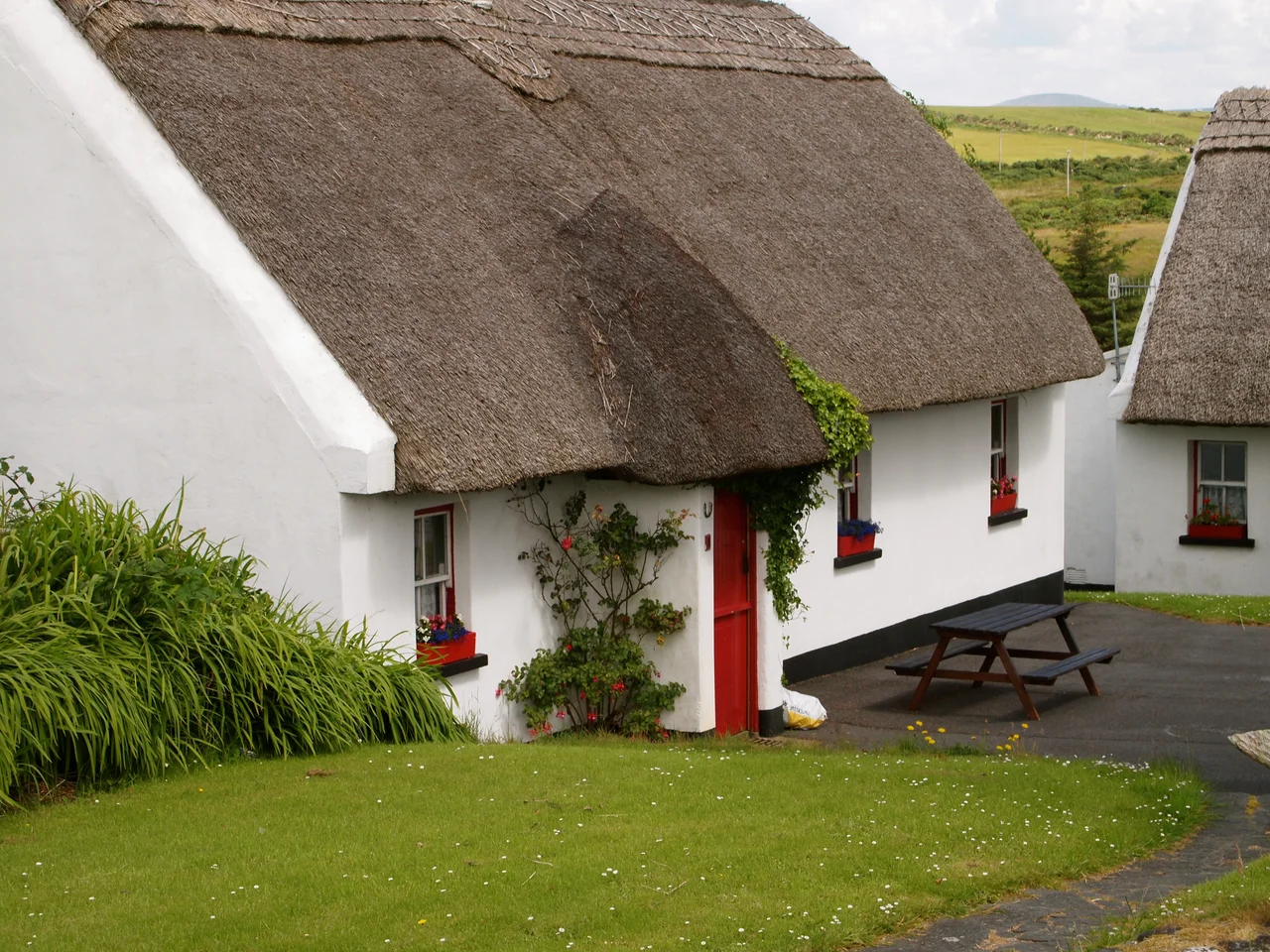

Tully Cross
Step inside the Church of Christ the King at Tully Cross and look up. Three dark leaded windows glow above the altar, throwing pools of cobalt and ruby across the floor. They are the work of Harry Clarke, signed and dated 1927, and they belong to one of the strangest, most exquisite bodies of stained glass produced anywhere in the twentieth century. Clarke made them for a small parish on the Renvyle Peninsula in north-west Connemara, a village so small it occupies the townland of Gorteenclough and answers to the name of the cross on the hill.
The Cross on the Hill
Tully Cross sits a short walk from the Atlantic, on a stretch of County Galway's coastline where the Wild Atlantic Way bends north toward Killary Harbour. From here, the land tilts down through stone-walled fields toward Tully Bay; on a clear evening, the light off the sea turns the whole peninsula the color of soft slate and gold. The village proper is tiny - a Catholic church, a community centre called the Marian Hall, a credit union, two pubs, a hotel, and nine thatched cottages clustered like loaves of brown bread along the road. Letterfrack lies three miles east, Clifden thirteen miles south. In every other direction, sheep and bog and stone wall stretch to the horizon.
Harry Clarke's Windows
Harry Clarke died young, in his early forties, but in the time he had he transformed Irish stained glass into something otherworldly - faces ringed with halos of indigo and emerald, draperies stitched in detail so fine the eye keeps finding new patterns. The windows he made for Tully Cross in 1927 depict Saint Barbara, Saint Bernard, and an apparition of the Sacred Heart. They are dark, in the Clarke manner, drinking the light and giving it back changed. The Diocese of Tuam owns them; a parish of a few hundred people prays beneath them. There is nothing else of comparable artistic value in the church, and there does not need to be.
The Mussel Festival
Every May Bank Holiday weekend, the village fills up for the Connemara Mussel Festival - bands in the pubs, cooking demonstrations in the hall, mussels by the bucketful pulled from the cold bays of the peninsula. It is the kind of event that explains how a village this small keeps going. Tully Cross is affiliated with Renvyle GAA, with the women's club Gráinne Mhaols (named for Grace O'Malley, the sixteenth-century pirate queen whose strongholds lie just up the coast), and with West Coast United FC. The thatched cottages, originally built in the 1970s to revive the local craft of thatching, now welcome visitors who come for the quiet and stay for the light off the water.
Renvyle and the Atlantic Edge
The Renvyle Peninsula reaches west into the Atlantic between Killary Harbour and Cleggan, an arm of land sheltered on one side by the Twelve Bens and exposed on the other to whatever the ocean sends. Boats from Cleggan still ferry visitors to Inishbofin; on clear days the islands of Inishturk and Caher rise on the northern horizon, the same waters Grace O'Malley patrolled four hundred years ago. Tully itself, the slightly larger sister village, lies less than a mile to the west, and the two settlements share schools, services, and the long Atlantic light that makes this corner of Connemara feel further from Dublin than the map suggests.
From the Air
Tully Cross is located at 53.589°N, 9.964°W on the Renvyle Peninsula in north-west Connemara. Best viewed from 2,000-4,000 feet AGL, with Tully Bay to the south and the Twelve Bens visible inland. Nearest aerodrome is Connemara Regional Airport at Inverin (EICA), about 35 nm to the south. Ireland West Airport Knock (EIKN) lies roughly 50 nm to the northeast. Coastal weather is changeable; low cloud often hugs the peninsula from the Atlantic.
Nearby Stories
- Clare Island Abbey 2.1 km away
- Lough Mask Murders 3.7 km away
- RMS Carinthia (1925) 9.4 km away
- Battle of Castlebar 15 km away
- The Burren 23 km away
- Inishmore 25 km away
- Action of 7 May 1794 73 km away
- Inishtooskert 155 km away