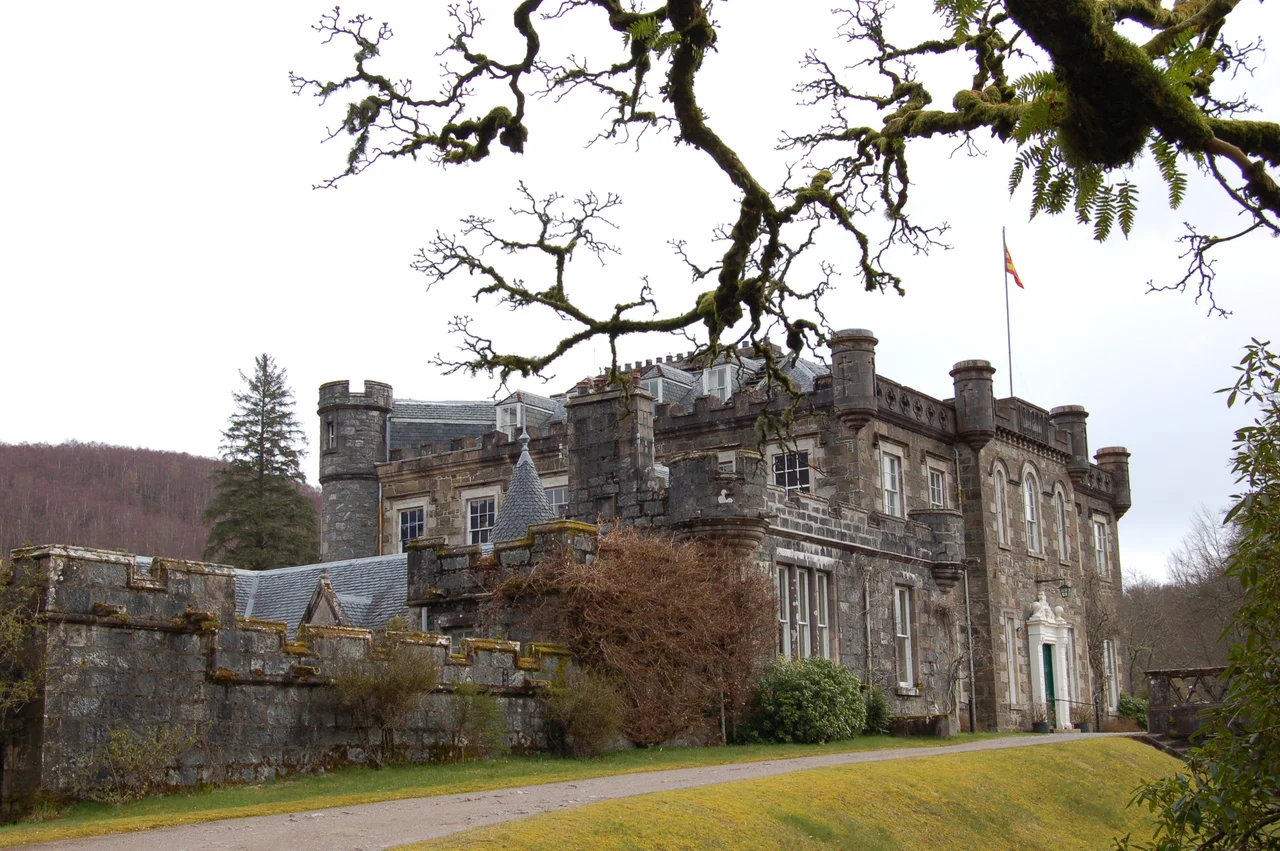

Achnacarry
In March 1942 the British Army turned a private Highland estate into a school for killing. Achnacarry Castle, the seat of Clan Cameron, sat on an isthmus between two lochs in some of the wildest country in Britain. For the next three years, twenty-five thousand commandos passed through its gates: British, American, French, Dutch, Norwegian, Czech, Polish, Belgian. Each course ended with an opposed landing exercise on the shore of Loch Lochy using live ammunition. Some trainees were killed. The men who survived went on to raid occupied Europe and to lead the way ashore on D-Day. The current Chief of Clan Cameron still lives at Achnacarry. The Commando Memorial stands at Spean Bridge, seven miles away.
The Isthmus and the First Castle
Achnacarry occupies an isthmus between Loch Lochy to the east and Loch Arkaig to the west, an obvious place of strength in country that does not give up many such places. Ewen Cameron, thirteenth Chief of Clan Cameron, enlarged the disputed Tor Castle in the early sixteenth century, but it was Sir Ewen Dubh Cameron, the seventeenth chief, who built the first Achnacarry around 1655. He wanted somewhere more convenient and further from his enemies, the Mackintoshes and Campbells, and from Oliver Cromwell's garrison at Inverlochy. One contemporary description called the new house a large building of fir planks, the handsomest of that kind in Britain. Around 1663 Sir Ewen's bard sang of it as the generous house of feasting, pillared hall of princes, where wine goes round freely in gleaming glasses, music resounding under its rafters. After Culloden in 1746, government troops under the Duke of Cumberland burned it to the ground. New Achnacarry, in Scottish Baronial style, was built near the same site in 1802.
Bonnie Prince Charlie and the Dark Mile
Donald Cameron of Lochiel, the Gentle Lochiel, was one of the first chiefs to commit his clan to Charles Edward Stuart's 1745 Jacobite rising. His decision essentially started the rebellion: when Lochiel agreed, others followed. The rising ended at Culloden in April 1746, and the Cameron estates were forfeited. Lochiel himself escaped to France and died there in 1748. The castle the Duke of Cumberland burned was the price of that choice. Between the new castle and Loch Arkaig runs a path so densely overhung by trees it is called The Dark Mile, in Gaelic Mile Dorcha. Queen Victoria visited and wrote about the estate in her journals. The Camerons recovered their lands and titles eventually, and Achnacarry has remained the family seat ever since.
The Commando School
From March 1942 to 1945 the estate housed the Commando Basic Training Centre. British Commandos trained alongside United States Army Rangers and units from France, the Netherlands, Norway, Czechoslovakia, Poland, and Belgium. The country was the curriculum. Recruits ran the hills, crossed the lochs, and finished each course with an opposed landing exercise around Bunarkaig on Loch Lochy using live ammunition. The training killed some of them. Twenty-five thousand commandos completed the course in the four years it ran, and the survivors went on to almost every major Allied operation of the war. Their memorial stands at Spean Bridge, seven miles south. Military associations still organise a timed seven-mile Commando march from the memorial to Achnacarry, in full battle gear, backpack, and combat boots. The castle suffered some damage from fire during the war years and remains in private hands.
The Oil Cartel
On 17 September 1928, in the relative privacy of Achnacarry, executives from the world's three largest oil companies met and signed what became known as the Achnacarry Agreement, or As-Is Agreement. Walter Teagle of Standard Oil of New Jersey, Sir Henri Deterding of Royal Dutch Shell, and Sir John Cadman of Anglo-Persian Oil agreed to freeze each company's market share at then-current levels and to coordinate prices and production. It was an early and very successful attempt at international cartel-building, intended to end the price wars that had crashed petroleum prices in the late 1920s. The agreement is one of the founding documents of the modern oil industry. The 1944 Anglo-American Petroleum Agreement followed it. The fact that all of this was negotiated at a Highland estate normally associated with Clan Cameron and Commando training is one of the more unusual collisions in twentieth-century corporate history.
From the Air
Achnacarry sits at 56.945 N, 4.998 W on the isthmus between Loch Lochy and Loch Arkaig in Lochaber. Recommended viewing altitude 2,500-4,000 ft AGL. Visual references: Loch Lochy as part of the Great Glen system running northeast-southwest, Loch Arkaig as a long narrow ribbon running west-northwest from the isthmus, and Ben Nevis rising to the south. The village of Spean Bridge is about 7 miles southeast. Nearest ICAO airport is Inverness (EGPE) about 50 nm northeast; Oban (EGEO) is the regional alternate to the southwest. Watch for orographic cloud on the surrounding mountains and turbulence over the Great Glen.
Nearby Stories
- Morvern 4.8 km away
- Gavin Maxwell 5.7 km away
- Lochaber 6.5 km away
- Ben Alder 8.6 km away
- Meggernie Castle 13 km away
- Battle of Glen Shiel 14 km away
- Foyers hydropower schemes 16 km away
- Castle Stalker 18 km away