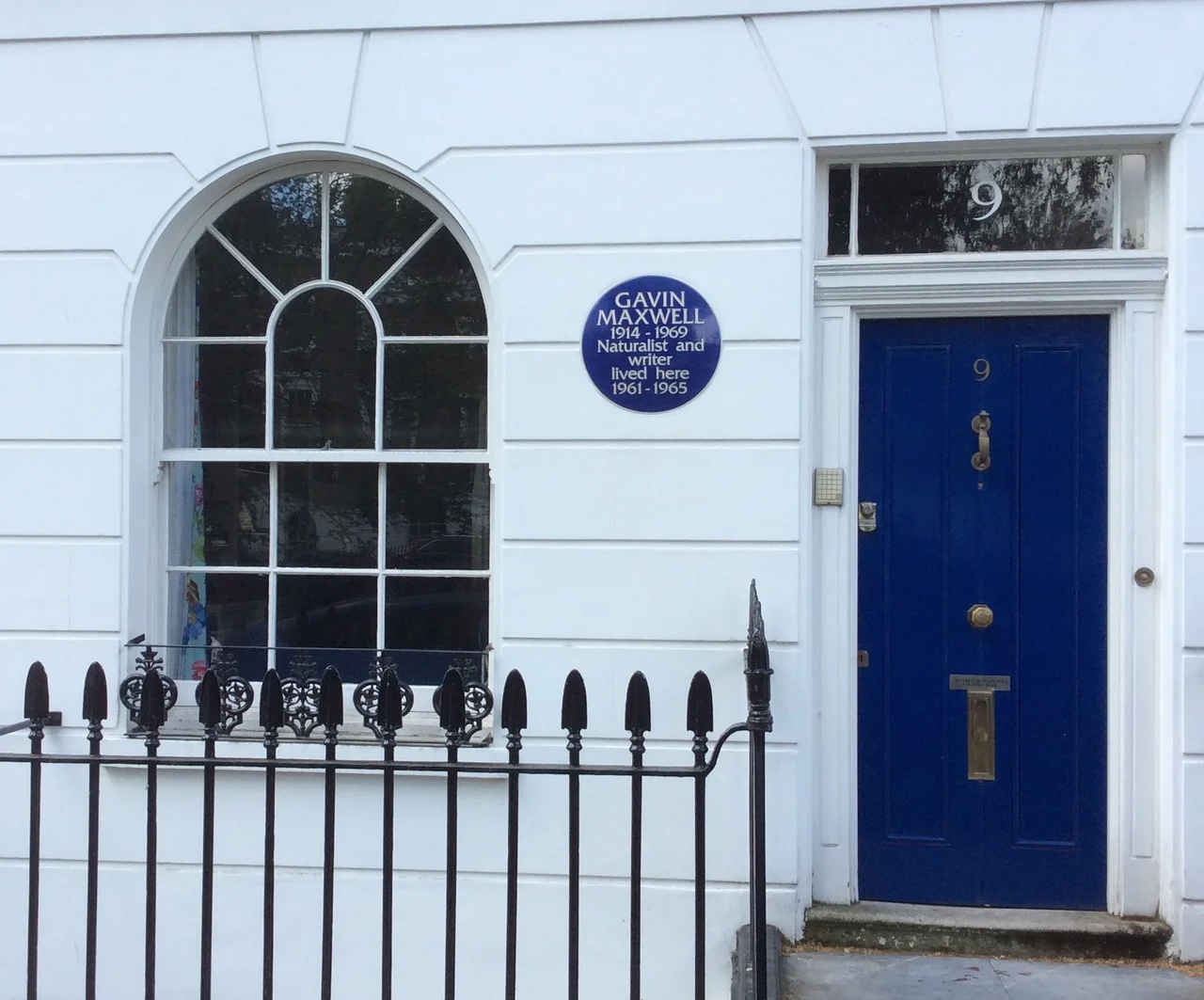

Gavin Maxwell
Maxwell called the place Camusfeàrna, Gaelic for Bay of Alders, but on the maps it was Sandaig - a cluster of lighthouse keepers' cottages on a peppercorn rent, opposite Isleornsay on Skye, with a parallel lighthouse marking the shipping channel through the Sound of Sleat. He arrived in 1948 as a writer's retreat, brought the first of his otters in 1956, and spent the next decade making this corner of the Highland coast famous to millions of readers. His book Ring of Bright Water (1960) sold more than two million copies. It also concealed - because Maxwell, born 15 July 1914, made a complicated, often painful path through the world - more than it revealed.
From Elrig to Soay
Maxwell was born at the House of Elrig in Wigtownshire, the youngest of four children of Lieutenant-Colonel Aymer Edward Maxwell and Lady Mary Percy, daughter of the 7th Duke of Northumberland. His father was killed at the Siege of Antwerp on 9 October 1914, when Gavin was three months old. He was raised in the Catholic Apostolic Church by his mother and aunts, did not attend school until he was ten, and developed an early passion for natural history with his brothers - particularly his eldest brother Aymer, with whom he shared what he later called a near-twin closeness. After Oxford and an unhappy stretch as an equipment salesman, his Second World War service with the Special Operations Executive brought him to the Highlands - training agents in small-arms warfare at bases around Arisaig and Knoydart. After the war he bought the island of Soay off Skye for £900, borrowing the money from his mother, and started a basking shark fishery. By 1948 the business had failed, and he was deep in debt that would shape the rest of his life.
Iraq, Mij, and the Bay of Alders
In January 1956 Maxwell travelled to Iraq with the explorer Wilfred Thesiger to tour the reed marshes of the Euphrates. He spent seven weeks on a traditional canoe called a tarada, an experience he found both physically painful and life-changing. In Basra at the end of the journey, Thesiger arranged for an otter cub to be sent to Maxwell. He named him Mijbil - Mij for short. The bond between man and otter, established on the difficult journey back to London, became the heart of Ring of Bright Water. Mij was eventually identified at the London Zoological Society as a previously unknown subspecies of smooth-coated otter, and was named Lutrogale perspicillata maxwelli - Maxwell's otter - in his honour. At Sandaig, Maxwell raised and lived with a succession of otters, and the cottage became the centre of an unconventional household. The book that came out of it remains in print, has been translated into more languages than any of his others, and was filmed in 1969 starring Bill Travers and Virginia McKenna.
The Curse and the Cottage
Maxwell's life was shadowed by a difficult friendship with the poet Kathleen Raine, six years older, whose unrequited love for him she described in her memoir The Lion's Mouth. After a fierce argument at Sandaig in July 1956, Raine - frustrated by Maxwell's homosexuality and mood swings - returned in the night, grasped the rowan tree near his cottage, and spoke a curse: "Let Gavin suffer, in this place, as I am suffering now." She later came to believe this curse marked the start of Maxwell's catalogue of misfortunes - the death of Mij in 1957, his brief and unhappy marriage to Lavinia Renton in 1962, two crushing libel verdicts after his Sicily reporting, the 1968 fire at Sandaig that killed his otter Edal, and the lung cancer diagnosed in August 1969. Whether one believes in such curses or not, Maxwell's later years were extraordinarily painful. The title of Ring of Bright Water came from a Raine poem, The Marriage of Psyche, which he never properly credited to her. It is one of many things between them that was never resolved.
Eilean Bàn and After
After the fire destroyed Sandaig, Maxwell moved to the lighthouse keepers' cottages on Eilean Bàn - White Island - between Skye and the mainland near Kyleakin. He called it Kyleakin Lighthouse and invited the young naturalist John Lister-Kaye to help him build a small zoo and write a book about British wild mammals. Both projects were unfinished when Maxwell died, on 7 September 1969, at the Royal Northern Infirmary in Inverness. He was 55, a lifelong heavy smoker, three weeks past a diagnosis of late-stage lung cancer. His ashes were placed under a boulder where his writing desk had stood at Sandaig. Eilean Bàn now supports a pier of the Skye Bridge, built in the 1990s; the island is a commemorative wildlife sanctuary and museum, open to the public from spring through autumn. Royalties from his books will continue to flow until 2039 under UK copyright. Maxwell's otter is still listed in IUCN registers under his name.
From the Air
Sandaig and Eilean Bàn coordinates 57.168°N, 5.685°W. From 2,500-3,500 ft AGL: Sandaig itself is a tiny bay on the mainland 3 nm southwest of Glenelg, marked by lighthouse keepers' cottages opposite Isleornsay on Skye. Eilean Bàn lies in the kyle at Kyleakin under the modern Skye Bridge. Nearest fields: Plockton (EGPO) 6 nm north, Broadford bay 7 nm southwest. The Sound of Sleat funnels weather; expect downdrafts and squalls in westerlies. Useful navigation references: Isleornsay lighthouse on Skye and the Skye Bridge pylons at Kyleakin.
Nearby Stories
- Arisaig 5.3 km away
- Talisker distillery 9.7 km away
- Loch Torridon 11 km away
- Uig 12 km away
- Neptune's Staircase 16 km away
- Glen Affric 18 km away
- Corrieshalloch Gorge 34 km away
- Coll 39 km away