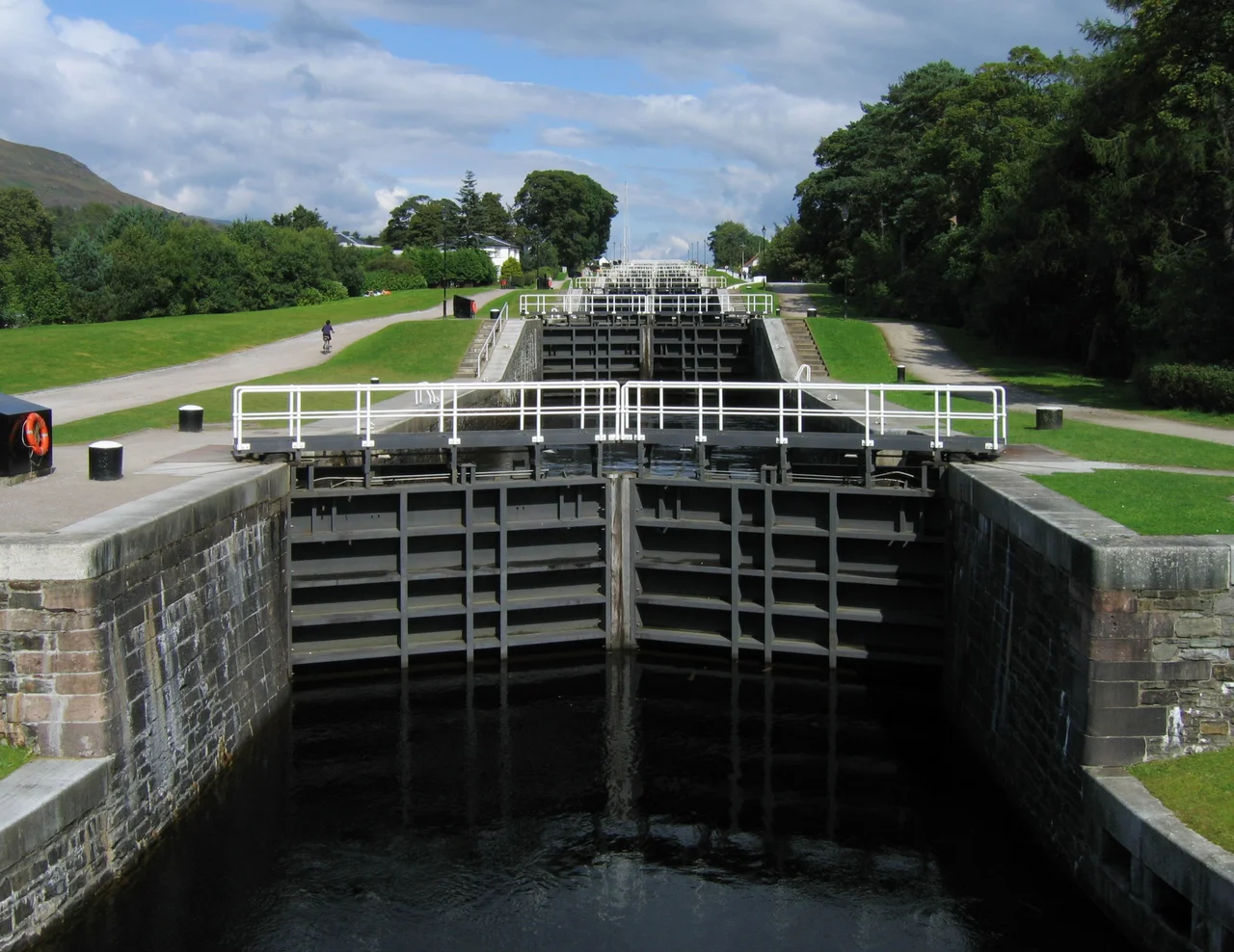

Neptune's Staircase
Before mechanisation, it took a boat half a day to climb Neptune's Staircase. Three lock-keepers worked in tandem, turning capstans by hand, four poles to a capstan, seven full revolutions to open or close each gate. Each lock had four gates. The flight had eight locks. Doing the arithmetic on a stiff morning gave you 126 revolutions to ascend the full sixty-four feet from Loch Linnhe to the canal level above. Today, hydraulic rams do the same work in ninety minutes. The stone walls still rise in eight steps up the hillside at Banavie, just outside Fort William, the longest staircase lock in Britain and one of Thomas Telford's most ambitious feats of civil engineering.
The Engineer Who Wanted to Stop the Highland Clearances
In 1801 the British government asked Thomas Telford to look at ways of slowing the depopulation of the Highlands. His answer was infrastructure. Public works, he argued, would provide employment, support fishing and agriculture, and connect remote settlements to markets. An Act of Parliament in July 1803 authorised a Caledonian Canal across the Great Glen, sixty miles long, of which only twenty-two miles would actually need digging. The rest used existing lochs: Lochy, Oich, Ness. Telford was principal engineer. William Jessop, the leading canal engineer of the age, served as consultant. The southern section, including the great flight at Banavie, was overseen by John Telford, no relation. A rubble quarry opened at Corpach Moss. Construction began.
Eight Locks at Banavie
Locks could have been spread along the canal individually, but Telford and Jessop concluded that grouping them saved money on land and labour. Banavie became the site for eight locks in a continuous flight, each chamber draining into the next. The locks were sized to handle 32-gun frigates and Baltic traders: 180 feet long, with masonry walls rising 64 feet from bottom to top. Cast-iron swing bridges, not bascules, were used at the foot of the flight, because Telford and Jessop feared masts being struck by lifting bridges. The first three locks were complete by June 1809. Labour shortages slowed the rest. The final two were finished by the end of 1811, eleven years before the rest of the canal opened in October 1822. The post-Napoleonic peace had already made the canal strategically pointless.
Execrable Masonry and Ten Winters of Repair
Trouble surfaced almost immediately. The canal closed for two weeks in April 1829 to fix problems at Banavie. In 1837, George May's report on the canal described the Banavie masonry as execrable, suggesting that the contractor had never expected the locks to be used and had concealed shoddy work from Telford. The locks held anyway, with repairs in 1880 and 1910. By the end of the First World War the canal was bankrupt, and the Ministry of Transport gave 11,000 pounds for emergency works. In 1929 a fishing drifter smashed two of the gates and flooded the lower chambers. By the 1990s the walls were bulging and leaking, with a 60-million-pound rebuild estimated. Instead, engineers spent ten winters from 1995 to 2005 draining the chambers in sequence, drilling 16,000 holes through the double-skinned walls, stitching them together with stainless-steel rods, and pumping 25,000 tons of grout into the gaps.
The Long Climb Today
Scottish Canals has run the flight since 2012, accountable now to the Scottish Parliament. Each of the modern gates weighs 22 tons. Three keepers operate the staircase, working on what they call an efficiency basis, batching ascending boats together or descending boats together, or letting a rising vessel pass a falling vessel in the same chamber. The capstan plinths still sit beside each gate, though the capstans themselves are long gone. Tourists park beside the swing bridge at the foot of the flight and walk up the towpath, watching pleasure craft climb step by step from Loch Linnhe toward the heart of the Great Glen. Above the eighth lock, the canal turns east. Below the first, the sea waits.
From the Air
Neptune's Staircase sits at 56.846 degrees North, 5.094 degrees West, at Banavie just north of Fort William and a mile inland from Loch Linnhe. The eight locks ascend up the hillside in a single straight line, easily identifiable from the air. The Banavie swing bridge at the foot of the flight carries the A830 Road to the Isles and the West Highland Line. The nearest airport is Oban (EGEO) about 40 nautical miles south, with Glasgow (EGPF) the main commercial gateway 90 nautical miles south and Inverness (EGPE) 60 nautical miles northeast at the other end of the canal. Best viewed at 1,500 to 3,000 feet AGL to see the stepped flight, the swing bridge, and the start of the Caledonian Canal threading northeast into the Great Glen. Ben Nevis rises immediately east; weather changes rapidly.
Nearby Stories
- Morvern 4.8 km away
- Gavin Maxwell 5.7 km away
- Lochaber 6.5 km away
- Ben Alder 8.6 km away
- Meggernie Castle 13 km away
- Battle of Glen Shiel 14 km away
- Foyers hydropower schemes 16 km away
- Castle Stalker 18 km away