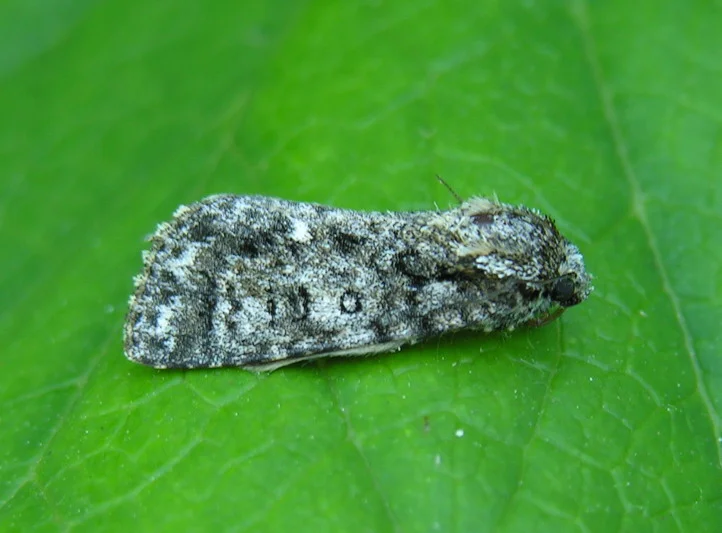

Acronicta rumicis
Carl Linnaeus described the knot grass moth in 1758, slipping it into the tenth edition of his Systema Naturae as just one more obscure noctuid among hundreds. He named it after the leaves it ate - rumex, the dock - and moved on. He could not have known that for the next two and a half centuries this small grey moth would quietly serve as a witness to industrial Europe: darkening as factory soot coated the trees, lightening as the air cleared, vanishing from English hedgerows as the hedgerows themselves came down. Acronicta rumicis is a 4-centimeter scrap of evolution, and reading its wings is something like reading a tree ring of the continent it lives on.
The Quiet Owlet
Knot grass moths are members of the family Noctuidae - the owlet moths, named for the way their large eyes catch and throw back light. Folded at rest, the wings form a small grey tent the size of a fingernail. The wingspan runs 34 to 44 millimeters; the forewings carry a mottled wash of dark and light grey, broken by a single distinctive white spot on the trailing edge that lets a careful observer tell A. rumicis from its cousins. The hindwings are brown. Almost all the work of identification happens in poor light, because adults fly at night, navigating not by sight but - recent research suggests - by smell, following olfactory corridors that run along hedgerows like invisible roads. A break of even a single meter in those hedgerows can leave a moth lost in open air.
Soot on the Wings
The most striking thing the knot grass moth ever did was turn black. From the late 19th century into the early 20th, as British and German industry blanketed Europe in coal smoke, two melanic forms of A. rumicis became common: the aberration salicis, dark grey with the white spot still visible, found mostly in England, Wales and Ireland; and aberration lugubris, almost wholly black, prevalent in England. The same selective pressure that produced the famous peppered moth ratio - dark wings hide better against soot-stained tree bark - did its quiet work here too. Then, as Europe cleaned its skies through the second half of the twentieth century, the ratio reversed. In 1995 about 20 percent of British A. rumicis were melanic; by 2000 only 6.1 percent; by 2004 just 2.8 percent. The species had recorded the Industrial Revolution and its undoing in its own pigment.
Caterpillars in the Corn
A. rumicis is most visible to humans not as a moth but as a caterpillar - marbled dark and light grey with a dorsal row of red spots on black blotches, tufts of black and orange-brown hairs running its length, segments five and twelve humped into small saddles. The larvae feed on what their generation can find: sorrel, dock, bramble, thistle, hop, occasionally young shrub leaves. Lately they have also taken up maize. Polish researchers documented A. rumicis caterpillars stripping the leaves and silks of corn cobs in southeastern Poland through the 2000s, occasionally eating into soft kernels. Where eastern European farmers replaced traditional crops with industrial corn, the moth followed. In southern Europe the species produces three broods a year; in the colder north only one; in Britain and central Europe two - May-June, then August-September - the second brood entering diapause to overwinter as pupae underground.
Vanishing from the Hedgerows
Across the Palearctic - from the British Isles east through Belgium, France, Germany, Russia, and on into Korea, Japan, and northwestern China - A. rumicis is still common. But in the United Kingdom it has fallen sharply: research cited by conservation bodies finds the population down by roughly 75 percent since 1969. The decline tracks the loss of hedgerows from British farmland. As agricultural efficiency drove fields together and tore the green seams out, the moth lost both its food plants and its olfactory corridors at once. A. rumicis is now on the UK's Priority Biodiversity Action Plan list, which directs focused conservation attention at species in trouble. Recovery, if it comes, will require restoring exactly the kind of unkempt mixed plantings that A. rumicis evolved to live among - the rough edges that modern farming has been trying to remove for fifty years.
A Liège Specimen Drawer
Why does this small Palearctic moth show up tied to the hills southeast of Liège? Probably because of an entomologist's specimen card. Belgium has a deep amateur and museum tradition in Lepidoptera; collectors from Wallonia have catalogued the regional fauna for more than a century, and individual records - a moth caught in a Hesbaye field, pinned, labelled with a date and locality - become geographic points in the global biodiversity record. A. rumicis ranges across every Belgian province, from the Ardennes forests up to the Polders. To stand on a warm August evening in the herbaceous edge of a Walloon farm field is to stand in habitat the species would readily use. Whether the moth still uses it depends on what the hedgerows are doing this year, and how dark the sky is at dusk.
From the Air
Recorded near 50.73°N, 5.33°E, in the gently rolling agricultural country of Belgian Hesbaye northwest of Liège. The Liège metropolitan area lies just southeast; Tongeren is to the north. Nearest airport: Liège (EBLG), about 20 km east. Brussels (EBBR) is roughly 80 km west. This species is found across the Palearctic, so a sighting here represents one point in an enormous range. Best looked for at dusk on warm summer evenings near hedgerows, weedy field edges, and broad-leaved dock plants.
Nearby Stories
- Limburg (Belgium) 4.7 km away
- Herbesthal railway station 5.9 km away
- Castle of Westerlo 12 km away
- Heinsberg-Lindern Railway 14 km away
- Ad's Path 20 km away
- Marcinelle Mining Disaster 35 km away
- Fort Jeanne d'Arc 148 km away
- Basilica of Saint-Pierre-aux-Nonnains 157 km away