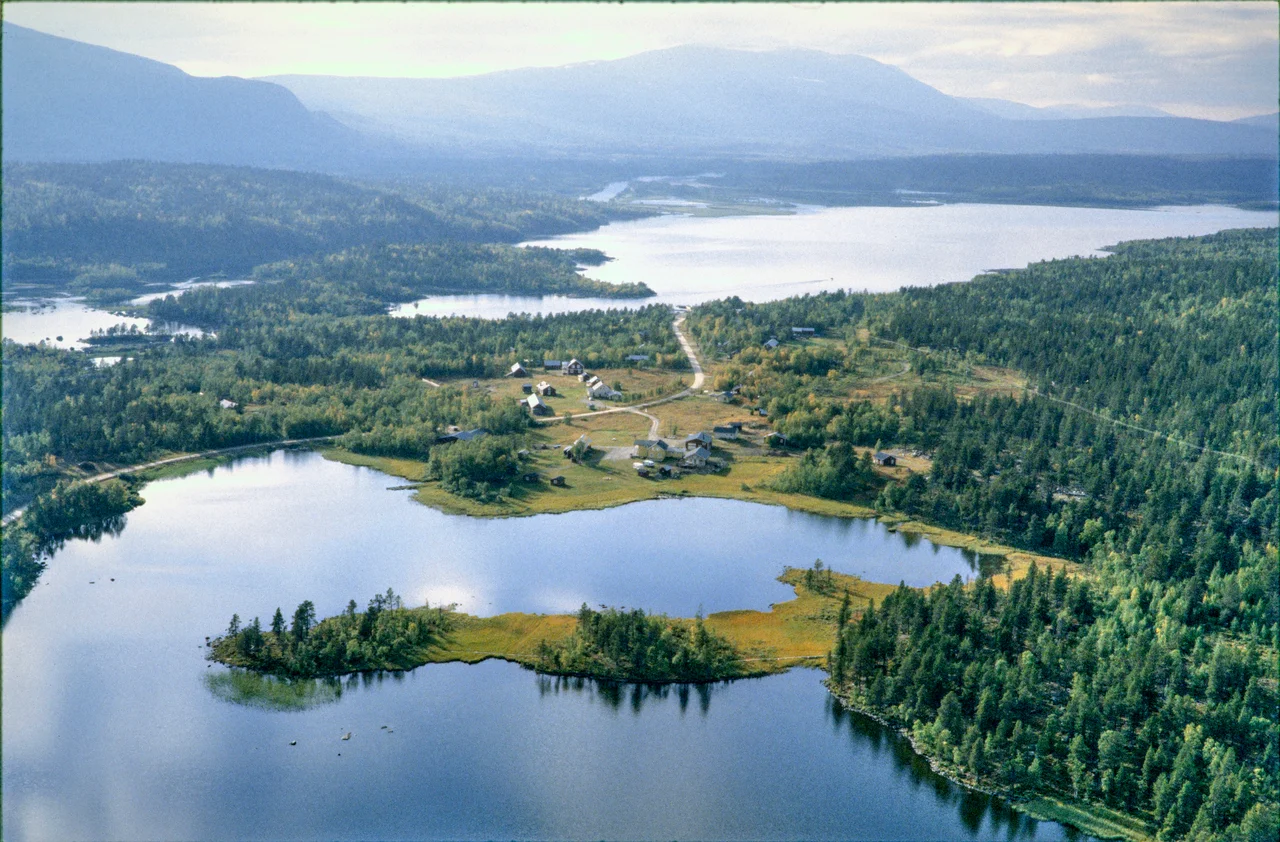

Adolfström
One building came through the fire of 1821, and it is still standing. Everything else at Adolfsström burned that year: the smelting house, the workers' quarters, the sheds where silver ore hauled sixty kilometres over the mountains from Nasafjäll had been stacked and weighed. People at the time believed the fire had been set deliberately, and nobody seems to have argued very hard against them. By then the works had been dead for eleven years anyway. The fire was less a catastrophe than a full stop. What survived is called Majorsgården, the major's farm, and today it stands in a village of red cabins at the end of a road that goes no further, on the shore of Lake Iraft, in the middle of the emptiest quarter of Sweden's most famous trail.
Silver, Second Attempt
Nasafjäll had already broken one company. The mine's first period ran from 1635 to 1659, produced roughly 860 kilograms of silver and 250 tonnes of lead, and ended when a Norwegian raiding force burned its smelter at Silbojokk. A century later, investors tried again. A new company formed in 1770 and received its royal privileges on 17 February 1774. A smelter went up at Adolfsström that same year, and the first metal ran in the autumn of 1775. There was a plain reason not to rebuild on the old site: the pine forest around Sädvvájávrre had been cut out for charcoal during the first attempt and had not come back. So the ore came here instead, another day's haul east. The second period lasted until 1810 and yielded 110 kilograms of silver and 21 tonnes of lead. Thirty-five years of work, at the end of the world, for a weight of silver about equal to one large man.
The People Who Carried It
Nobody sent the Sami down the mine. What the Crown did instead was conscript them, with their sleds and their reindeer, into hauling everything the works could not produce for itself - ore, timber, provisions - across sixty kilometres of mountain in a climate that punished animals and drivers alike. Many Sami families responded by leaving, moving west into Norway to get out from under the levy, which meant giving up grazing grounds their households depended on. During the first period the foreman Isak Tiock paid his workers in flour, salt, tobacco and liquor while embezzling the wages they were owed, and dealt harshly with anyone who refused the work; a royal commission eventually imprisoned him and saw the debts settled. Across both periods, everything Nasafjäll ever produced amounted to less than a tonne of silver.
Empty, Then Not
When the mining stopped in 1810 the village stopped with it, and after the fire of 1821 there was hardly a village left to stop. For roughly two decades Adolfsström was simply an abandoned industrial site above the Arctic Circle, its foundations going quietly under moss and dwarf birch. Then in 1840 a settler named Jonas Lundmark arrived with his family and stayed, and everything the place is now grew from that one decision. Modernity turned up at a Lapland pace afterwards: a telephone line in 1922, mains electricity in 1947, and in 1960 a proper road you could drive. That road comes in from Laisvall and ends here. There is nowhere further to go by car, which is precisely the quality that made the village useful again.
The Trail's Quiet Quarter
Kungsleden passes Adolfsström on its long run between Ammarnäs and Jäkkvik, and this is the section that separates the committed from the curious. There are no Swedish Tourist Association huts across the roughly 130 kilometres between Kvikkjokk and Ammarnäs - the longest hut-free gap on a trail of some 467 kilometres. Walkers crossing it depend on the handful of villages scattered along the way, and Adolfsström is one of them. The Swedish description of the modern village is flat to the point of comedy: mainly a tourist place. What that means on the ground is cabins, a shoreline, and a trail coming through. It also means that a walker who has not seen a building for two days comes down off the fell, sees red-painted houses on the water, and feels something disproportionate about it. The silver is long gone. The village outlived it by two centuries, on the strength of being somewhere to arrive.
From the Air
Adolfsström sits at 66.278N, 16.661E on the shore of Lake Iraft in western Arjeplog Municipality, Swedish Lapland, about 40 km east of the Norwegian border. The village is tiny and shows from the air mainly as a cluster of red roofs at the end of a single road running west from Laisvall - the road's dead end is the most reliable identifier. The Laisälven valley and the pale braided fan of the Yraft delta immediately southwest are the strongest visual anchors. Best viewed from 1,500-3,000 feet AGL. Nearest airports are Arvidsjaur (ESNX) about 150 km southeast and Gällivare (ESNG) to the northeast, with Bodø (ENBO) roughly 150 km northwest in Norway. Terrain rises sharply on both sides of the valley to bare fell above 1,000 m; expect valley cloud and rapid weather changes in summer, and near-total snow cover from November into May.
Nearby Stories
- Lapland (Sweden) 18 km away
- Skellefte River 22 km away
- Vindelfjällen Nature Reserve 25 km away
- Nasa Silver Mine 37 km away
- Kungsleden 43 km away
- Junkerdal National Park 49 km away
- Kallak Mine 96 km away
- Boden Fortress 204 km away