.jpg)
Lapland (Sweden)
Sweden's largest province is losing its name. Lapland is still printed on maps, but the word at its root reads as a slur to the Sámi people whose homeland this is, and Swedish writers have spent three decades edging away from it. Some default to the counties instead — Västerbotten in the south, Norrbotten in the north. Since the mid-1990s, most use the name the Sámi use for their own territory, a name that ignores national borders entirely: Sápmi. Nothing about the ground has changed. The vocabulary describing it has changed completely.
A Quarter of a Country
The scale is the first thing that defeats intuition. Lapland covers 109,702 square kilometres — larger than Austria, near enough the size of Portugal, more than double Switzerland, bigger than the Benelux countries put together and comfortably bigger than the island of Ireland. Nearly one Swedish square kilometre in four lies inside it. Much of that is protected. Vindelfjällen, established in 1974 and extended in 1988, spreads across 562,772 hectares and ranks among the largest protected areas in Europe. Sarek National Park dates to 1909, part of the first wave of national parks anywhere on the continent. And in 1996 UNESCO inscribed the Laponian area on the World Heritage list under both natural and cultural criteria — not as wilderness, but as a landscape that reindeer-herding Sámi have shaped and are still shaping.
The Wildman on the Shield
Lapland's coat of arms shows a naked man with red skin, birch leaves bound round his head and waist, a golden club over his shoulder. He first appeared at the coronation of Charles IX in 1607 and again at that king's burial four years later, and he was never a portrait of anyone. The wildman was a stock figure of sixteenth-century woodcuts and travel books, shorthand for the uncivilised north — an image assembled in the south, of a country most of the artists had never seen, and then fixed to the shield of a homeland that already had inhabitants with their own languages and law. His skin was rendered in various shades for centuries, including ordinary human tones, before the red was standardised in 1949. Finnish Lapland carries the same figure in different colours.
The Border of 1809
Lapland once reached much further east. Then the Russian Empire took the eastern half of Sweden in 1809 and made it the Grand Duchy of Finland, cutting the province in two along a line that still exists. The split created a people as well as a border. Tornedalians — Finnish speakers of the Torne Valley, or Meänmaa — found themselves on the Swedish side, and their language drifted. It absorbed Swedish loanwords, sat out the standardisation that shaped modern Finnish, and kept older Swedish borrowings that Finland later shed during the language politics of the Fennoman era. Meänkieli and Finnish remain largely mutually intelligible, and whether Meänkieli is a separate language or a dialect is still argued over. Sweden recognises the Tornedalians and the Sámi as national minorities.
Conversion and Extraction
Medieval maps treated the interior as no man's land. It was nothing of the sort — Sámi communities moved through it with their herds — but the label was convenient, and from the Middle Ages onward the Swedish crown worked to settle and Christianise the region using colonists from Finland and southern Sweden. Church and state pressed conversion through the seventeenth and eighteenth centuries until pre-Christian Sámi religious practice gave way to Lutheranism, and from the nineteenth century the austere Laestadian revival shaped religious life across the north. The second wave of extraction was industrial. Hydroelectricity, timber and ore from Lapland powered Sweden's late-nineteenth-century industrialisation, and mining, forestry and power generation remain the backbone of the economy alongside municipal employment. Unemployment has run high for decades, and young people leave for the coastal cities and the south.
Eighty-Seven Thousand People, Portugal's Worth of Ground
At the end of 2023, 87,744 people lived in Swedish Lapland — fewer than one per square kilometre, in a province the size of a mid-sized European nation. Winters are the coldest in Sweden, unmoderated by any sea; at the Tarfala research station the average July high stays below 10 °C, while Lycksele in the lower south gets genuinely warm summers. Above the Arctic Circle the sun refuses to set in June and refuses to rise properly in December. Since 1993, Swedes of Sámi descent have elected a 31-member Sámi Parliament, and North Sámi holds official minority-language status in Kiruna, Gällivare, Jokkmokk and Arjeplog. Meanwhile the name the newspapers are retreating from has been claimed by a tourism board: "Swedish Lapland" is an EU-subsidised brand, and it cheerfully covers coastal towns on the Gulf of Bothnia that were never part of the province at all.
From the Air
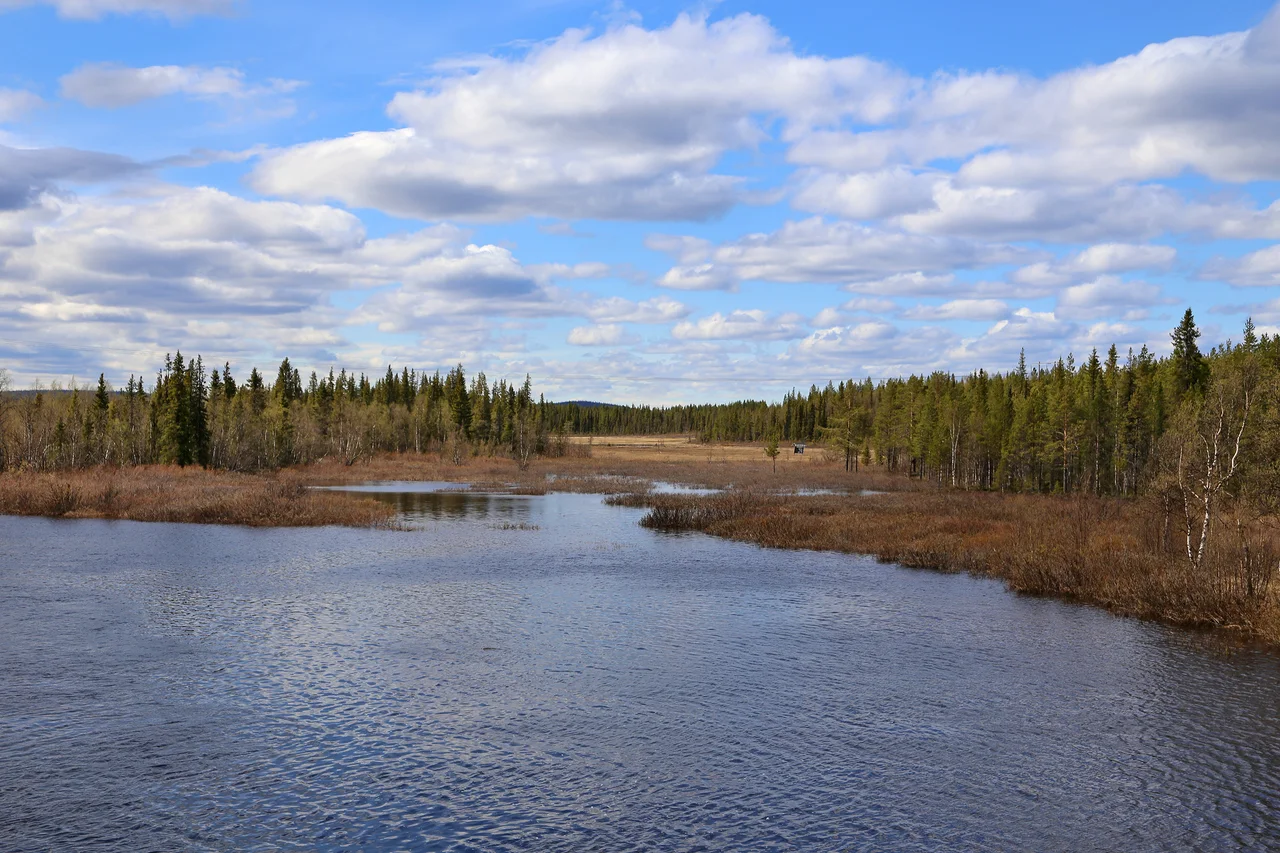
Swedish Lapland spans the inland and mountain west of Norrbotten and Västerbotten counties, from roughly 64°N to beyond 69°N; the reference point here is 65.929°N, 16.743°E. It is 109,702 km² of terrain with almost no cultural lighting between towns, which makes natural features the primary reference: the mountain chain along the Norwegian border, Kebnekaise (Sweden's highest mountain), the U-shaped glacial gap of Lapporten near Abisko, and the long lakes of Torneträsk, Hornavan and Storuman. Terrain in the west rises above 2,000 m; the inland plateau runs 300–600 m. For sightseeing, 8,000–12,000 ft MSL suits the interior, more in the mountains. Airports: Kiruna (ESNQ, elev. 460 m) in the far north, Hemavan (ESUT, elev. 458 m) and Storuman (ESUD, elev. 279 m) in the west and centre, Lycksele (ESNL, elev. 215 m) and Vilhelmina (ESNV, elev. 350 m) in the south. Plan for extreme winter cold, rapid orographic cloud on the Norwegian frontier, near-continuous daylight in June and only brief civil twilight in December.
Nearby Stories
- Adolfström 1.9 km away
- Vindelfjällen Nature Reserve 17 km away
- Nasa Silver Mine 41 km away
- Matsdal 46 km away
- Storuman (lake) 56 km away
- Kungsleden 79 km away
- Kallak Mine 121 km away
- Gammelstad Church Town 220 km away