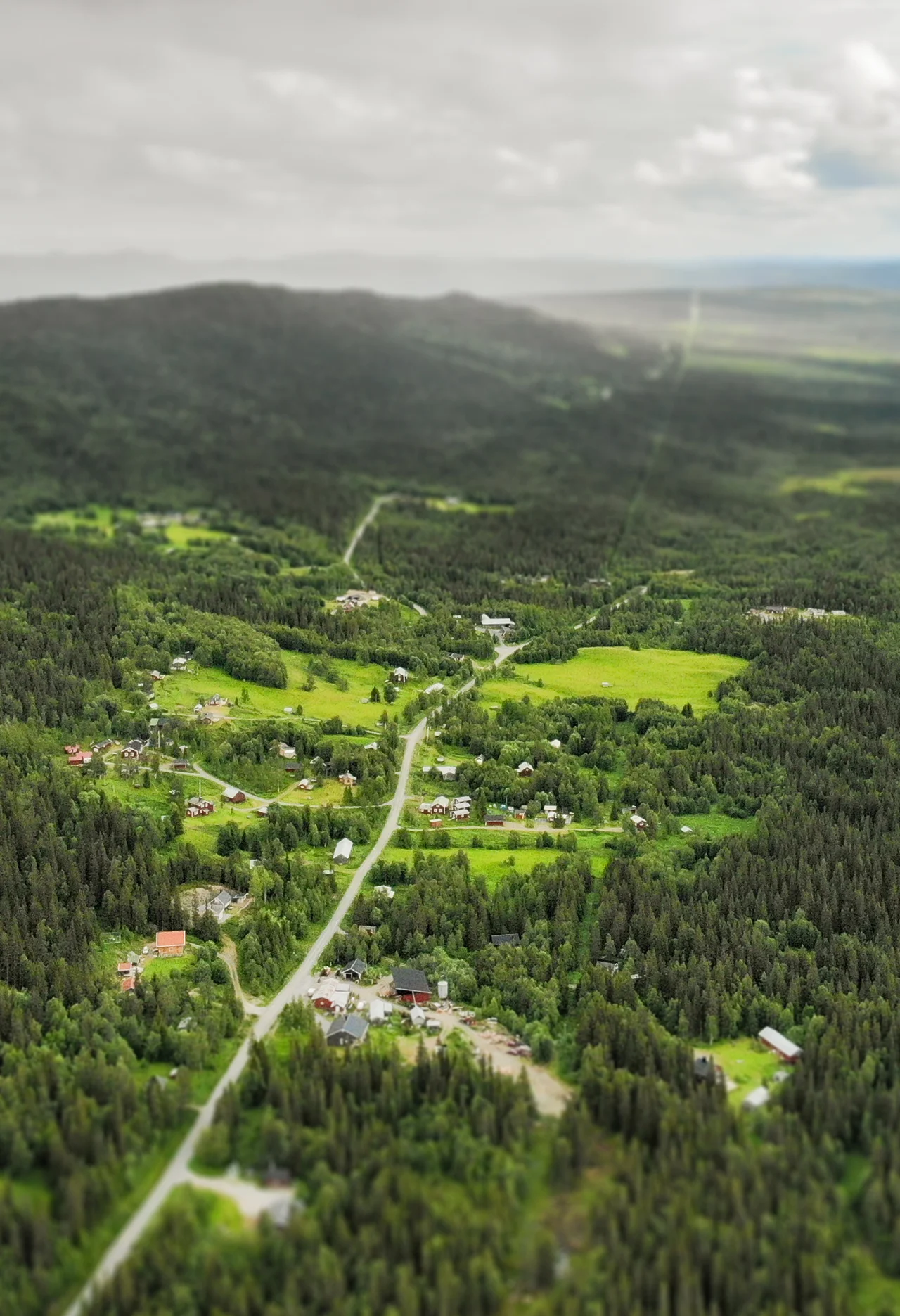

Matsdal
On 30 November 1825, at the northern end of Lake Volgsjön, a fifty-six-year-old former soldier from Dalarna froze to death. Mattias Hansson Bjur had spent the best part of twenty years walking north — out of a village in Bjursås parish, through a sawmill season in Ångermanland, through seven years in Resele — to reach a valley in the Lapland fells that no crown surveyor had yet written down. He had lived in it for eight years. The bay where he died carries his name now, Bjurviken, and the valley he cleared carries his: Matsdal.
The Inspection Nobody Attended
The paperwork tells a quieter story than the winter did. On 18 June 1817, the crown district police chief Nils Petter Degerman came up the valley with two jurymen and measured what a settlement would need — dwelling, arable ground, forest. The land was not empty. It formed part of the taxed holding, the lappskatteland, of a Sámi man named Sjul Andersson, and under that system the crown both recognised his claim and collected from it. Andersson could not be found on the day. Degerman wrote in his report that Andersson probably had no objection, reasoning that there was no fishing water close by and that no complaint had been lodged. On 1 September the county authority in Västerbotten issued its decree, and the valley became a settler's. What survives of Sjul Andersson in the record is his absence and another man's guess about what he would have said. Sámi households had been herding reindeer across these fells for generations — documents from 1739, and Major Peter Schnitler's border examinations of 1742–45, record them here.
Eleven Years in the Hälsinge Regiment
Mattias Bjur was born on 26 December 1768 in Sörskog, a village in Bjursås parish. At twenty-one he took the soldier's path that poor men took, enlisting with the Ovansjö Company on 15 September 1790, and he served the Hälsinge Regiment for eleven years until a knee injury and the illness that followed it forced his discharge on 10 September 1801. Then the walking began. He and Elisabet Andersdotter and their sons Hans and Anders moved north in stages, pausing around 1806 at the Håknäs sawmill, where a daughter was born; settling in Resele around 1809; staying until 1816. When the family finally reached Vilhelmina parish in 1817 and stopped at a place then called Lillkittelfjäll, the parish books note that the community had not sanctioned their arrival. The likeliest reason is the plainest one: they were too poor to be welcome. By the time the cold took him eight years later, the holding he had cleared was already divided between his son Hans and his daughter Elisabet.
Eleven Kilometres Between Two Fells
Matsdal is less a village than a line drawn along a valley floor. It runs roughly eleven kilometres from Kanan in the north to Södra Matsdal in the south, pressed between the Northern and Southern Gardfjället massifs, whose highest point, Gälta, stands at 1,308 metres. South of Kanan, a stream called Bullerbäcken drops into a ravine and then into a narrow canyon walled with cliff, where the Bullerfallen falls have worn a basin so smooth and so round it looks turned on a lathe. Below the canyon lie fields of stone that glacial meltwater rolled and polished. Further down still, where the valley opens out, the river frays into a delta of braided channels. Everything here is the leftover work of moving water and moving ice, and the mountainsides above are steep, scree-choked and largely unwalkable.
Klip
The fell tops are stripped down to bare rock. The Sámi word for that exposed stone, klip, is the root of the older name for these heights — Klipfjäll, Klipentjahke — and it describes them exactly. In 2022 the county administrative board placed 38,886 hectares of Södra Gardfjället under protection as a nature reserve, and the reasoning was cultural as much as natural. Mountain birch forest, mires, willow thickets and clear water are only half of it; the other half is a landscape shaped by reindeer herding over millennia, dense with archaeological sites from many different periods. Walk it and you cross the outlines of settlements long abandoned and enclosures where herds were once gathered, along with the foundations of farms and cottages that families built and then gave up during the twentieth century. Two waves of leaving, laid over one another.
A Valley of Locked Doors and Open Seasons
The permanent population has never been large and is smaller now. What has grown instead is the seasonal one: a substantial share of the houses in the valley are holiday properties, occupied in bursts. People come for the fishing waters, for the snowmobile trails that thread the fells in winter, and for hiking routes in the brief, bright summer. It is a familiar arithmetic across inland Lapland — the year-round village shrinks while the number of beds rises — and Matsdal has followed it without ever becoming a resort. The valley Mattias Bjur reached on foot is now reached by road in an afternoon, and most of the people who arrive will leave again within a week.
From the Air
Matsdal lies at 65.3466°N, 15.8628°E, strung along a valley in Vilhelmina Municipality, Västerbotten County, about 10 nm northeast of Kittelfjäll. The valley runs roughly north–south for 11 km between the Northern and Southern Gardfjället massifs; Gälta, the high point of the northern fell, reaches 1,308 m (4,291 ft), and the surrounding summits are bare rock above the birch line, making them easy to identify. Plan on 7,000–9,000 ft MSL for a clean look at both the valley floor and the flanking scree slopes. The 38,886-hectare Södra Gardfjället reserve spreads south and west. Nearest fields: Vilhelmina (ESNV, elev. 350 m) about 50 nm southeast, Hemavan (ESUT, elev. 458 m) about 35 nm northwest, and Storuman (ESUD, elev. 279 m) to the east. Subarctic conditions apply — rapid cloud build-up against the fells, mechanical turbulence in the valley on windy days, and severe winter cold.
Nearby Stories
- Storuman (lake) 14 km away
- Hemavan 32 km away
- Vindelfjällen Nature Reserve 38 km away
- Lapland (Sweden) 42 km away
- Stekenjokk 53 km away
- Stora Blåsjön 69 km away
- Lapplandsleden 89 km away
- Umeå City Fire 225 km away