
The Museum That Survived Its Own Air Base
Somewhere on the outskirts of Sacramento, in a building that was once part of a military installation the federal government decided it no longer needed, sits a jet engine that used to push the fastest aircraft ever built past Mach 3. The Pratt & Whitney J58 turbojet on display at the Aerospace Museum of California was the power behind the SR-71 Blackbird, a reconnaissance plane that flew so fast its titanium skin expanded several inches from friction heat at cruising speed. The engine sits in a row with others -- a World War I-era Gnome rotary, a massive radial piston, a J57 from 1952 -- arranged like a timeline of human obsession with going faster, higher, further. This is not the Smithsonian. It is a nonprofit museum on the grounds of a closed Air Force base, and the fact that it exists at all is its own kind of improbable story.
Born on a Base, Orphaned by Budget Cuts
McClellan Air Force Base opened northeast of Sacramento in 1936 and spent six decades as a major logistics and maintenance hub for the U.S. Air Force. In 1982, a group of aviation enthusiasts and military veterans founded a small museum on the base, initially named the Air Force Logistics Museum of the West. Within a year, it was rechristened the McClellan Aviation Museum. The National Museum of the United States Air Force in Dayton, Ohio, granted it a charter, and volunteers began refurbishing an abandoned building to house a growing collection of aircraft, engines, and military artifacts. The museum opened to the public in 1986. Then the base closure process caught up with it. In 1998, McClellan was slated for shutdown under the Base Realignment and Closure program, and the museum faced a deadline: find a new home or lose everything.
Saving the Collection
The base officially closed in 2001, and with it went the museum's building, its utilities, and its location. But the collection survived. The U.S. Air Force transferred the majority of its aircraft to the newly incorporated Aerospace Museum of California as indefinite loan items -- a legal arrangement that kept ownership with the military but gave the museum custody. The planes were safe on paper, but they still sat on land the museum no longer controlled. Securing a new site proved agonizing. The museum looked to purchase property in nearby Freedom Park, hired a new director, and announced plans for a permanent facility. In 2005, it adopted its current name. On January 5, 2007, the museum finally opened the Hardie Setzer Pavilion, a 37,500-square-foot exhibit hall, alongside a 4.5-acre outdoor Air Park. The years of uncertainty had cost momentum, but the collection had grown rather than shrunk.
Wings Across a Century
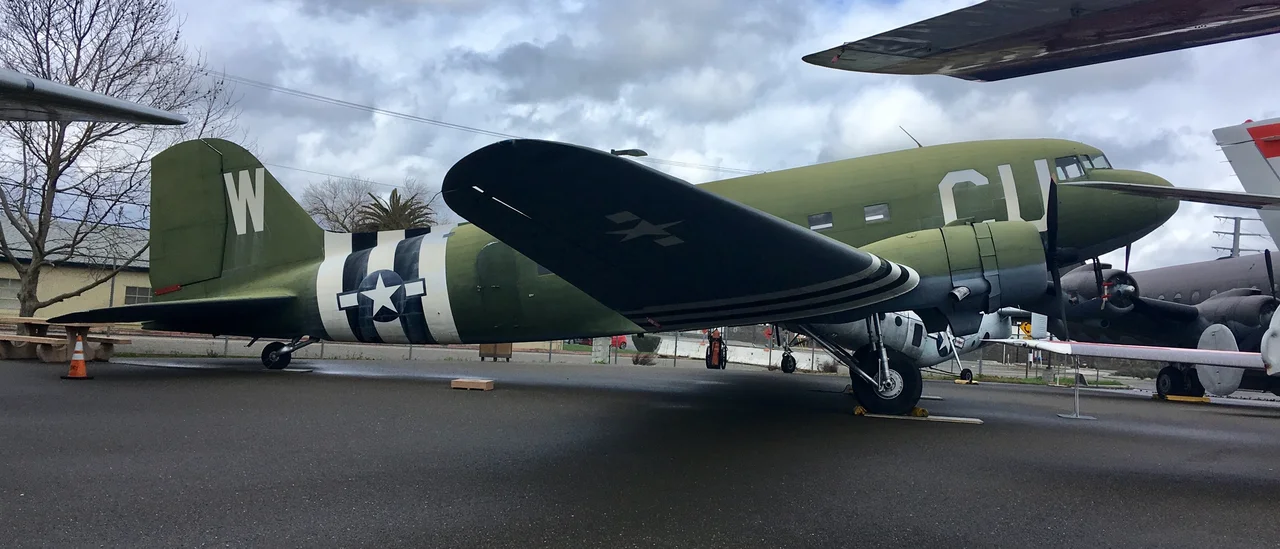
The museum's collection spans the full arc of powered flight. More than 40 aircraft sit in the Air Park and exhibition hall, ranging from a fully restored Fairchild PT-19 trainer -- the open-cockpit biplane that taught thousands of cadets to fly during World War II -- to one of the last Grumman F-14D Tomcats retired from U.S. Navy service in 2006. Between those bookends stand Cold War interceptors like the Convair F-106 Delta Dart, Vietnam-era workhorses like the Douglas A-1E Skyraider, and a FedEx Boeing 727 freighter that represents commercial aviation's own evolution. The museum also holds a MiG-17 and a MiG-21, Soviet-designed fighters that once squared off against American jets over North Vietnam. An art gallery houses more than 50 original works from the Air Force Art Collection and the United States Coast Guard Art Collection, paintings that document military aviation from a perspective no photograph can capture.
The Engine Room of Innovation
If the aircraft tell the story of what flight accomplished, the engine collection tells the story of how. The museum's lineup begins with a Gnome rotary piston engine from the World War I era, a design so early that the entire engine block spun around a fixed crankshaft, using centrifugal force for fuel distribution. From there, the collection moves through the massive radial engines that powered bombers and transports in World War II, then into the jet age. A General Electric I-16 from 1940 -- built to a design by Frank Whittle, the British engineer who invented the turbojet -- represents the dawn of jet propulsion. The J57 number 35 from 1952 powered everything from B-52 bombers to the U-2 spy plane. And then there is the J58, the engine built for the Blackbird. Each engine in the row is a solved engineering problem, a moment when someone figured out how to wring more thrust from combustion, and together they form an argument that the real story of aviation is not in the airframes but in the power plants that made them possible.
Sacramento's Quiet Aerospace Legacy
Sacramento does not usually appear on lists of great aviation cities. It lacks the mythology of Kitty Hawk or the glamour of Edwards Air Force Base. But McClellan and its sister installation, Mather Air Force Base, anchored a regional aerospace economy for decades. McClellan alone employed thousands of civilians and military personnel in aircraft maintenance and logistics. When the base closed, that infrastructure dispersed, but the Aerospace Museum of California kept the memory operational. In 2021, it opened the Old Crow Cafe on its grounds, named for the bourbon favored by World War II fighter pilots. The museum's stated mission focuses on STEM education, aiming to give 30,000 Sacramento-area children hands-on exposure to science and engineering regardless of their background. It is a modest ambition for a museum that houses a jet engine capable of accelerating a 170,000-pound aircraft past three times the speed of sound. But then, modesty has always been part of the story here -- a collection that nearly died, saved by people who refused to let it go.
From the Air
Located at 38.68N, 121.39W on the grounds of the former McClellan Air Force Base in McClellan, California, northeast of Sacramento. The museum's 4.5-acre Air Park with over 40 aircraft is visible from low altitude. The former base's runways and infrastructure remain partially intact and serve as a visual landmark. Nearby airports include Sacramento McClellan Airport (KMCC) on the former base grounds, Sacramento Executive Airport (KSAC) approximately 10nm south-southwest, and Sacramento Mather Airport (KMHR) approximately 10nm south-southeast. Sacramento International Airport (KSMF) lies approximately 12nm west-northwest. The museum sits in the flat Sacramento Valley, with the Sierra Nevada foothills visible to the east on clear days.
Nearby Stories
- Twenty Rounds in a Grandmother's Backyard 1.7 km away
- Sutter's Mill 5.9 km away
- The Siege at Lindhurst 9.1 km away
- The Warehouse on Oakdale Road 9.8 km away
- Where a Quarter Million Wings Converge 16 km away
- Gold Country 16 km away
- The Night Napa Burned 25 km away
- Malakoff Diggins State Historic Park 38 km away