.jpeg)
The Warehouse on Oakdale Road
Three days before the Fourth of July, the fireworks went off early. At 5:50 p.m. on July 1, 2025, firefighters responded to a fire at a warehouse on the outskirts of Esparto, a small agricultural town in Yolo County about 30 miles west of Sacramento. Within an hour, the situation had moved beyond anyone's control. Small explosions crackled through the structure as flames reached one cache of pyrotechnics after another. Then, at roughly 7 p.m., the warehouse detonated in a single massive blast that sent debris arcing across the surrounding farmland and ignited spot fires in the dry grass. The smoke was visible from space. Seven men who had been working inside were killed.
An Evening Turned Catastrophic
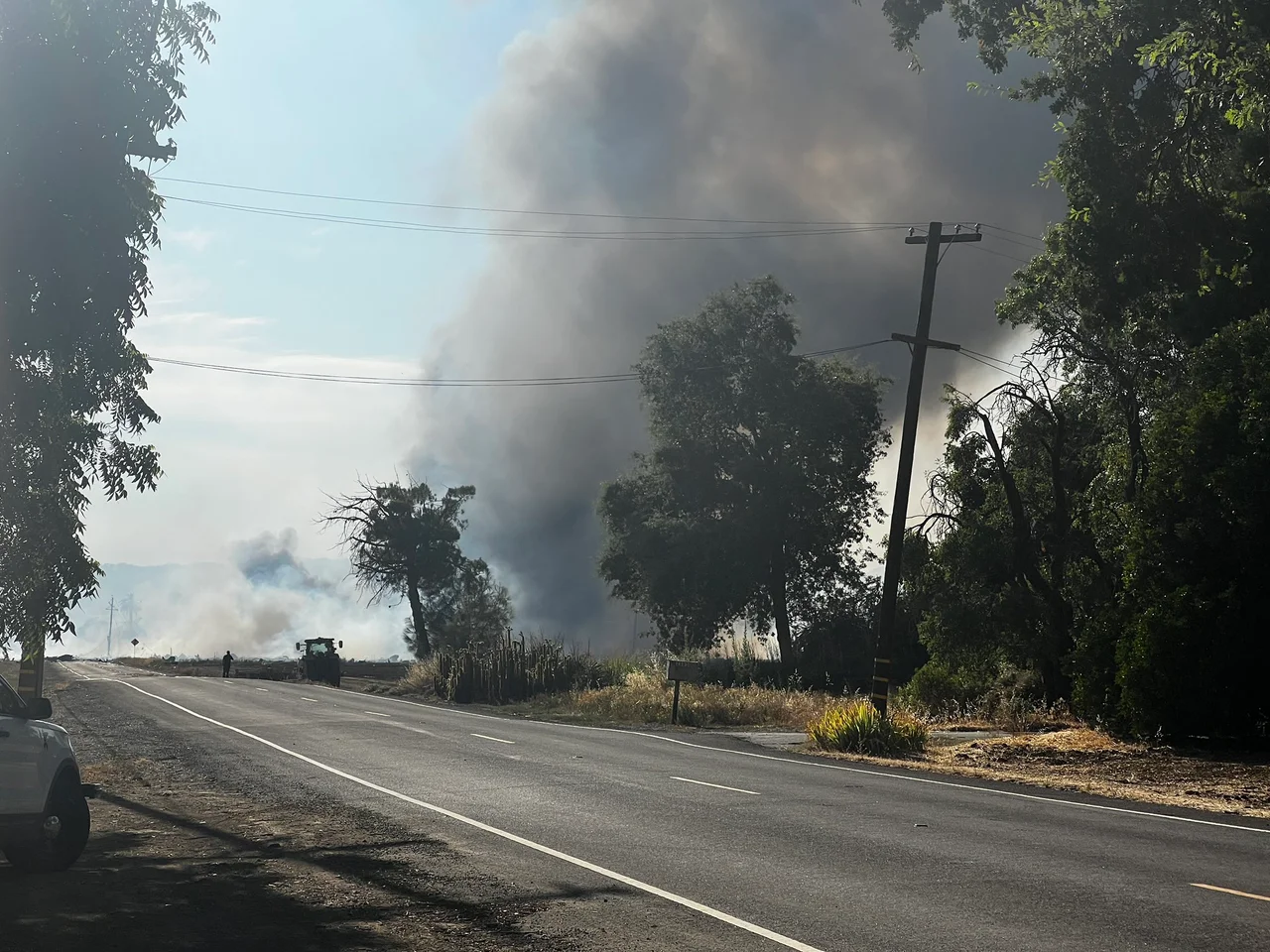
Helicopter footage from KCRA-TV captured the progression in real time: thick black smoke pouring from a property that included the warehouse, two houses, and several vehicles, all engulfed. Bright sparks shot from the structure in bursts, each one a smaller detonation as the fire burned through stored fireworks inventory. The culminating explosion at 7 p.m. was of a different order entirely. It flattened the warehouse, destroyed two to three nearby homes, and damaged several more. Burning debris rained across the area, igniting the Oakdale Fire, which by the following night had grown to 78 acres with no containment. CAL FIRE would not achieve full containment until July 6. Residents of Esparto and the neighboring community of Madison were placed under evacuation orders as the fire spread through the surrounding landscape.
Seven Men Who Did Not Come Home
In the hours after the explosion, seven men were reported missing. Two additional workers survived with injuries. As recovery crews sifted through the devastated site -- now designated a crime scene -- the scope of the loss became clear. Family members and friends publicly identified four of the workers: brothers Jesus Ramos, 18, and Jhony Ramos, 22, along with 28-year-old Junior Melendez. The Yolo County coroner's office confirmed all seven victims' identities in a press release on July 11. These were men who had been handling fireworks in a warehouse on a Tuesday afternoon, performing the manual labor that puts pyrotechnics into the hands of celebrations across California. Dozens of cities canceled their Fourth of July fireworks displays in the aftermath, a grim acknowledgment that the holiday's raw materials had already exacted their cost.
Questions About the Property
The investigation that followed raised uncomfortable questions about how the warehouse had come to operate where it did. CAL FIRE led the probe, with the Bureau of Alcohol, Tobacco, Firearms and Explosives called in for assistance. KCRA-TV reported a significant complication: the property where the explosion occurred was owned by a Yolo County Sheriff's lieutenant named Machado. Blackstar Fireworks had been operating adjacent to Machado's home. A separate company, Devastating Pyrotechnics, held permits to store fireworks in containers roughly 2,000 feet from the blast site -- far from the actual explosion. The California State Fire Marshal's office disclosed that local jurisdiction had not permitted the facility. The San Francisco Chronicle reported that the owner of the fireworks company linked to the explosion had been denied a federal license.
Regulatory Reckoning
The Esparto explosion forced California to confront gaps in its fireworks oversight. In August 2025, the General Fireworks Advisory Committee of the State Fire Marshal's office convened to review the incident and hear details about legislative reforms. State Senator Christopher Cabaldon introduced legislation in response, targeting the regulatory patchwork that had allowed a warehouse full of explosives to operate without proper local permitting on a property entangled with law enforcement connections. The tragedy fit a pattern familiar in industrial disaster investigations: a facility operating in a gray zone between jurisdictions, with permits that did not quite cover what was actually happening on site, and oversight that arrived only after the damage was irreversible. For Esparto, a community of fewer than 4,000 people, the explosion left a crater that was both literal and civic -- a scar on the landscape and a breach in the trust that small towns place in the assumption that someone, somewhere, is making sure the dangerous things are stored safely.
From the Air
The explosion site is located at approximately 38.674N, 122.018W, on the rural outskirts of Esparto in Yolo County. Esparto sits in the flat agricultural land between the Sacramento Valley floor and the eastern foothills of the Coast Ranges. University Airport (KEDU) in Davis is approximately 15nm east-southeast; Sacramento Executive (KSAC) is roughly 25nm east. From 2,000-3,000 feet AGL, the town of Esparto is visible as a small grid of streets amid vast agricultural parcels, with County Road 21 and State Route 16 serving as primary identifiers.
Nearby Stories
- Sutter Hock Farm 2.9 km away
- Feather River 3.2 km away
- Where Carlin Took His Last Bow 4.7 km away
- The Geysers: Earth's Steam Engine 5.5 km away
- Clear Lake: California's Ancient Inland Sea 12 km away
- The Night Napa Burned 13 km away
- Twenty Rounds in a Grandmother's Backyard 15 km away
- Where a Quarter Million Wings Converge 18 km away