
The Geysers: Earth's Steam Engine
There are no actual geysers at The Geysers. The name is a misnomer that has stuck since the nineteenth century, when visitors mistook the roaring fumaroles and billowing steam vents of the Mayacamas Mountains for the erupting columns of water they had read about in Yellowstone. What this place actually offers is something rarer: a dry steam field, one of only a handful on Earth, where superheated vapor rises directly from rock heated by a magma chamber more than four miles beneath the surface. For 12,000 years, people have found uses for that steam. The Pomo, Wappo, and Lake Miwok peoples built steam baths and thermal pools here for healing, ceremony, and cooking. Today, 18 geothermal power plants draw from more than 350 wells across these ridges, producing roughly 20 percent of California's renewable energy. The Geysers is the world's largest developed geothermal field, and its story spans from indigenous medicine to industrial electricity -- with a presidential spa resort in between.
Twelve Thousand Years of Steam
Long before European Americans arrived in the Mayacamas, six native tribes inhabited the area around The Geysers: three bands of Pomo people, two bands of Wappo people, and the Lake Miwok. They understood the thermal landscape intimately. The steam vents and hot pools served as natural medicine -- the heated water treated rheumatism and arthritis, while mud from the fumaroles soothed skin ailments and aches. These were not casual uses. The thermal features were woven into spiritual and ceremonial life, and the cooking potential of naturally heated water and steam made the area a practical resource as well. When European Americans arrived in the mid-nineteenth century, they found a landscape already deeply integrated into indigenous culture, a place where the earth's heat had been a companion to human life for millennia.
The Presidents' Spa
Between 1848 and 1854, Archibald C. Godwin saw commercial potential in the same steam that had drawn indigenous peoples for thousands of years. He developed The Geysers Resort Hotel, a spa that traded on the area's otherworldly landscape of hissing vents and mineral-laden pools. The guest list grew impressive: Ulysses S. Grant visited, as did Theodore Roosevelt and Mark Twain. For a few decades, the resort thrived as a destination for wealthy San Franciscans seeking curative waters and mountain air. But fashions shift. By the mid-1880s, the resort's popularity had waned, and management rebranded to appeal to less affluent visitors. The spa era faded, but it had introduced the outside world to the thermal energy beneath these mountains -- energy that would prove far more valuable than any resort admission fee.
Tapping the Magma Chamber
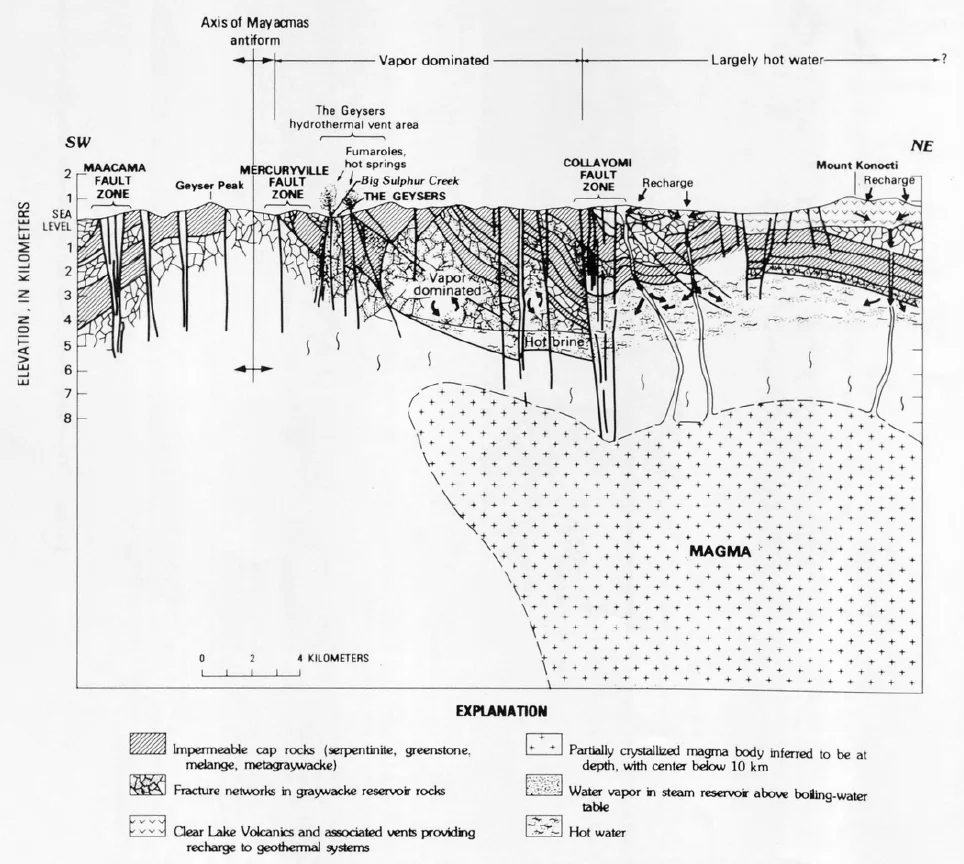
The geology beneath The Geysers reads like science fiction made real. Gravitational and seismic studies suggest that the heat source is a silicic magma chamber more than eight miles in diameter, sitting four miles underground. Steam rises through a greywacke sandstone reservoir, capped by a heterogeneous mix of low-permeability rocks that trap the vapor like a pressure cooker's lid. Unlike most geothermal resources worldwide, The Geysers produces dry superheated steam rather than a mixture of steam and water -- a characteristic that makes electricity generation more straightforward. The first geothermal wells drilled in Geyser Canyon were the first in the Western Hemisphere. The original turbine ran for more than 30 years, producing 11 megawatts of net power. By the early 2000s, Calpine -- the largest generator of electricity from natural gas and geothermal resources in the United States -- operated the majority of the field's plants.
Running Low on Steam
Success brought its own problems. By 1999, decades of extraction had begun depleting the steam reservoir, and production dropped. The solution was inventive: treated wastewater, piped up to 50 miles from Lake County sanitation plants, is now injected into the geothermal field to replenish the steam supply. The process works, but it comes with a side effect. The injection of water into hot, fractured rock causes small earthquakes -- dozens per day, mostly below magnitude 2.0, rarely felt by anyone. An estimated 99 percent of seismic events at The Geysers measure 3.0 or smaller, and the frequency of events above 3.0 has trended downward since 1990. Before 1969, no earthquakes above magnitude 2 had been recorded in the roughly 70-square-mile area around the field. Scientists at Lawrence Berkeley National Laboratory have confirmed that the seismicity is induced by the injection process, but they consider a large earthquake unlikely given the absence of major faults nearby.
Fire and Resilience
The Geysers has weathered more than geological tremors. In September 2015, the Valley Fire damaged five of the field's facilities, causing severe harm to cooling towers while leaving the main powerhouses intact. Four years later, the Kincade Fire ignited at John Kincade Road and Burned Mountain Road within The Geysers complex itself, at 9:24 p.m. on October 23, 2019. That blaze went on to burn nearly 78,000 acres of Sonoma County. Yet the geothermal field persists. From the air, the cleared pads and steam plumes of The Geysers are visible against the forested ridgelines of the Mayacamas, 72 miles north of San Francisco -- a reminder that beneath the fire-prone surface of Northern California, a reservoir of energy has been building pressure for millions of years, indifferent to the flames above.
From the Air
Located at 38.78N, 122.76W in the Mayacamas Mountains, approximately 72 miles north of San Francisco. The geothermal field spans ridgelines between Sonoma and Lake counties. From the air, cleared well pads, pipeline corridors, and steam plumes from cooling towers are visible against the forested terrain. Sonoma County Airport (KSTS) is approximately 20nm south; Lampson Field (1O2) in Lakeport is roughly 20nm northwest. The terrain is mountainous with elevations ranging from 1,500 to 4,000 feet. Be aware of thermal updrafts and mountain weather conditions. Best viewed at 4,000-6,000 feet AGL on clear days when steam plumes are most visible against the dark forest.
Nearby Stories
- The Laguna de Santa Rosa: Sonoma County's Hidden Sea 3.9 km away
- The Valley That Invented Its Own Language 4.9 km away
- Clear Lake: California's Ancient Inland Sea 5.7 km away
- The Sea Ranch 6.8 km away
- The Bottle That Humbled France 11 km away
- Rico Harris 17 km away
- Where a Quarter Million Wings Converge 30 km away
- ʻAkaka Falls State Park 3685 km away