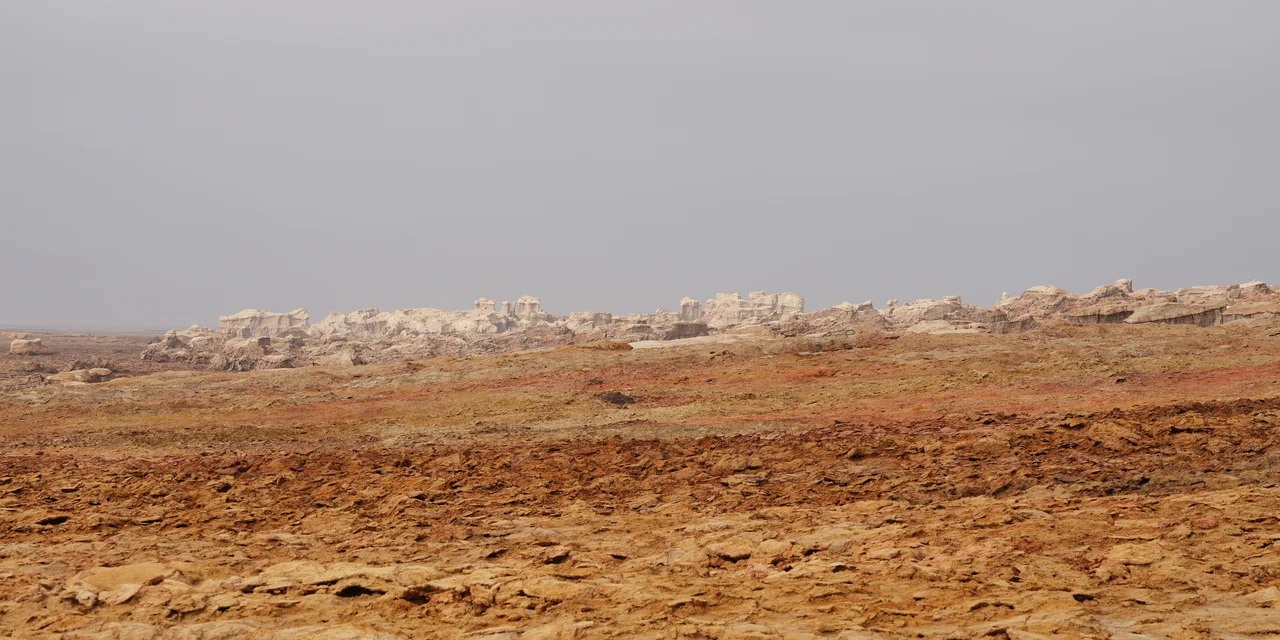

Afar Triangle
Lucy walked here. More precisely, she walked near the Awash River, in what is now the Afar Region of Ethiopia, about 3.2 million years before any paleoanthropologist named her. When her fossilized skeleton was found in 1974 at a place called Hadar, she was the most complete early human ancestor ever recovered, and she made a strong case that our lineage started upright in the Rift Valley. Two decades later, just up the river at a site called Aramis, Tim White and his team found something older still - Ardi, Ardipithecus ramidus, 4.4 million years old, a female who represents one of the earliest known stages of the human family tree. Both fossils came out of the same geological oddity: the Afar Triangle, the place where a continent is coming apart.
A Continent Breaking
Three tectonic plates meet in the Afar region, and none of them want to stay put. The Arabian plate is drifting north-eastward at roughly 20 millimeters per year, pulling away from Africa. The Somali plate is sliding east, more slowly - about 5 millimeters per year - relative to the bulk of the Nubian (African) plate. Where they meet is the Afar triple junction, a depression that dips as low as 155 meters below sea level at Lake Assal in Djibouti, the lowest point on the African continent. The Red Sea rift feeds in from the north, the Gulf of Aden rift from the east, and the East African Rift System runs south for more than 6,000 kilometers from here to Mozambique. Geologists predict that in about ten million years, this entire length will flood and become a new ocean basin.
Hottest on Earth
Dallol, in the northern Afar Depression, holds the record for the hottest year-round average temperature of any inhabited place on Earth. Observations from 1960 to 1966 recorded daily mean temperatures ranging from 30°C in January to 39°C in July. Rain falls in millimeters per year, with even less closer to the coast. The Awash River provides the main waterflow into the region, running northeastward through the southern Afar before ending - not at the sea, but in a chain of evaporating salt lakes. About 1,200 square kilometers of the depression is covered in salt deposits, and salt mining has been a major source of income for Afar nomads for centuries. Camel caravans still carry slabs of mined salt out of the low desert to the highlands, a trade route as old as writing.
The Cradle
The Afar Triangle contains what some paleontologists consider the most important fossil beds for human evolution on Earth. The Middle Awash region alone has yielded Ardi, Lucy, the fossilized Australopithecus child named Selam from Dikika, the Gawis cranium from Gona, and some of the oldest known stone tools. The geological combination is extraordinary: active volcanism deposits ash layers that can be radiometrically dated, lakes create sedimentary beds where bones can be preserved, and erosion from rift faulting exposes those beds for modern excavators to read. Where the rifting is fastest, the fossils are cleanest. For fifteen years after her discovery, Ardi's skeleton was so fragile that researchers worked on excavation, preservation, and description before formal publication in 2009. Her foot still had an opposable toe. She could climb and walk both.
Life in the Depression
The Afar biome is harsh desert scrubland, and the wildlife has adapted accordingly. Grévy's zebras still roam here. Soemmerring's gazelles and beisa oryx survive in the drier zones. Most remarkably, the Afar Triangle contains the last viable population of the African wild ass, Equus africanus somalicus - the ancestor of all domesticated donkeys, now critically endangered and clinging to a few protected areas including the Mille-Serdo Wildlife Reserve in the southern plains. Birds include the ostrich, the endemic Archer's lark, and the Abyssinian roller with its cobalt wings. The Afar people themselves - nomadic pastoralists after whom the region is named - move seasonally across this landscape with their herds, a way of life shaped by the same water scarcity that killed so many domesticated species in other parts of the Horn of Africa.
The Ocean to Come
In 2005, a swarm of earthquakes and volcanic activity hit the Dabbahu volcanic complex in central Afar. Over just two weeks, the ground opened in a rift segment sixty kilometers long; up to eight meters of extension occurred, and 2.5 cubic kilometers of lava intruded the crust. Magma welled up through the dikes, some of it erupting at the surface, some of it freezing underground as an intrusion that effectively grouted the crack with fresh basalt. Geologists call this magma-compensated thinning, and it explains why central Afar - despite all its stretching - has not yet thinned to the point of producing normal oceanic crust. The new seafloor is waiting. The Afar Triangle is, as one Science News article put it, the death of a continent and the birth of an ocean. For the moment, it is also home - to Afar people, to wild asses, to fossilized ancestors we share a pelvis with.
From the Air
Coordinates: 11.500°N, 41.000°E. The Afar Triangle sprawls across the borders of Ethiopia, Eritrea, and Djibouti. From altitude, the region is unmistakable: a vast low-lying depression flanked by the Ethiopian Highlands to the west and the Danakil block to the northeast, with salt lakes, young volcanoes (including Erta Ale's lava lake), and strikingly colored hydrothermal fields at Dallol. Nearest airports: Djibouti-Ambouli (HDAM) to the east, Dire Dawa (HADR) in Ethiopia, Massawa (HHMS) in Eritrea. Recommended cruising altitude 10,000+ feet for the full rift structure; lower altitudes reveal extraordinary salt formations and volcanic terrain.
Nearby Stories
- Lake Abbe 34 km away
- Wollo Province 47 km away
- Adal Sultanate 92 km away
- Lake Assal (Djibouti) 103 km away
- Djibouti 103 km away
- Lalibela 153 km away
- Awash National Park 255 km away