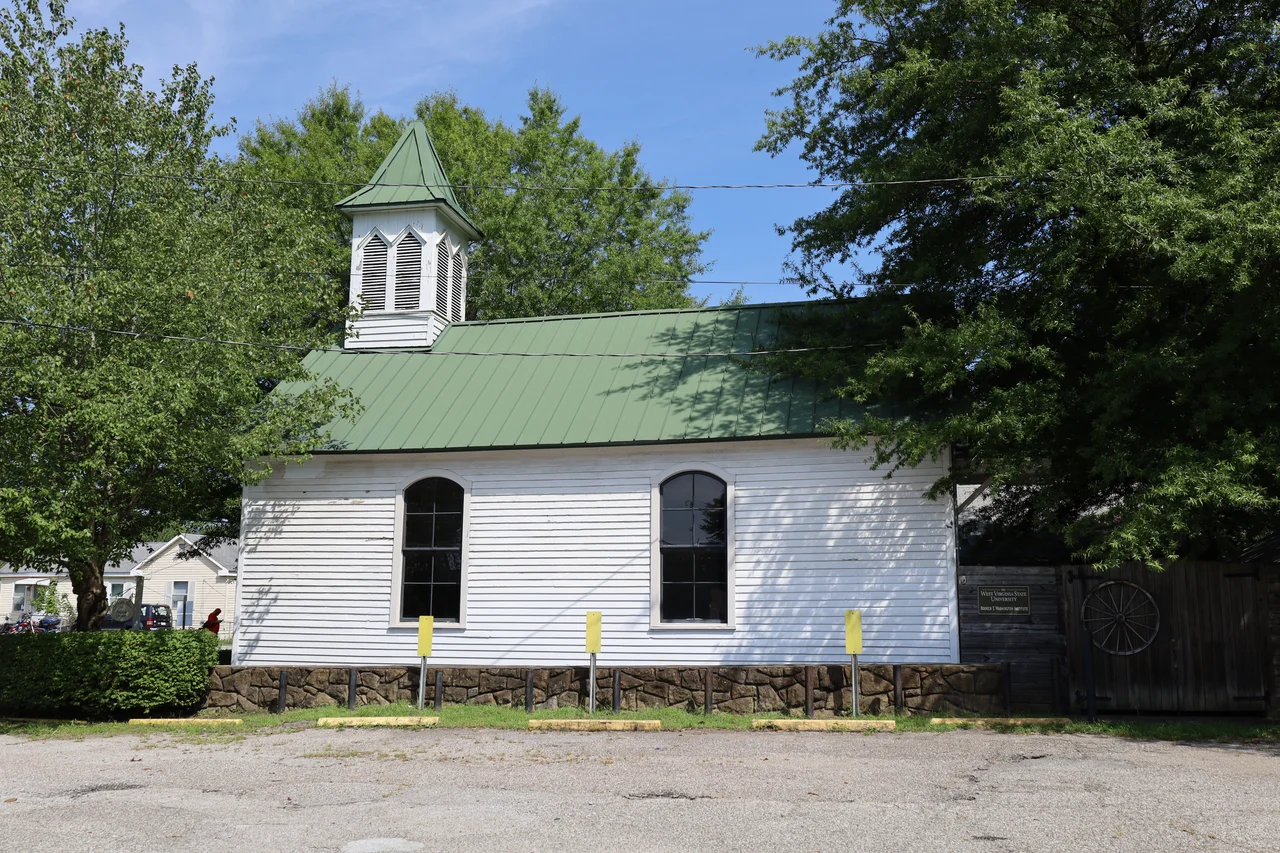

African Zion Baptist Church
Booker T. Washington was nine years old when his family was freed from slavery in Virginia and walked the long road over the mountains to Malden, West Virginia, where his stepfather had found work in the salt furnaces and coal mines along the Kanawha River. The Washingtons settled in a Black community that was growing rapidly through the late 1860s and 1870s as newly free people sought wage labor in the postwar industrial economy. In that community, a man called Father Lewis Rice was building a church. The frame structure he and his congregation completed in 1872 - a single story on a stone foundation, with a gable roof and a small wooden bell tower - is the African Zion Baptist Church. Booker T. Washington worshipped here as a teenager. It is considered the mother church of African-American Baptists in West Virginia.
Father Lewis Rice
Lewis Rice was the founding pastor and the figure around whom the African Zion congregation organized in the years after emancipation. The honorific 'Father' was the title his congregation chose for him - a recognition of his role as both spiritual leader and community organizer. He led the church through its first decades, oversaw the construction of the present building, and was a leading voice in the Black community that gathered in Malden after the war. The community was largely composed of formerly enslaved people from Virginia and Kentucky who had migrated to the salt and coal works of the Kanawha Valley as wage workers. African Zion served not just as a religious gathering place but as a community center, mutual aid society, and political meeting hall.
Young Booker
Booker T. Washington's autobiography Up From Slavery describes his Malden years in detail. He worked in the salt furnaces as a child, then in the coal mines, and finally as a houseboy for the family of mine operator Lewis Ruffner. He attended the African Zion church with his family. He learned to read in a school that operated for a time in the church. When he set out for Hampton Institute in Virginia in 1872 - walking and riding most of the five hundred miles - he was leaving from this congregation and from Father Rice's pastoral influence. He returned to Malden during summer breaks from Hampton to teach in the Malden school. The route from Malden to Hampton Institute and then to Tuskegee Institute in Alabama, where Washington became the most prominent African-American leader of his generation, began here.
Mother of the Movement
The recognition of African Zion as the mother church of African-American Baptists in West Virginia is more than honorary. The congregation served as the organizational core from which other Black Baptist churches in the Kanawha Valley and across West Virginia derived their early structure, ordained their early ministers, and drew their early traditions. The Mt. Pleasant Baptist Association, the regional Black Baptist body, traced significant lineage back to African Zion. As Black Baptist congregations spread through the coalfields in the late nineteenth and early twentieth centuries - serving the company-town Black populations of McDowell, Mercer, and Logan counties - many of them maintained organizational and family ties to the Malden congregation that had first organized.
The Building
The 1872 frame structure remains substantially intact. It is a single-story wooden building on a stone foundation, with a gable roof topped by a modest square wooden bell tower. The interior is simple: rows of pews facing a raised pulpit, walls of unpainted or whitewashed planks. The Historic American Buildings Survey documented the structure in the twentieth century, and it was added to the National Register of Historic Places in 1974 as both an individually significant property and a contributing structure to the Malden Historic District. The congregation continues to worship in the building. The active church and the historic landmark coexist - this is a working congregation in a building old enough to be a museum, which neither replaces nor diminishes its religious function.
Flying Over the Kanawha Salt Towns
From the air, the African Zion Baptist Church is a small white frame structure among the houses and trees of Malden, a small unincorporated community along the Kanawha River about five miles east of Charleston. The Kanawha valley here is broad, with low ridges rising on either side and the river itself flowing past industrial sites and small towns. The remains of the nineteenth-century salt works that brought the Washington family to Malden are scarce on the landscape now but readable to a knowing eye - the historic district preserves several related structures. The church does not announce itself from cruising altitude, but its presence in this small community is a major piece of the cultural history of African Americans in Appalachia.
From the Air
Located at 38.30°N, 81.56°W on Malden Drive in Malden, West Virginia, about 5 nm east of downtown Charleston in the Kanawha River valley. The small frame church is part of the Malden Historic District. Nearest airport: Yeager Airport (KCRW) at Charleston about 6 nm west. The structure is too small to identify from cruising altitude; use Malden's location along the Kanawha River as orientation. Best photographed from 2,000-3,000 feet AGL where the historic district can be picked out.
Nearby Stories
- Summersville, West Virginia 5.8 km away
- Westsylvania 13 km away
- Toyota Motor Manufacturing West Virginia 13 km away
- Upper Big Branch Mine Disaster 14 km away
- Logan County, West Virginia 16 km away
- Hobet Coal Mine 18 km away
- Robey Theatre 26 km away
- Greenbrier County, West Virginia 36 km away