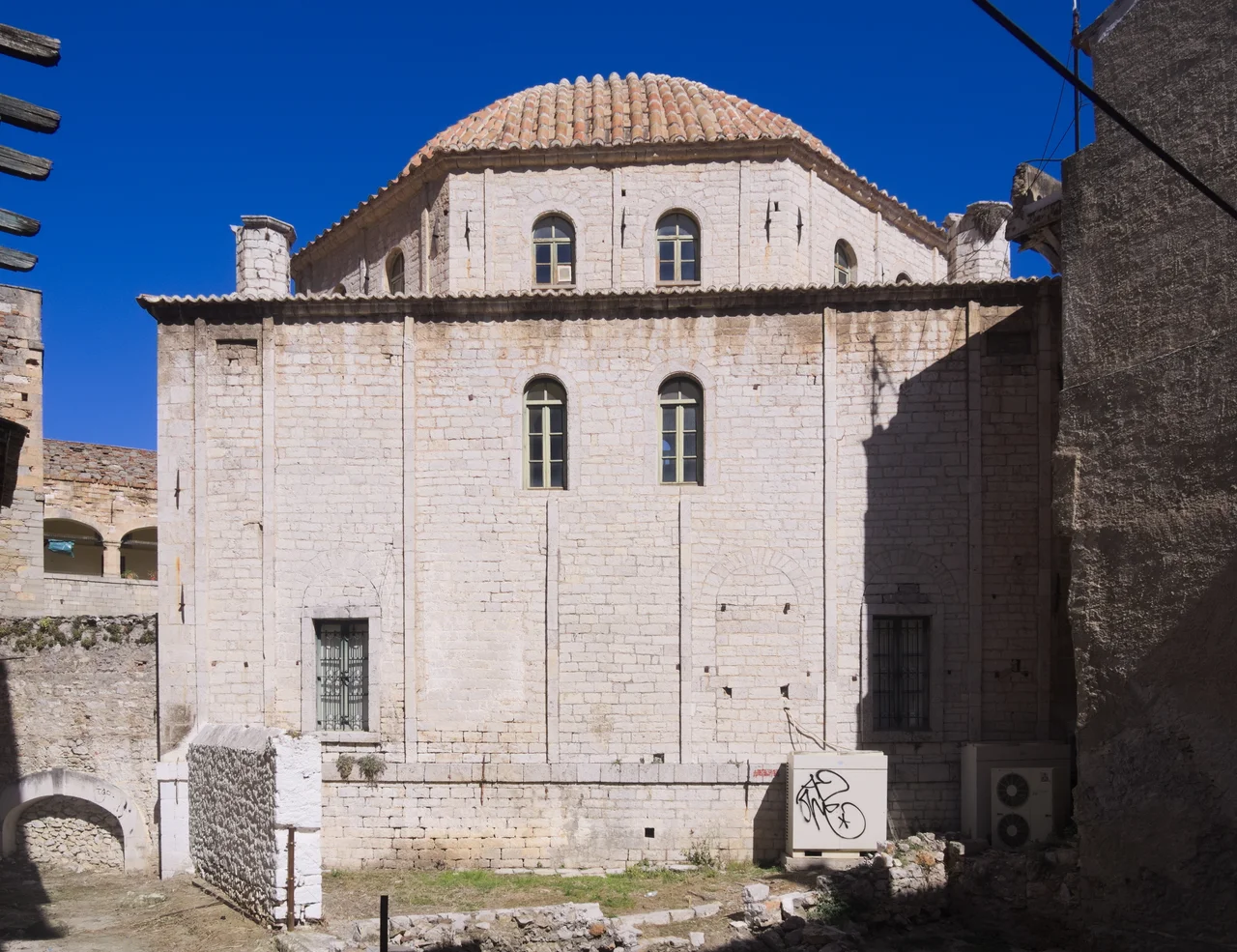

Agha Pasha Mosque
A mortar round ended parliamentary democracy here. On July 2, 1827, during fighting among rival revolutionary factions, a mortar struck the Agha Pasha Mosque — by then converted into Greece's first parliament — and killed the deputy Christos Gerothanasis where he sat. The building had been a parliament for less than two years. It had previously been a mosque, and before that, according to legend, the blood money of a murderer. Few buildings anywhere carry such a compressed weight of history.
A Legend Built on Blood Money
The mosque's origins are contested by historians, but local legend offers a darker and more compelling explanation than any archive. A Turkish agha, the story goes, discovered that two Venetian brothers had come to Nafplio following a map left by their father — a map pointing to a treasure hidden in the agha's own house. Rather than share it, the agha killed both men, kept the gold, and then, consumed by guilt, used the stolen wealth to build a mosque in the hope of purchasing divine forgiveness. He never saw it completed; he threw himself from a balcony before the work was done. Historians are more cautious. The mosque may be attributable to Ragıb Pasha, a provincial general who died in August 1820, with construction completed between 1818 and 1820 according to designs by the architect Antonios Rigopoulos. Other sources propose earlier dates of 1716 or 1730. The written record is sparse, the building altered too many times to reveal its own secrets.
From Minaret to Parliament Floor
When Greek forces captured Nafplio in 1822 during the War of Independence, they found the mosque in ruins. By June 1824, the Parliamentary Corps — Greece's new national legislative body — decided to restore it as a parliamentary chamber. The military engineer Theodoros Vallianos oversaw the work; a contract for 7,000 piastres was signed in March 1825. The walls were plastered and whitewashed, the domes re-covered, the interior renovated. Where women had once prayed on a raised wooden gallery, deputies now debated the future of a nation fighting for its existence. The inaugural session took place on September 21, 1825. Plenary sessions ran from autumn 1825 through spring 1826 — and then came the mortar round of 1827, and the parliament moved on. The building had served as the seat of Greek democracy for barely a year and a half.
Ballroom, Courtroom, Storage Room
What followed the parliament's departure was a kind of institutional restlessness. The mosque became a ballroom during the early years of the Regency, then a court of law — and it was here, in 1834, that two heroes of the revolution stood trial: Dimitrios Plapoutas and Theodoros Kolokotronis, the great guerrilla commander whose exploits against the Ottomans had made him a national legend. From 1915 to 1932 the building stored collections for the nearby Archaeological Museum of Nafplion. After that came stints as a school, a hospital, and barracks. Today the upper floor operates as a cultural events space; the ground floor houses the Nafplion Municipal Gallery.
Stone Built from Older Stones
The mosque belongs to the Ottoman architectural type called fevkani — a raised mosque with two floors, the prayer hall above and commercial or service rooms below. The upper prayer hall is topped with a dome, accessed by a staircase that leads to a facade flanked by two muqarnas niches. A three-domed porch once completed the forecourt, but an earthquake in 1910 brought it down. One detail is quietly extraordinary: the lintel of one of the mosque's original doors is a repurposed column from the archaeological site of Mycenae, ancient stone pressed into Ottoman service without ceremony. The mihrab inside — the prayer niche marking the direction of Mecca, decorated in polychrome — was rediscovered only in 1990, having been covered over during the building's long sequence of conversions. It was restored between 1994 and 1999. The building stands on Syntagma Square, Nafplio's graceful central plaza, as solid and inscrutable as the layers of history it contains.
From the Air
The Agha Pasha Mosque sits at 37.566°N, 22.796°E in the heart of Nafplio's old town, on Syntagma Square just a short distance from the seafront. Nafplio occupies a small peninsula projecting into the Argolic Gulf, making it highly distinctive from the air — the old town forms a dense, tile-roofed cluster at the tip of the peninsula, with the Palamidi fortress rising dramatically on the cliffs above. The Bourtzi islet fortress is visible in the harbour to the northwest. The nearest major airport is Athens International Eleftherios Venizelos (LGAV), approximately 130 km to the northeast. Approach from the north over the Argolic plain gives the best view of Nafplio's peninsula setting and the layered fortifications around it. Summer visibility is excellent; sea haze can reduce clarity on autumn mornings.
Nearby Stories
- Kastanitsa 2.3 km away
- Heroon at Nemea 3.4 km away
- Psari, Trikolonoi, Arcadia 4.2 km away
- Siege of Gardiki-Arcadia 8 km away
- Cleitor 12 km away
- Troezen 15 km away
- Cave of Euripides 24 km away
- SS Heraklion 94 km away