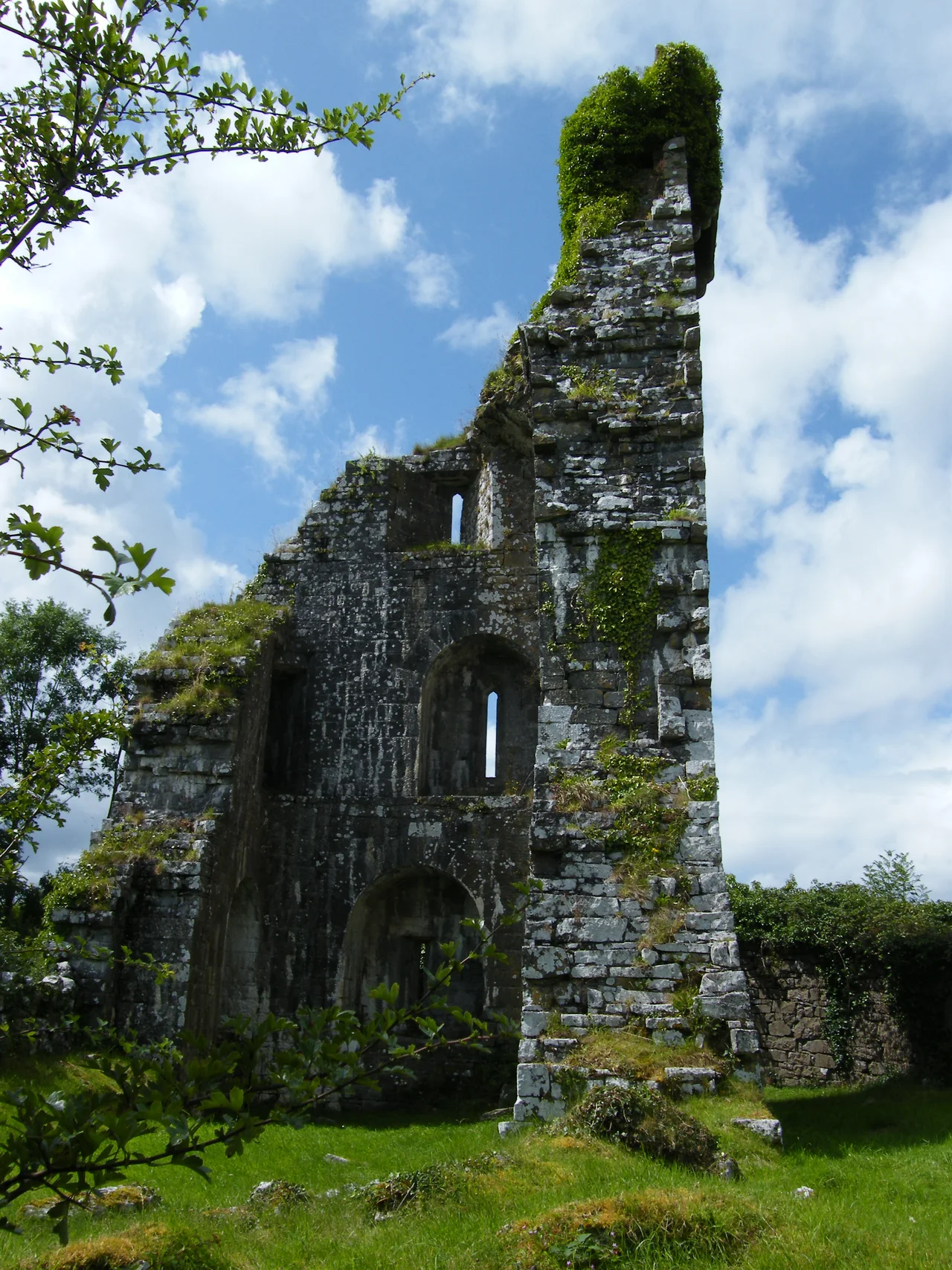

Aghalard Castle
Around 1490, descendants of the McDonnells of Knocknacloy, a Scottish family that had crossed to Ireland and taken service as gallowglass warriors for the Norman Irish Burkes of Mayo, built themselves a tower house in the country south of Castlebar. The result was Aghalard Castle: three storeys of stone topped with square turrets, the whole structure enclosed by a bawn, a defensive walled courtyard. It stood at the meeting point of two worlds, Scottish and Hiberno-Norman, military and domestic, and for the next four centuries it stayed in McDonnell hands. The story of how it changed owners reads like a small piece of Irish political history compressed into one building.
The Gallowglass Who Stayed
The gallowglass were a particular kind of medieval Irish institution: heavy infantry, mostly of Scottish Hebridean and West Highland origin, who hired out their fighting skills to Irish lords. They appeared in the thirteenth century and remained a fixture of Irish warfare for three hundred years. The McDonnells were one of the great gallowglass families, and the Knocknacloy branch crossed to County Mayo to take service with the Burkes, a Norman family that had become thoroughly Gaelicised after centuries in Ireland. Service in the Burke retinue eventually became settlement. The McDonnells took land, built a castle, and turned themselves from professional fighters into landowners. Aghalard was the architectural expression of that transition: a fortress that doubled as a family seat.
The Siege of 1596
In 1596, during the chaotic late stages of the Nine Years War, a combined force took Aghalard Castle. The attackers included Edward Brabazon, the 1st Baron Ardee; Ulick Burke, the 3rd Earl of Clanricarde; and James Riabhach Darcy. The capture was brief. Word reached the occupiers that Hugh Roe O'Donnell, the formidable young lord of Tyrconnell and one of the principal Irish commanders in the war, was approaching with his forces. The decision was immediate: evacuate. O'Donnell's reputation for fast movement and decisive action had reached the point where his approach was reason enough to abandon a captured position. The McDonnells returned to their castle, and the episode passed into local memory as the one time Aghalard changed hands by force.
The Stout Plan of a Tower House
Aghalard followed the standard plan of late medieval Irish tower houses: three storeys of solid stone, square turrets at the corners for flanking fire, and a defensive enclosure or bawn around the base. These structures were built by the thousand across Ireland in the fifteenth and sixteenth centuries, a response to the lawless conditions of the late medieval period when small lords needed defensible residences. The design was practical rather than elegant. Walls were thick enough to absorb cannonballs from the period's small artillery. The lower floors housed storage and servants. The family lived above. Aghalard's ruins still show the basic outlines: the rectangular footprint, the turret bases, the line of the bawn wall.
From McDonnell to Guinness
Aghalard remained in McDonnell ownership through the upheavals of the seventeenth and eighteenth centuries: the Cromwellian conquest, the Williamite War, the imposition of the Penal Laws. Many older Irish families lost their land entirely during these centuries. The McDonnells held on. The castle finally passed out of family hands in the nineteenth century, when Sir Benjamin Guinness, the brewing magnate and philanthropist, bought it. The Guinnesses by that point were accumulating estates across the west of Ireland, including Ashford Castle near Cong. Aghalard was a smaller acquisition, a ruined property by then, but it joined a family portfolio that knit together much of the western landscape. Today the National Monuments Service records it as MA120-024, a recognised ruin in the country south of Castlebar, where the gallowglass once kept watch.
From the Air
Coordinates: 53.5562 N, 9.2993 W. Aghalard Castle ruins sit in farmland south of Castlebar, in the country between Lough Mask and the western shore of Lough Carra. From the air the tower house remnant is small but distinguishable by its rectangular stone footprint surrounded by green pasture. Nearest airports: Ireland West Knock (EIKN) about 40 km east-northeast, Galway (EICM, GA only) about 60 km south. Recommended viewing altitude 1,500 to 3,000 ft for clear detail of the structure.
Nearby Stories
- Kylemore Abbey 5 km away
- Granuaile's Castle 7.2 km away
- Castlebar 8.1 km away
- Knockmoy Abbey 9.9 km away
- Kilmovee 13 km away
- Salthill 16 km away
- Loughrea 17 km away
- RMS Carinthia (1925) 55 km away