
Ahakista
Each year on the morning of 23 June, a small crowd gathers in a garden in Ahakista and waits for the sun. At 08:00 the light strikes the face of a bronze sundial, and 329 people are remembered - the passengers and crew of Air India Flight 182, killed when a bomb tore apart their Boeing 747 in the sky high above this stretch of County Cork on 23 June 1985. The garden sits beside the harbour of a wooded village on the Sheep's Head peninsula, halfway between Durrus and Kilcrohane. Ahakista is small. It has two pubs, a sandy beach, and a deep harbour. It is also where the families of the dead first came to throw wreaths into the sea.
The Memorial Garden
The Air India Memorial Garden was officially opened on 23 June 1986, exactly one year after the bombing. Cork County Council purchased the site after relatives of the victims, having flown from India and Canada in the days following the disaster, came to the nearest point of land to where their loved ones had died and asked that something be built. The opening ceremony was attended by the foreign ministers of Ireland, India, and Canada - an acknowledgment that the dead belonged to all three nations and that Ahakista, though small, had become a place of international grief. The garden's focal point is a sundial designed by the Cork sculptor Ken Thompson. Its alignment is precise: the sun strikes the dial face at 08:00, the moment the bomb detonated at 31,000 feet, near the end of the flight's transatlantic leg from Montreal to London Heathrow. The plane fell into the Atlantic about 190 kilometres southwest of this coast.
What Happened Above the Sea
Air India Flight 182 was operating Montreal to London to Delhi to Bombay when it disappeared from radar at 07:14 GMT. The bomb had been placed in checked luggage by members of a Sikh extremist group seeking revenge for the Indian Army's 1984 storming of the Golden Temple at Amritsar. There were no survivors. Of the 329 dead, 268 were Canadian citizens, most of them Indian-Canadians, and 86 were children. Eight days later, a related bombing at Tokyo's Narita Airport killed two baggage handlers - a parallel device intended for another Air India flight, detonated prematurely. The Air India 182 bombing remained the deadliest aviation terrorism incident in history until 11 September 2001. The Royal Canadian Mounted Police investigation became the largest and longest in Canadian history. The legal proceedings dragged on for decades; only one man was ever convicted in connection with the attack, after a trial that took until 2003. Most of the dead were never identified by their bodies. Many were never recovered at all.
Why Ahakista
The wreckage and remains fell into the sea on a stretch of Atlantic that ships from Cork could reach faster than anywhere else. Bodies recovered in the days after the bombing were brought ashore and taken to Cork Regional Hospital. When the families arrived from across the world, traumatised and looking for somewhere to be, they were brought to Ahakista because it was the nearest accessible coast. They stood at the harbour and threw wreaths into the water. The decision to build a memorial here was theirs, not the Irish government's. Ireland was, in this case, the country that received the grief and held it - and continues to hold it, year after year, with a small ceremony on a midsummer morning. The annual commemoration draws families, diplomats, and locals together at the sundial. The Indian and Canadian governments have sent representatives; an Irish President has attended. For most of the year the garden is quiet, with the sea wind moving through it. Each 23 June it is briefly full again, holding what cannot be filled.
The Village Around the Garden
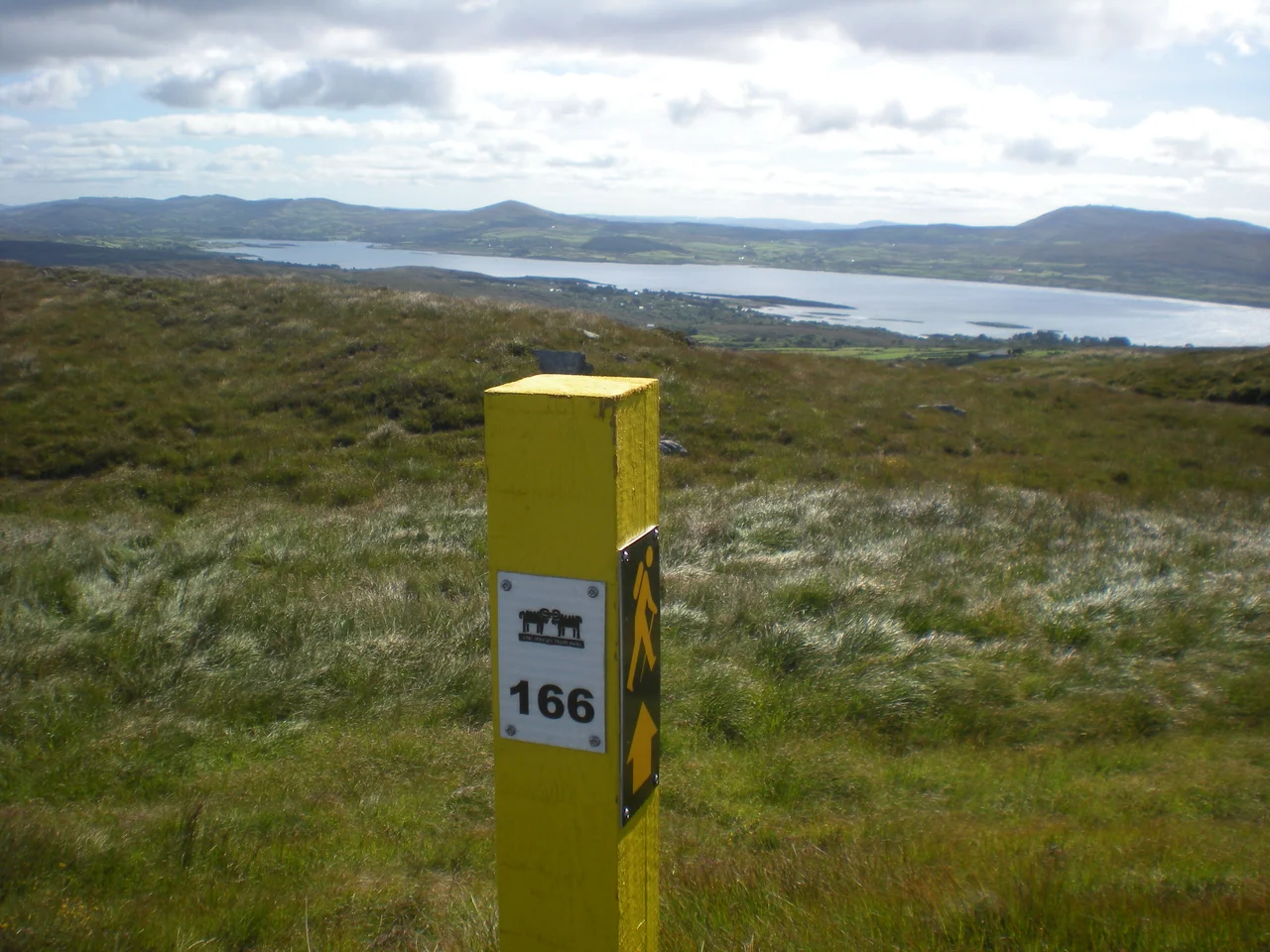
Ahakista's life has continued around the memorial without being defined by it. The village's deep, sheltered harbour hosts the Ahakista Regatta each August bank holiday weekend, fishing boats and pleasure craft side by side. There are two pubs with beer gardens - one of them locally called the Tin Pub for its corrugated-iron walls and roof. There is a small sandy beach, a wine shop, and several places to stay. The Sheep's Head Way, a 90-kilometre marked trail, threads through the village; in August 2008 it became one of Ireland's first four publicly funded walkways. Older histories layer the landscape: ringforts and fulacht fiadh sites in the surrounding townlands, and a Bronze Age stone circle at Gorteanish, undocumented until the 1990s and only excavated and renovated in 2023. The writer Wolf Mankowitz lived in Ahakista until his death in 1998. The children's author Noel Streatfeild spent summers here; the area features in her book The Growing Summer. Graham Norton, the television host, owns a holiday home overlooking the harbour and Dunmanus Bay. Ahakista holds all of this - festival weekend and famine sundial - on the same small shore.
From the Air
Located at 51.60 degrees N, 9.63 degrees W on the Sheep's Head peninsula, between Bantry Bay to the north and Dunmanus Bay to the south. The village sits at sea level on a wooded coastal stretch, with the long thin ridge of the Sheep's Head running west to east above it. Cork Airport (EICK) is the nearest major airfield, about 90 kilometres east. The site of the 1985 bombing - around 190 kilometres west-southwest of here over open Atlantic - is empty water now. The memorial garden is best visited on foot from the harbour; from the air, look for the small village clustered around a deep inlet between Durrus and Kilcrohane.
Nearby Stories
- Dursey Island 1 km away
- Glandore 3.2 km away
- Coolavokig ambush 8.1 km away
- Valentia Lifeboat Station 10 km away
- Battle of Callann 16 km away
- HMHS Llandovery Castle 16 km away
- RMS Lusitania 42 km away
- Sao Miguel 1926 km away