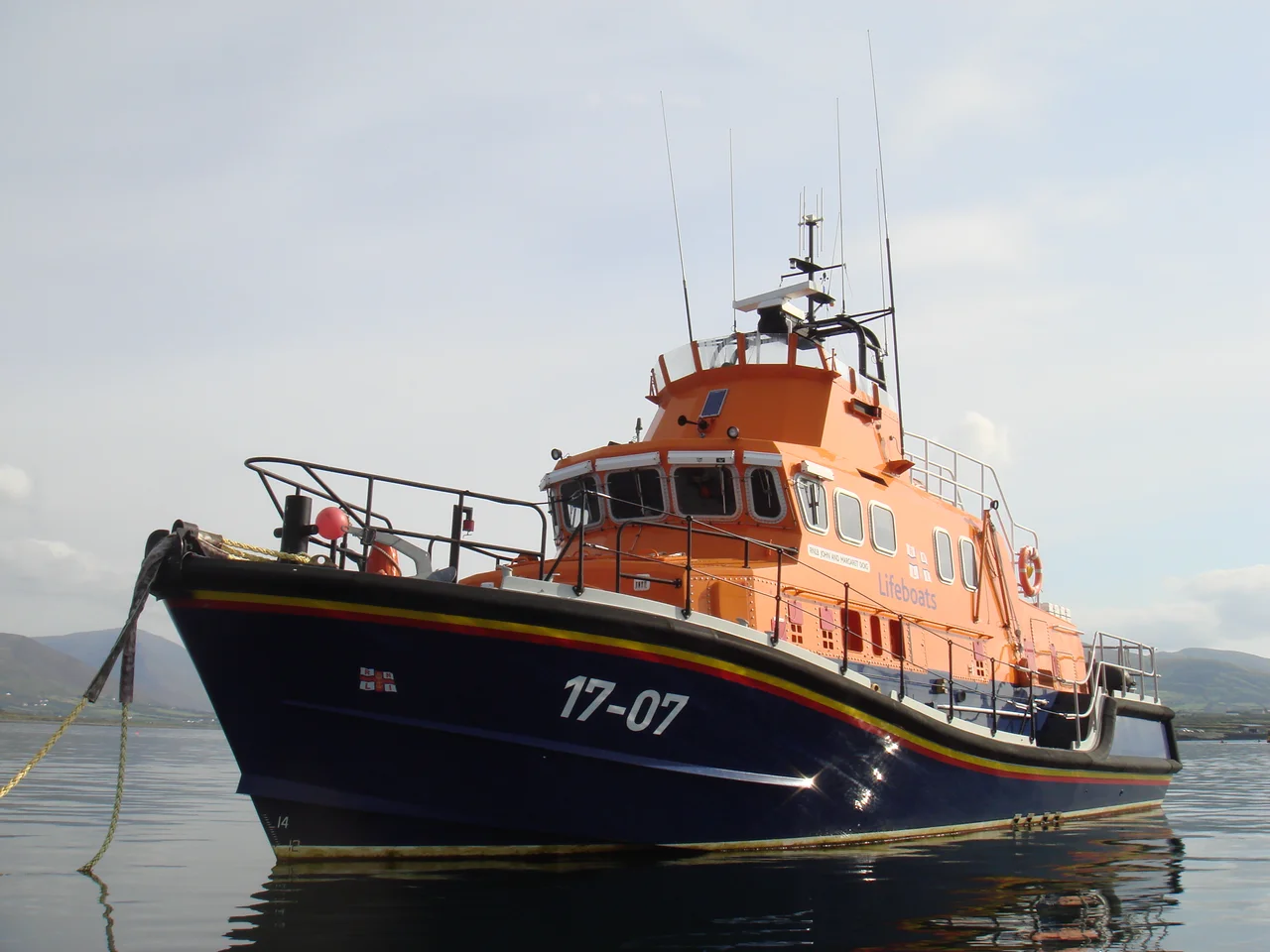

Valentia Lifeboat Station
Some lifeboat stations are postcard pretty and quiet. Valentia is not one of those. The boathouse beside the Watch House Cottages at Knightstown sits where the Atlantic stops being theoretical, where weather that has crossed three thousand miles of open water makes its first landfall on the Iveragh coast. The RNLI has had a boat on station here, with one interruption, since 1864. The current boat is 17-07 John and Margaret Doig, a Severn-class all-weather lifeboat, one of only thirty-five of its kind around the British and Irish coasts, and a vessel that can stay at sea in conditions that would close most harbours.
Before the Station Existed
Lifesaving on this coast predates the lifeboat by decades. On 7 December 1828, the brig Veronica out of Belfast was driven onto a sandbar in Dingle Bay and wrecked. Eighteen people clung to the rigging in heavy surf. Five coastguard boatmen launched a small four-oared gig and rowed out, managed to get every one of them off, and then capsized on the way back to shore. Somehow they recovered all twenty-three people from the surf and made the beach. The Royal National Institution for the Preservation of Life from Shipwreck, the body that would become the RNLI in 1854, awarded each of the five boatmen a Silver Medal. In 1861, another Silver Medal went to Chief Boatman Hugh Cooper at Dingle Bay for his part in saving two crew from the wreck of the barque Florence of Liverpool. The lifeboat would come later. The willingness to launch was already there.
1864 and the Lady from Berkshire
The RNLI built its first boathouse on this coast in 1864, at Reenard Point on the mainland directly across from Valentia. The cost was 155 pounds. A 32-foot self-righting lifeboat with sails and ten oars cost another 223, the carriage to transport her overland 96. The total was met by a single donor: a Berkshire woman, identified in the records only as 'a Lady', who gave 508 pounds to cover the whole station. She had previously funded a lifeboat on the northwest coast of England. At her request, the new boat was named Mary. Five years later, in 1869, the RNLI moved the boathouse onto Valentia Island itself, at a cost of seventy pounds, and the station has been known as Valentia Lifeboat Station ever since.
A Closure and a War
Lifeboat history is not always smooth. In 1890 a new boat called Crosby Leonard arrived by rail to Killorglin, where a railway worker was killed during the unloading; the boat was then rowed and sailed down the coast to Valentia. Just over five years later, on 14 November 1895, the RNLI committee voted to close the station entirely. It stayed closed for fifty years. Between 1939 and 1945, an auxiliary rescue boat was stationed back at Valentia to help aircraft crews flying transatlantic routes during the Second World War. After the war, the RNLI formally reopened the station in 1946. A new boathouse went up in 1995. The John and Margaret Doig arrived the following year and has been on station ever since.
Why Valentia Is Different
Most RNLI stations have a single boat. Valentia operates one of the institution's largest, a 17-metre Severn-class hull designed to self-right in any sea, with a range of 250 nautical miles at full speed and the capacity to remain operational in winds up to severe gale force. The station covers a stretch of water that includes the Skellig Islands, the approaches to Dingle Bay, and the open Atlantic west of the Iveragh Peninsula, an area where commercial fishing vessels, transatlantic yachts, and small leisure craft can all need help in the same week. The crew, like every RNLI crew, is largely made up of volunteers, drawn from the village and the surrounding farms. The pager goes off, they come down to the pier, and the boat goes out.
From the Air
The Valentia Lifeboat Station sits at 51.93 N, 10.29 W in Knightstown, on the eastern tip of Valentia Island. Best viewed at 1,500-3,000 ft. The modern boathouse and the John and Margaret Doig (a 17-metre Severn-class lifeboat) are visible at the pier. The station covers the approaches to Dingle Bay, the Skellig Islands to the west, and the open Atlantic west of the Iveragh Peninsula. Nearest airport is Kerry (EIKY), 38 nm northeast. Atlantic weather here can deteriorate rapidly; the boat's operating area extends well into open ocean.
Nearby Stories
- 1955 RAF Shackleton aircraft disappearance 3.8 km away
- Ballynavenooragh 5.4 km away
- French Expedition to Ireland (1796) 9.4 km away
- Tralee 12 km away
- Uragh Stone Circle 18 km away
- The Laki Eruption: The Volcano That Changed World History 1385 km away
- The Northern Lights: The Sky Show That Vikings Thought Was Bridge to the Gods 1487 km away
- Sao Miguel 1921 km away