
French Expedition to Ireland (1796)
Wolfe Tone could see Ireland. That was the worst part. The Dublin-born Protestant lawyer who had spent years convincing the French Republic to help drag his country into rebellion sat aboard the Indomptable in Bantry Bay in late December 1796, with the Cork coast close enough that he later said he could have touched either side of the bay with both hands. Forty-three French ships had reached this water. Fifteen thousand soldiers and tons of muskets, cavalry, and field artillery were waiting to be put ashore. Not one of them landed. The storm that had scattered the fleet on the way over kept scattering it for two weeks, until the surviving ships gave up and crawled back to France through fog and British patrols, and the Irish revolution that might have happened in the winter of 1796 did not happen at all.
Wolfe Tone Goes to Paris
The Society of United Irishmen was founded in 1791 as a non-sectarian republican movement uniting Catholics, Presbyterians, and dissenting Protestants in opposition to British rule of Ireland. Initially open and reformist, it was driven underground in 1793 and decided armed insurrection was its only remaining option. The leaders looked outward for help. Lord Edward FitzGerald and Arthur O'Connor travelled to Basel to meet General Lazare Hoche, the French commander who had crushed the Royalist uprising in the Vendee. Tone went to Paris himself. He spent 1795 and 1796 lobbying the French Directory in person, building the case that an Irish landing would not just liberate Ireland but cripple Britain's war effort and clear the way for an eventual French invasion of England. The Directory, recovering from peace settlements on other fronts and looking for ways to attack Britain, agreed. Hoche was given command, the entire French Atlantic Fleet was placed at his disposal at Brest, and a force was assembled - somewhere between 12,000 and 20,000 troops depending on the historian, with the working figure usually given as 15,000.
Leaving Brest in the Wrong Weather
The expedition's commanders were not optimistic. Hoche told the Directory on 8 December 1796 that he would rather lead his men on almost any other operation. Vice-Admiral Morard de Galles admitted his sailors were so inexperienced that British warships should be avoided wherever possible. They sailed anyway, on 15 December - one day before a Directory message arrived ordering the operation cancelled. The British were watching Brest harbour, as they always were, but de Galles tried to disguise the fleet's intentions by anchoring first in Camaret Bay and ordering his ships out through the dangerous Raz de Sein channel rather than the usual route. The plan immediately fell apart. Confused orders scattered the fleet across the approaches to Brest in the dark. The 74-gun ship of the line Seduisant drove onto the Grand Stevenent rock during the night, fired rockets to call for help that only added to the chaos, and sank with the loss of 680 men. When dawn broke on 17 December, the French were already in trouble - one ship and 680 lives gone, the fleet's commanders separated, and the worst Atlantic winter recorded since 1708 just getting started.
Bantry Bay, and the Wind That Would Not Stop
By 19 December, Vice-Admiral Francois Joseph Bouvet had gathered 33 ships and was steering for Mizen Head, the designated rendezvous on the southwestern Irish coast. The flagship Fraternite, carrying General Hoche, was missing - blown off course, chased by a British frigate far into the Atlantic. The fleet sailed on without its commanders. By 21 December most of it had reached Bantry Bay through high winds and thick fog. They anchored and waited. The wind kept blowing - now from the east, straight off the land they were trying to invade, pinning their ships against the bay's mouth and making any landing impossible. On 24 December the wind slackened, and the senior officers held a council of war. They resolved to force a landing on Christmas Day. The wind picked up again. The landing did not happen. On shore, the local landowner Richard White had marshalled militia along the bay's edges in anticipation, but they had nothing to fire at. The French sailors, lacking proper winter clothing, struggled even to manage their own ships. After almost two weeks of trying, the fleet began to break up and head home in small groups.
The Long Voyage Back
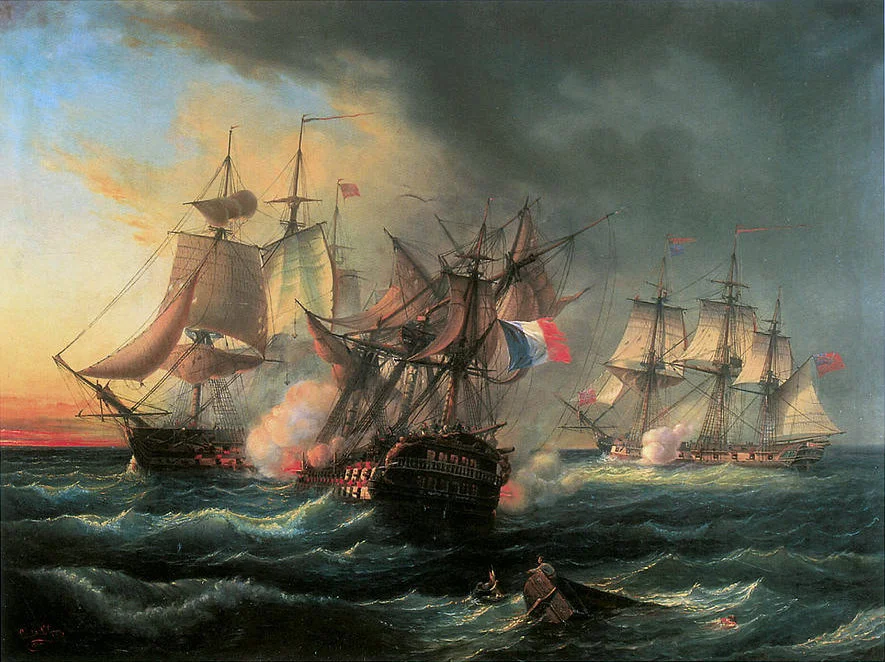
Returning ships ran into the same storms that had thwarted the landing. The frigate Surveillante, taking on water, was scuttled in Bantry Bay on 2 January 1797; General Julien Mermet and 600 cavalrymen were rescued by other French boats, while others scrambled ashore as prisoners of war. The 74-gun Droits de l'Homme, carrying 1,300 men, was intercepted off Brittany on the night of 13-14 January by the British frigates Indefatigable under Captain Sir Edward Pellew and Amazon. In a running gun battle through darkness and high seas, the larger French ship was unable to outmanoeuvre the smaller, faster British vessels. At 04:20 the lookouts on all three ships saw surf breaking immediately to the east. Indefatigable and Amazon managed to turn; the Droits de l'Homme could not. She drove onto a sandbar near Plozevet, rolled onto her side, and the heavy surf prevented every attempt to launch boats. Over a thousand men drowned. Amazon was wrecked too, in a more sheltered spot; her crew built rafts and reached shore. Indefatigable alone survived. Twelve French ships were lost in total. Over 2,000 soldiers and sailors drowned. Not one French soldier had successfully landed in Ireland.
Aftermath, and Wolfe Tone's End
The British response was widely criticised at home. Both fleets sent to intercept the French had failed; only Pellew's independent frigates and a small squadron from Cork inflicted any losses on the enemy. Richard White was rewarded with the title Baron Bantry for his shore defence. The French Navy, paradoxically, was praised for having reached Ireland and returned without meeting the Channel Fleet at all. Encouraged, the Directory launched a second attempt in 1798 - a small force of 2,000 men under General Jean Humbert that landed in Mayo in August, fought briefly, and surrendered at the Battle of Ballinamuck. A separate squadron that month was destroyed at the Battle of Tory Island. Wolfe Tone, who had been aboard one of the ships in that final battle, was captured. Refused a soldier's execution and sentenced to hang as a traitor, he cut his own throat in a Dublin prison and died of the wound a week later, in November 1798. The United Irishmen rebellion, sparked by British arrests in May 1798, was crushed by autumn. The Irish republican movement Tone had built did not recover for generations. But the memory of Bantry Bay - of how close it had come, of a biscuit's throw between freedom and storm - became part of the long argument Ireland had with itself about what might have been.
From the Air
The events centred on Bantry Bay at 51.60 degrees N, 9.80 degrees W on the southwest coast of Ireland. From the air the bay reads as a 35-kilometre slash running northeast-southwest between the Beara Peninsula to the north and Sheep's Head Peninsula to the south. Mizen Head, the original rendezvous point, lies further south. The action of 13 January 1797 against the Droits de l'Homme took place off the Brittany coast near Plozevet. Cork Airport (EICK) is the nearest major Irish airfield, about 100 kilometres east. Best appreciated at mid altitudes in clear weather.
Nearby Stories
- Dursey Island 1 km away
- Glandore 3.2 km away
- Coolavokig ambush 8.1 km away
- Valentia Lifeboat Station 10 km away
- Battle of Callann 16 km away
- HMHS Llandovery Castle 16 km away
- RMS Lusitania 42 km away
- Sao Miguel 1926 km away