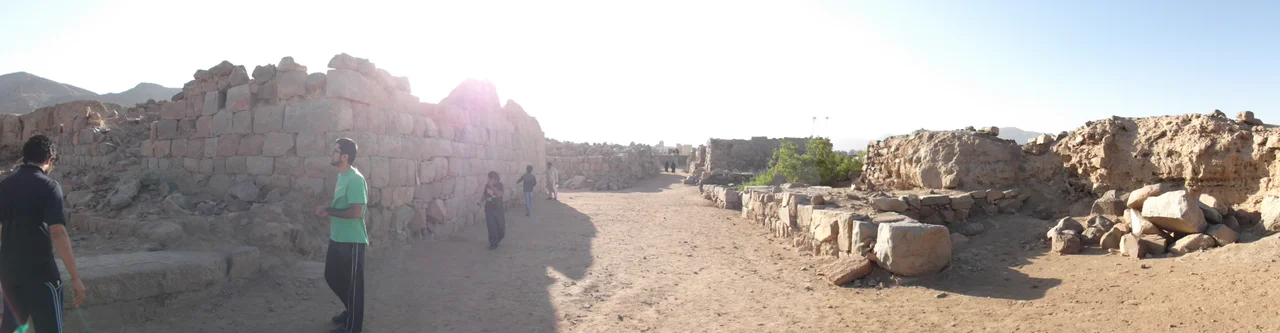

Al-Okhdood
The word itself is a wound. Al-Okhdood means the trench, the ditch, the pit - and the Quran, in its 85th chapter, curses the people who dug one. Somewhere beneath the sand and mud-brick walls 1,300 kilometers south of Riyadh, archaeologists believe they have found what the verse remembered: the place where, in the 520s, the last Himyarite king Dhu Nuwas ordered the Christians of Najran thrown alive into fire. The town is in ruins now. It has been in ruins since the 7th century. But its silence is not empty - it is full of the names of people who died refusing to recant their faith, and whose deaths entered scripture.
A Town 2,500 Years Old
Long before the massacre, Al-Okhdood was a prosperous South Arabian trading town. The earliest structures date to at least 500 BCE. The largest visible building - a fort of stone-and-mud bricks - rose in the 1st century BCE, its walls thick enough to defend caravans moving between the incense kingdoms of Yemen and the Mediterranean markets far to the north. Najran sat on a critical junction of trade routes, and Al-Okhdood grew rich from taxes, stopovers, and the slow accumulation of a crossroads. The inhabitants practiced South Arabian polytheism, including the veneration of a single great tree that had been deified. Into that world, sometime in Late Antiquity, a Christian preacher named Phemion arrived. He spoke of a single god. The people listened. His apprentice, Abdullah ibn Thamir, is credited by some sources with actually establishing the Christian community that would later define the town.
Azqir of the Chapel
The first victim recorded by name was a priest called Azqir. In the 470s, he built a chapel - the text is uncertain whether small or church-sized - inside the ancient town. The Himyarite king Sharhabil Yakkuf ordered his execution and sent two governors, Dhu Tha'laban and Dhu Qaifan, to tear the building down. Later scholars think this was political rather than theological: Sharhabil feared Christianity because it was tied to Byzantium, and Byzantium was a distant empire whose influence he did not want at his borders. But the effect on Azqir was the same. His story is preserved in a text called the Martyrdom of Azqir - a document that, even in its brief summary, gives the priest back the dignity the king took from him. He built. He preached. He was killed for both. His name has outlasted the king who gave the order.
The Fires of Dhu Nuwas
A generation later, the situation grew much worse. Dhu Nuwas, the final Himyarite king, had converted to Judaism and viewed Christianity with open hatred - or, in another reading of the sources preserved by Al-Tabari, simply saw Najran's Christians as allies of his Byzantine enemies. When the city refused to pledge allegiance to him in the 520s, he marched on it. Those who would not convert to Judaism or abandon Christianity were killed. Churches were burned. Some victims, according to tradition, were thrown alive into burning trenches - the Ukhdud that gave the ruins their modern name. The massacre entered Islamic memory. The 85th chapter of the Quran, Surah al-Burooj, contains the lines: Destroyed were the people of the ditch, of the fire fed with fuel, when they sat by it and witnessed what they were doing to the believers. These verses are a condemnation of the killers and a memorial to the killed. Around 530 CE, Dhu Nuwas was defeated by the Christian Kingdom of Aksum from across the Red Sea, and Christianity returned to Najran - though the town itself never fully recovered.
What Remains
In the 620s, the surviving population of Najran migrated a short distance away and established the city that now bears the name. The old town was left to the wind. During the early Islamic period, a mosque was built there - the oldest in all of Najran Province. Over the centuries, Umayyad and Abbasid artifacts accumulated in the soil, layers of ordinary life settling atop the remembered atrocity. In 2016, the French National Centre for Scientific Research began excavating in collaboration with Saudi authorities. Their finds continue. In 2023 the Saudi government announced new efforts to make the site accessible to visitors, with signage and interpretive material. The walls are low now, the fort still visible in outline, the ancient carvings weathered but readable. Standing among them in the afternoon light, it is hard not to notice how small the place really is. A few hundred meters across. A town you could walk in an hour. And a name that refused to be forgotten, even when the town itself was.
The Weight of a Verse
Archaeology cannot verify every detail the sacred texts and later chronicles preserve. But the Quran's mention, the Martyrdom of Azqir's specificity, and the Ethiopian Aksumite inscriptions recording Dhu Nuwas's defeat converge on the basic fact: in this place, in this century, people were killed for what they believed. The Christians of Najran were a community with schools, bishops, names, families, commerce. Their descendants - or at least inheritors of their memory - lived in the area for centuries, eventually migrating north under Umar ibn al-Khattab's policies. Al-Okhdood is not only the Saudi archaeological site it looks like from a plane window. It is a memorial that refuses a single nation's claim on it: holy to Muslims who read the Quranic warning, sacred to Christians who venerate the Najran martyrs as saints, and a matter of sober record to anyone who believes human beings deserve to be remembered by name.
From the Air
Al-Okhdood lies southeast of the modern city of Najran at approximately 17.492 N, 44.132 E, in the Najran Province of southwestern Saudi Arabia, close to the Yemen border. Najran Domestic Airport (OENG) is the nearest airfield, a few kilometers away. Terrain is a broad valley with surrounding low mountains. Watch for border-area airspace restrictions - this is a sensitive zone given ongoing regional tensions to the south. Visibility is typically good year-round; summer temperatures are extreme. The site itself appears as a low, rectangular complex of ancient walls visible against desert surroundings.
Nearby Stories
- Houthi insurgency 50 km away
- Abu 'Arish 85 km away
- Emirate of Asir 110 km away
- Mundafan 116 km away
- Asir 152 km away
- Sheba 211 km away
- Dhorm Mountain 236 km away
- Marib Dam 241 km away