
Albemarle County Courthouse Historic District
On Sunday mornings in early 19th-century Charlottesville, the Albemarle County Courthouse on Court Square doubled as a church. Episcopalians, Presbyterians, Baptists, and Methodists took turns using the building for services, in part because the town was too small to afford four sanctuaries and in part because no one objected. Thomas Jefferson attended services there. So did James Madison and James Monroe. The 1803 Federal-style brick building at the center of what is now the Albemarle County Courthouse Historic District has been many things to many people, and most of them are still legible in the architecture.
An 1803 Federal Building
The original section of the courthouse was built in 1803 in the Federal style - the restrained Roman-influenced architecture favored by the early American republic. It is now the north wing of the building. The structure is two stories tall, five bays wide, and T-shaped in plan, built of brick fired locally. A Greek Revival portico was added in the 19th century when classical architecture fully replaced Federal restraint as the American civic style. The result is a hybrid building that shows two different generations of American architectural preferences sharing the same walls. The original courtroom was large enough to accommodate the multi-denominational Sunday rotation that Jefferson, Madison, and Monroe attended in their visits to Charlottesville from Monticello, Montpelier, and Ash Lawn-Highland.
Court Square's 22 Buildings
The historic district extends beyond the courthouse itself to encompass 22 contributing buildings and one contributing object around Court Square. Levy Opera House (around 1851) housed local performances and meetings for decades. Number Nothing (around 1820) is a small commercial building whose unusual name became its identity. The Redland Club (around 1832) was a private gentleman's social club. Eagle Tavern, dating to the early 19th century, served travelers using the road network that connected Charlottesville to Richmond, Lynchburg, and the Shenandoah. The district reads as a near-complete antebellum and 19th-century county seat, with brick commercial buildings, hotels, the courthouse, and the related public buildings all surviving on a square small enough to walk in a few minutes.
The Jackson Statue
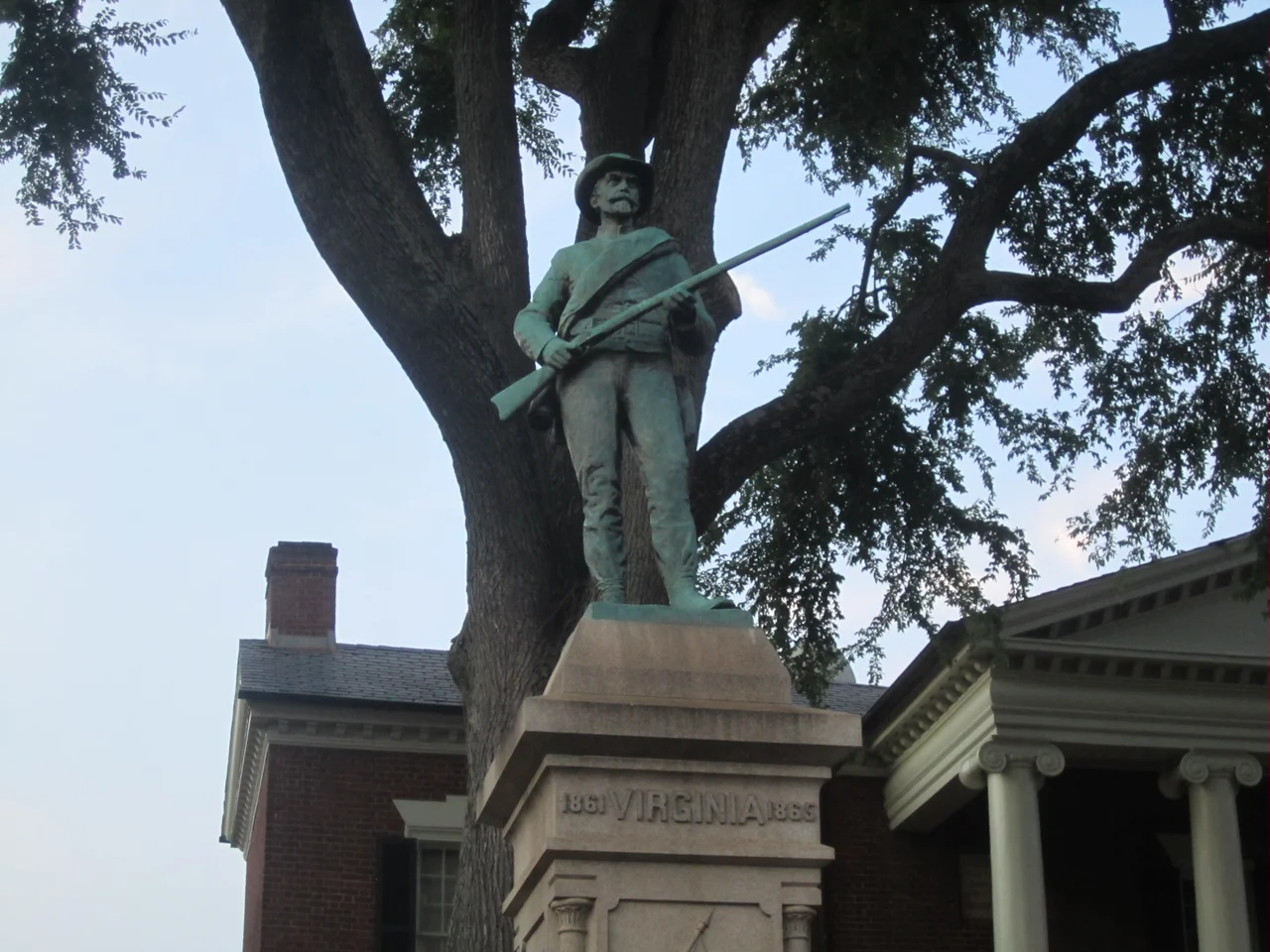
The one contributing object in the historic district is a sculpture of Confederate General Thomas Jonathan Stonewall Jackson. The statue was donated to Charlottesville by philanthropist Paul Goodloe McIntire in 1921, during a wave of Confederate monument construction across the South. After the 2017 white supremacist Unite the Right rally in Charlottesville - which had been ostensibly called to protest the planned removal of a different statue, Robert E. Lee - the city and state spent years in legal battles over the fate of Confederate monuments. In 2020, after the Virginia legislature gave localities authority over their own monuments, Charlottesville removed the Jackson statue from Court Square and donated it. Its empty pedestal marked a deliberate shift in how the historic district presented its own history.
From 1973 to Today
The Albemarle County Courthouse Historic District was added to the National Register of Historic Places in 1973. In 1982 it was incorporated into the larger Charlottesville and Albemarle County Courthouse Historic District, which extended the protected area to include additional buildings around the courthouse and along nearby streets. The Historic American Buildings Survey produced six measured architectural drawings and fifteen pages of documentation for the courthouse itself, preserving its precise dimensions and details for future preservation work. The courthouse still functions as Albemarle County's court of record. Trials are held there. Marriage licenses are issued there. The two-story Federal-Greek Revival hybrid that Jefferson sat in for Sunday services is, more than two centuries later, still in continuous public use.
From the Air
Located at 38.03 degrees north, 78.48 degrees west, in downtown Charlottesville, Virginia. From 3,000 to 5,000 feet AGL the historic district reads as a tight grid of brick buildings at the eastern end of downtown Charlottesville. The courthouse, on Court Square, sits at the district's center. Nearest airports include Charlottesville-Albemarle (KCHO) just north of downtown and Shenandoah Valley Regional (KSHD) to the west.
Nearby Stories
- Augusta County Training School 10 km away
- A. P. Hill Boyhood Home 18 km away
- Reddish Knob 20 km away
- Amherst County, Virginia 21 km away
- Appalachian Trail 21 km away
- Fork Union Military Academy 28 km away
- Huguenot Memorial Chapel and Monument 39 km away