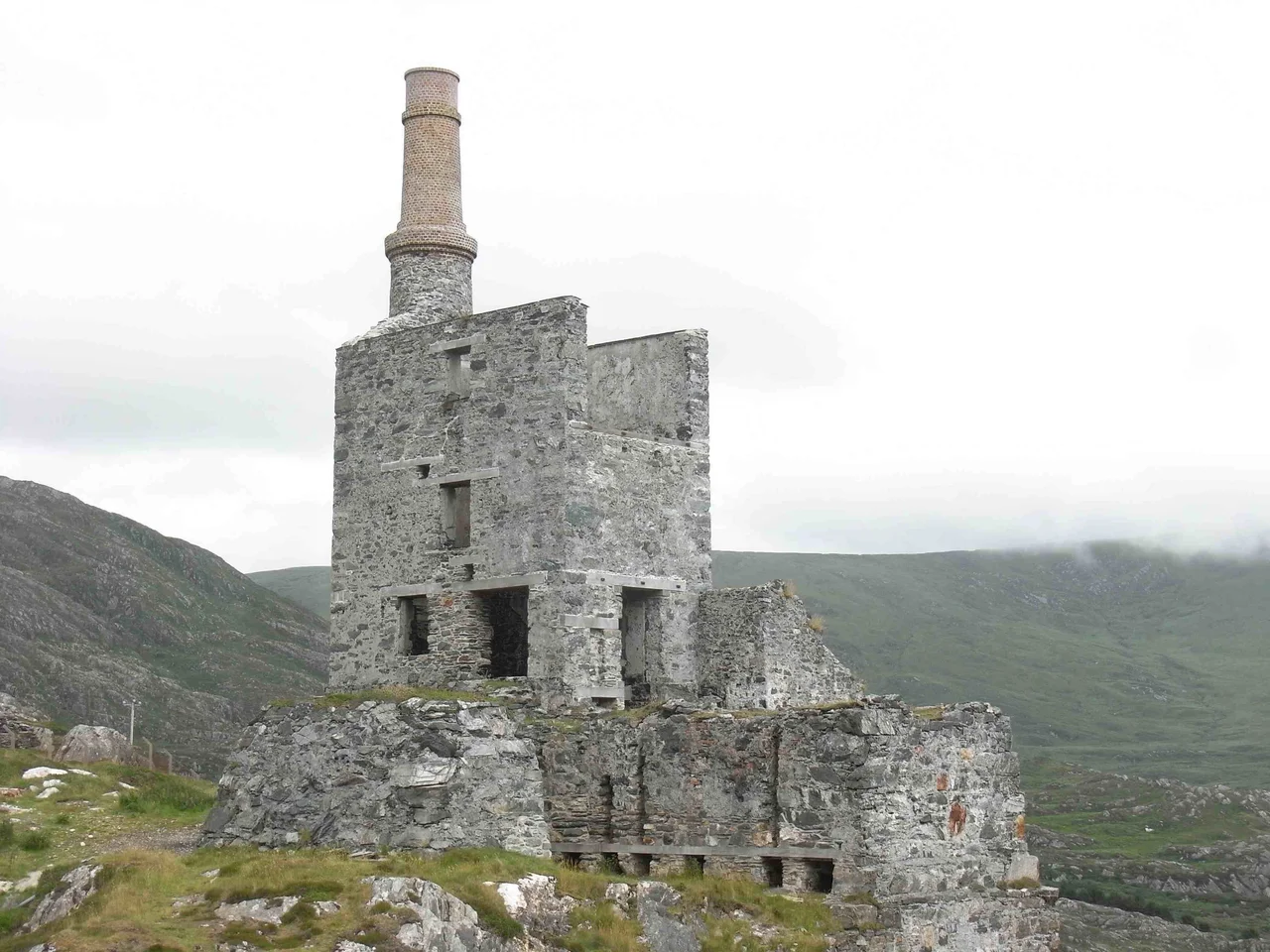

Allihies
Three roofless engine houses stand on the skyline above Allihies, the silhouette of an industry that left this corner of County Cork more than a century ago. The most prominent, the Mountain Mine man engine house, was built by the Cornish engineers Michael Loam and Son in 1862, when over a thousand workers were drawing copper from veins that ran down beneath sea level. By 1884 the price of copper had collapsed under competition from new mines in Africa, the Americas, and Australia. The Allihies workings closed. The miners packed up and sailed, many of them, for Butte, Montana - taking with them the techniques they had learned and the names that still appear in Butte's gravestones today.
Bronze Age to John Puxley
Copper has been pulled from these hills since the Bronze Age, when prospectors traced the green-stained outcrops above what is now Allihies village and dug shallow pits to follow the ore. The industrial phase began in 1812, when John Lavallin Puxley - whose family already owned much of the Beara Peninsula - established a company to work what were then known as the Berehaven copper mines. Cornish miners were brought across the sea, because Ireland had no established workforce trained in deep-shaft hard-rock mining. They built the engine houses in the Cornish style, with thick granite walls and tall chimneys; they laid out the village to suit themselves; they built a chapel in 1845 that still stands today as the Allihies Copper Mine Museum. Daphne du Maurier, granddaughter of Liskeard-born Muriel Beaumont, fictionalised the Puxley family's history in her 1943 novel *Hungry Hill*, named for the mountain that overlooks the workings.
Two Hundred and Ninety-Seven Thousand Tons
Between 1812 and 1912, mine records show that 297,000 tons of Allihies ore passed through the smelters at Swansea in south Wales. The ore was carted down to Ballydonegan Strand, loaded onto sailing ships that risked the Atlantic rollers along the Beara coast, and unloaded again at Swansea, where Welsh coal made smelting cheap. By 1845, peak employment at Allihies reached around 1,600 people - in a townland that had probably never held more than a few hundred souls before the mines opened. Then the Great Famine arrived. The mining community, slightly insulated from agricultural collapse by their wages, fared better than their farming neighbours, but the surrounding parishes emptied. Beara lost more than half its population to death and emigration in the famine decade. The mines kept working, but the world above them had changed permanently.
Butte, Montana
When the worldwide copper price fell in 1884, the Allihies mines could not compete with the open-pit and high-grade deposits being exploited elsewhere, and the operations closed. The Cornish miners had options: some returned to Cornwall, some moved on to mining work in Africa or Australia. The Irish miners and their families had narrower choices. Many made for the United States, and a substantial number ended up in Butte, Montana, drawn by the Anaconda Company's copper boom. The names that travelled together - Lowney, Harrington, Sullivan, O'Connor - filled neighbourhoods called Corktown, Dublin Gulch, and the Cabbage Patch. The miners brought hard-rock skills that Butte desperately needed and a Catholic faith that built parish churches at speed. Their descendants today number in the thousands, and Butte's annual St Patrick's Day parade remains one of the largest in America. Some of those descendants now return on pilgrimage to walk the engine house ruins above their ancestors' chapel.
The Festival, the Swans, the Mary Robinson Years
Allihies today is small, with shops and pubs you can count on the fingers of one hand and an annual festival traditionally held on 15 August - the feast of the Assumption, but also a date that survives from the mining era's calendar of races and games. Horse racing on the strand or in the fields above the village probably descends from the working days when the mines employed great numbers of horses and ponies. The festival now extends through the week with music and bale-tossing competitions. The mythological *Children of Lir*, whom Irish legend says spent 900 years as swans before being released into human form again, are claimed by oral tradition to be buried in Allihies; a local site is associated with this story. In June 1990, Mary Robinson chose Allihies as one of the first places she visited in her presidential campaign, recognising the village's symbolic weight as a place that had both endured and exported its people. She won. In 2007, her successor Mary McAleese opened the museum that now sits inside the miners' old chapel.
Untested Resource Potential
There is one detail the Allihies story usually omits. In the 1950s and 1960s, a company called Can-Erin Mines pumped out Mountain Mine, took core samples, and assessed whether a reopening might be viable. Their conclusion: not at the projected operating costs and world copper prices then prevailing. But they also noted, with the careful caution of geological reports, that the Mountain Mine 'has significant untested resource potential.' Copper prices, like every other commodity, rise and fall. The veins that defeated the Victorian operators by their depth and difficulty might one day be tempting again. For now, the engine houses stand empty on the skyline, the museum tells the story below them, and the Atlantic, rolling in across Ballydonegan Strand, keeps the time.
From the Air
Coordinates 51.633°N, 10.033°W, at the western tip of the Beara Peninsula in County Cork. The village clusters in a hollow below Mountain Mine, with the ruined engine houses prominent on the ridge to the north. Cruise at 1,500-3,000 ft for the clearest view of the mining landscape and the broader peninsula. The Wild Atlantic Way coastal route follows the R575 through the village. To the west, Dursey Island and the Bull Rock light; to the south, the open ocean. Nearest airports: Kerry (EIKY) about 35 nm northeast, Cork (EICK) about 60 nm east. Beara weather is exposed to all Atlantic systems; cloud bases drop fast.
Nearby Stories
- Iveragh Peninsula 4.6 km away
- Ballydehob 5 km away
- Battle of Callann 5.2 km away
- HMHS Llandovery Castle 8.9 km away
- Inishvickillane 21 km away
- SM U-68 41 km away
- RMS Lusitania 66 km away
- Sao Miguel 1909 km away