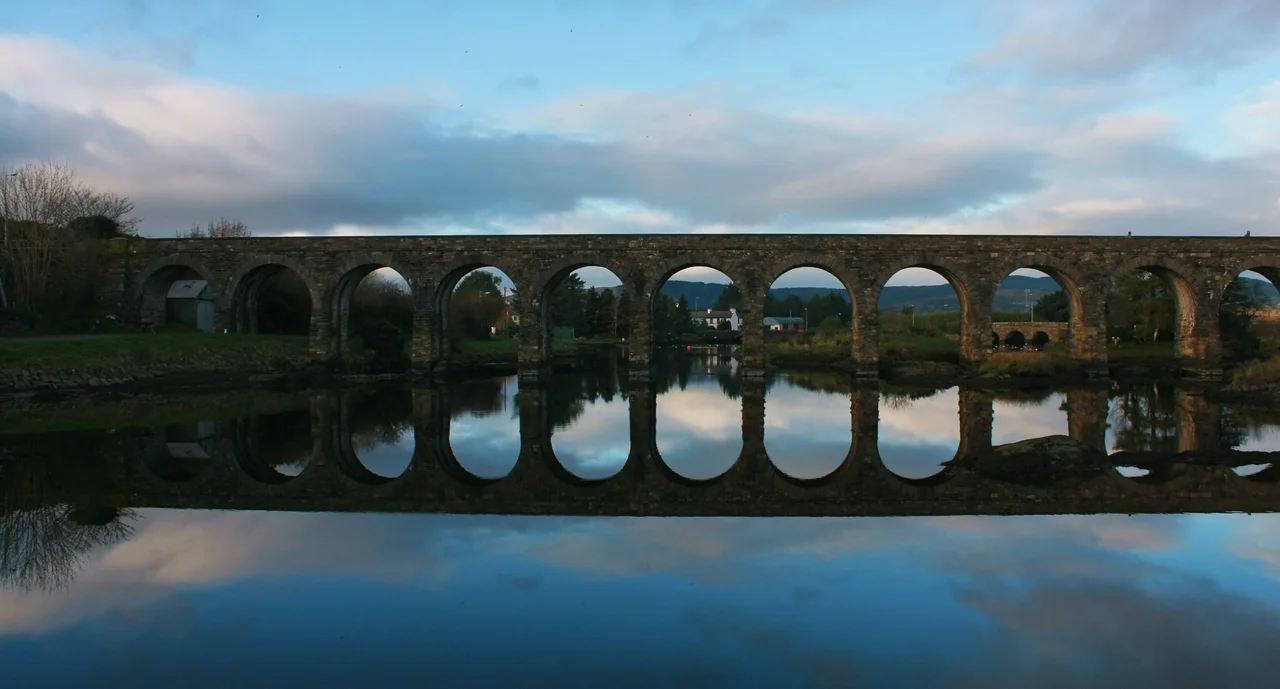

Ballydehob
Once, briefly, in the late 18th century, Ballydehob was called Swanton's Town. The Swantons from Norfolk had emerged as the dominant Anglo-Irish family in the locality, and they managed to get the place name changed on the parish maps. It lasted until 1821. After that the older name reasserted itself, as older names tend to do in West Cork, and by the time of the next census Ballydehob was Ballydehob again. The village sits 13 kilometres west of Skibbereen and 13 kilometres south of Bantry, with a population of about 350 according to the 2022 census, and is best known these days for a 12-arch railway bridge that no longer carries a railway, an annual turnip race held in mid-August, and the late actor and wrestler Danno O'Mahony, the Irish Whip, whose statue stands in the village centre.
Bronze, Copper, and Castles
Mount Gabriel rises just west of the village, and Bronze Age miners were working its copper somewhere between 2200 and 600 BC. The same period produced the stone circles, wedge tombs, and boulder tombs that still dot the West Cork landscape. The Celts came later, and the early historic period saw the McCarthys and the O'Mahonys emerge as the dominant clans of the region. They built a string of castles along the coastline. The McCarthys' westernmost stronghold, Kilcoe Castle, stood on a small island in Roaringwater Bay -- their only coastal foothold -- and it is still there today, painted ochre and restored by the actor Jeremy Irons, who bought it in 1997. In 1602 the English Lord President of Munster, Sir George Carew, swept through West Cork breaking the power of the Irish clan chieftains. The English account was Thomas Stafford's Pacata Hibernia; the Irish counter-narrative was Philip O'Sullivan Beare's Historicae Catolicae Iberniae Compendium. Both books survive.
The Mining Era and the Famine
Copper mining returned to the region in the 1820s. The Cappagh mine, financed by Lord Audley, ran its 20-metre brick chimney up out of the West Cork countryside as a landmark for nearly two centuries -- until February 2002, when a lightning strike took it down. Ballydehob got a police constabulary and a barracks in the mining era, six years before the first London police force, which is the kind of small fact local historians treasure. By the 1840s the population of the area had grown to nearly twenty thousand, packed into the small townlands around the village. Then in 1845 the potato crop failed, and the Great Famine that followed killed and emptied West Cork on a scale that the buildings here can still scarcely express. Between 1841 and 1851 the population of the area around Ballydehob fell by 42 percent -- well above the national average. The dead are buried in the local graveyards. The survivors emigrated. The village that exists today is the small remainder of a much larger world.
The Bohemians
In the 1960s, something unexpected happened to Ballydehob. Artists, writers, and craftspeople began to arrive from elsewhere -- referred to locally then and now as blow-ins -- and a handful of hippy communes were established in the area. The cohort came to be called the Ballydehob Bohemians. One house was painted with flowers and became known as the Flower House. The arts movement that grew out of this period transformed the cultural identity of the village. The Ballydehob Arts Museum keeps records of figures like the painter Nora Golden. The festivals that fill the village calendar now -- the Ballydehob Traditional Music Weekend, the Ballydehob Jazz Festival, the Country Music Festival, the Fastnet Maritime and Folk Festival, the West Cork Yoga Festival, the mid-August Summer Festival with its turnip race, and Cruinniu na mBad, the Gathering of the Boats, when a flotilla of working vessels and traditional sailing craft converges on Ballydehob Quay -- are the legacy of an older village rebuilt as something newer.
The Irish Whip and the Twelve Arches
Danno O'Mahony, born in Ballydehob, won the NWA World Heavyweight Wrestling Championship on 30 July 1935 in Boston, beating Ed Don George with the throwing technique he called the Irish Whip. He was also a champion hammer thrower. A bronze statue of him was put up in the village in 2000. The pub The Irish Whip is named for him. Another local connection: Kay Summersby, who served as chauffeur and personal assistant to General Dwight D. Eisenhower when he was Supreme Allied Commander in London during the Second World War, was born at Inish Beg house in 1908, about 20 km away. The 12-arch bridge that still dominates the estuary at Ballydehob was built for the narrow-gauge Schull and Skibbereen Railway, which opened on 6 September 1886 with a sports event to mark the occasion (the speed limit on the line was 15 miles per hour). The last train ran on 27 January 1947. The station closed completely in 1953. The bridge stayed, and Ballydehob did with it.
From the Air
Ballydehob lies at approximately 51.55N, 9.47W in southwest County Cork, 13 km west of Skibbereen and 13 km south of Bantry. Cork Airport (EICK) is roughly 80 km east-northeast; Kerry Airport (EIKY) about 90 km north-northwest. From the air, look for the village at the head of a small inlet, with the distinctive 12-arch stone railway bridge crossing the estuary just south of the village. Mount Gabriel rises 407 metres immediately to the west. Roaringwater Bay opens to the south, with Kilcoe Castle visible as a small ochre-painted tower on its island in the bay. Best in clear westerly conditions; Atlantic fronts can move in fast.
Nearby Stories
- HMHS Llandovery Castle 5 km away
- Bere Island 5.4 km away
- Kilcrea Friary 5.5 km away
- Timoleague Friary 6 km away
- Battle of Callann 9.2 km away
- Ring of Kerry 12 km away
- RMS Lusitania 19 km away
- Wolfpack Prien 78 km away