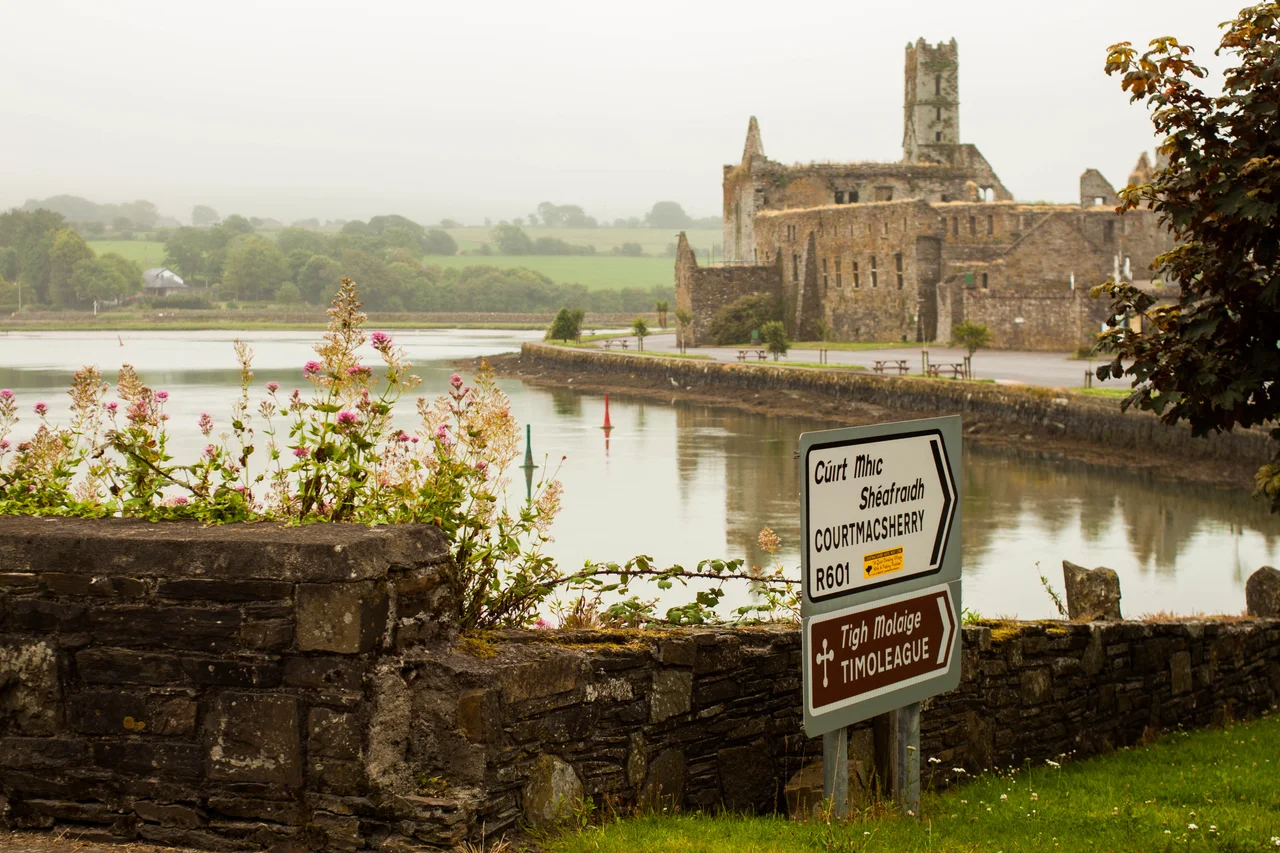

Timoleague Friary
There is a narrow gap in the south wall of the friary's transept, slightly wider on the inside than the outside, that is still called the Leper's Hole. On the days when Timoleague had a leprosarium up the road at Spittal, the sick would gather beneath this window during Mass. They could see and hear the service through it; they could not enter the church. The monks would pass the Eucharist out to them on a long spoon - close enough for communion, distant enough for fear of contagion. Of all the ruined abbeys that line the Irish coast, Timoleague Friary is one of the few whose stonework still keeps the architecture of plague visible in its walls. It is also the largest medieval ruin in West Cork, sitting directly on the bank of the Argideen River where it widens into Courtmacsherry Bay.
A Candle on a Sheaf of Corn
The story Timoleague tells about itself begins in the 6th or 7th century with Saint Molaga, the wandering Irish missionary said to have brought beekeeping to the country. According to legend, he tried to build a monastic settlement a mile west of here, but every day's work would collapse by morning. Reading this as a sign, Molaga set a blessed candle on a sheaf of corn and floated it down the Argideen River, and built where it came ashore. The town that grew around the site took his name - Teach Molaga, 'Molaga's House' - now Timoleague. Whether or not the candle and the sheaf existed, the saint did, and the spot he chose has held continuous Christian use for more than thirteen hundred years. The friary you see today is the medieval superstructure built over that older holy ground.
Franciscans and a Disputed Date
When exactly the Franciscans took over Molaga's old site is debated. The Annals of the Four Masters say 1240, founded by the MacCarthy Reagh dynasty - the local Gaelic rulers who became patrons of the friary for centuries afterward. Documentary evidence points later, to between 1307 and 1316. Physical evidence suggests a 13th-century building was incorporated into the new friary. Whatever the exact date, the buildings grew steadily. Local slate, quarried at nearby Borleigh, gave the friary its plain Early English Gothic character; a mill stood beside the main structure; the grounds covered four and a half acres - four times what survives today. Even after Henry VIII's dissolution of the monasteries in 1540, the friars stayed in Timoleague. In 1568 the crown finally seized the buildings. The friars still came back. By the early 17th century the friary was again a major ecclesiastical centre, trading actively with Spain - until 1642, when English soldiers under Lord Forbes burned the friary and the town.
St Molaga's Head and the Fairy Cupboard
The friary is full of small, particular things. A bullaun stone - a hollowed boulder older than the friary itself, probably surviving from Molaga's original 6th- or 7th-century settlement - sits in the sacristy. Local tradition calls it a 'wart well' because the water that collects in it is said to heal warts. On the exterior wall, a protruding stone is called St Molaga's Head; it was a gift from French sailors in thanks for safe harbour after a storm at sea, originally carved as the saint's face, now worn featureless by centuries of weather. In the south wall of the cloister there is a small intramural space called The Fairy Cupboard. In the 1800s some local children supposedly crawled in there and discovered a parchment manuscript under one of the flagstones, which they then proceeded to use as a football until the remainder was eaten by pigs. The story may be apocryphal - many old Irish stories are - but the gap in the wall is real, and so is the loss it represents.
Bell Tower, Burials, Lament
The bell tower was added between 1510 and 1518, funded by Bishop John Edmond de Courcy, who had been a friar at Timoleague before becoming bishop, and his nephew James, 8th Baron Kingsale. It is one of only fourteen pre-Reformation Franciscan towers still standing in Ireland - battlemented, slightly battered, wider north-to-south than west-to-east in the typical Franciscan way. De Courcy was buried in the transept, but during the Cromwellian period his grave was desecrated and his bones thrown into the estuary that runs past the wall. The floor of the friary today is considerably higher than it would have been during use - centuries of burials within the ruined walls have built it up. In about 1812 the Irish poet Seán Ó Coileáin wrote Machtnadh an Duine Dhoilghiosaich, a lament for the ruined abbey, which James Hardiman in 1831 called one of the finest modern poems in the Irish language. A bronze verse of it is set into the entrance gate today. William Ashford painted the friary in 1776 - twice. Standing now in the roofless choir, with the estuary just beyond the eastern window, you can see why anyone with a brush or a pen would have wanted to fix this place in something more durable than memory.
From the Air
Located at 51.64 N, 8.76 W on the southern bank of the Argideen River where it widens toward Courtmacsherry Bay. The friary's bell tower is the dominant feature - silhouetted against the estuary and visible from low cruise altitude (1,000-2,500 ft). The much smaller Church of the Ascension stands a few hundred metres away. Cork airport (EICK) is 26 nm to the northeast. Best photographed in the long evening light, when the western sun rakes across the tower face.
Nearby Stories
- Ballymaloe House 1.3 km away
- Ballincollig Castle 2.8 km away
- Skibbereen 9.8 km away
- Ballyvourney 10 km away
- Ballycotton 27 km away
- HMHS Llandovery Castle 53 km away
- Wolfpack Prien 74 km away
- SM U-27 85 km away