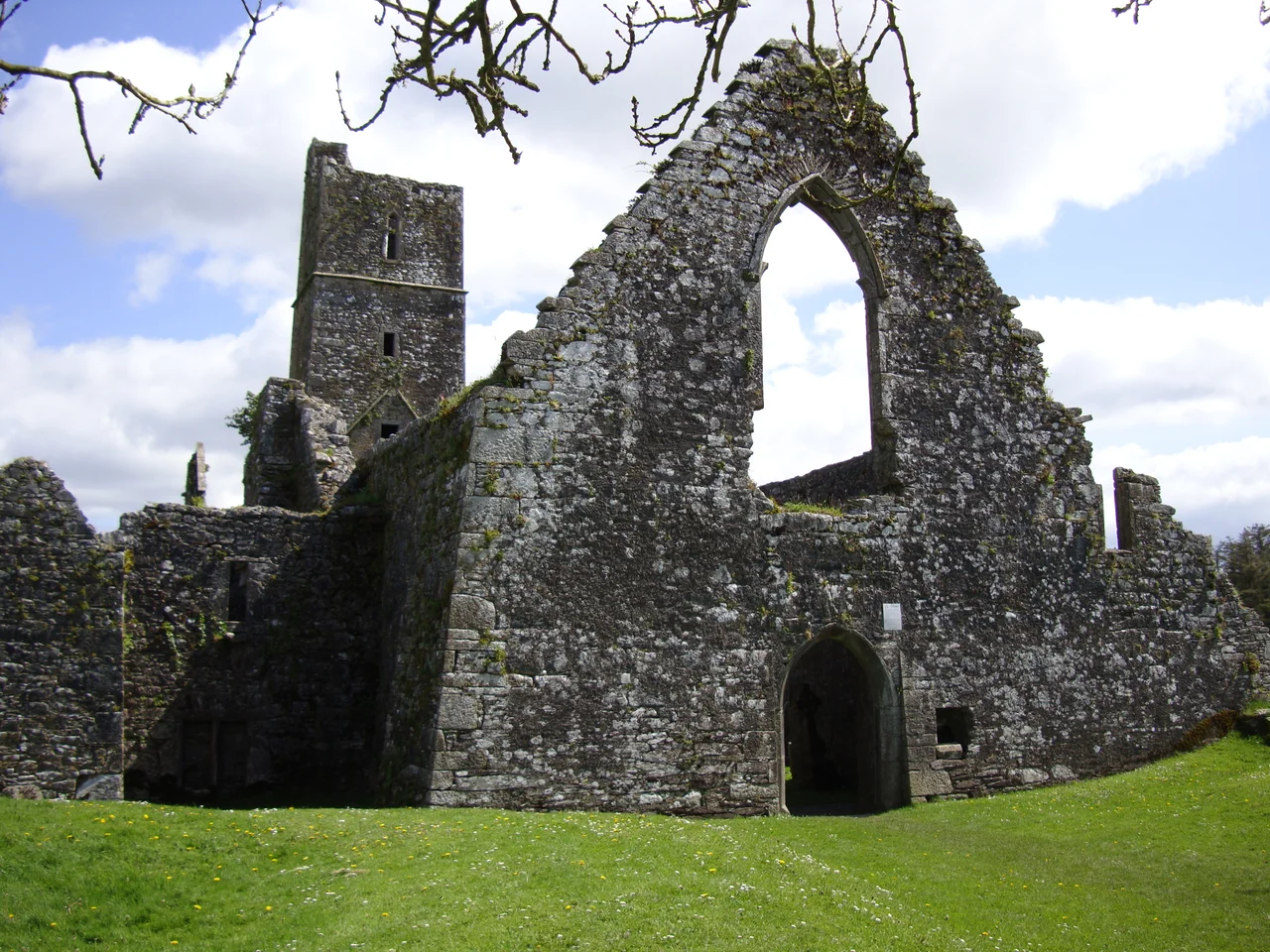

Kilcrea Friary
Eibhlin Dubh Ni Chonaill, twenty-six years old and newly widowed, drank her dead husband's blood from cupped hands beside the road. Then she composed, by tradition extempore, the poem that would become Caoineadh Airt Ui Laoghaire - the lament for Art O Laoghaire - the most celebrated piece of Irish-language verse of the eighteenth century. The man she mourned was buried at Kilcrea Friary, where his roofless stone slab still reads: "Lo Arthur Leary, Generous, Handsome, Brave, slain in His Bloom, lies in this Humble Grave, Died May 4th, 1773, Aged 26 Years." The friary that holds him is older than the Reformation, older than the Tudor conquest. It has been holding the dead of Muskerry for more than five centuries.
Cormac the Strong builds a refuge
In 1465, Cormac Laidir MacCarthy - Cormac the Strong, ninth Lord of Muskerry - invited the Observant Franciscans into the valley of the Bride. He built them a friary and, half a mile west, a tower house to protect it. The Observants were the strict branch of the Franciscan order, recently reformed, austere by design, and they suited Cormac's purpose: a religious foundation that would lend prestige to his lordship while a castle stood close enough to defend it. The site was not virgin ground. A sixth-century nunnery is said to have stood here under the abbess Saint Cyra, also called Creidh, from whom the name Kilcrea derives - Cill Chreidhe, Creidh's church. Legend places her grave at the centre of the choir. Cormac himself was killed in battle in 1494 and laid in the chancel beneath an inscription that called him "the first founder of this convent." A carved stone head on one of the upper floors of the tower is thought to be his portrait.
Sacked, repaired, sacked again
The English army first attacked Kilcrea in 1542 - the year Henry VIII declared himself King of Ireland - and sacked it again in 1584. Each time the friars came back. The MacCarthys kept paying for repairs through the late 1500s while the broader Gaelic order around them was breaking apart. The friary was granted to Cormac MacDermot MacCarthy in 1597, repaired again in 1604, and somehow remained an active religious house until the 1620s, with Father John Gould recorded as Superior in 1621. By then the cause was lost. The friars left or were driven out. The roof came down. But the graveyard kept filling. The MacCarthys of Muskerry were buried in the chancel from 1494 to 1616. None of their tombs survives intact - centuries of weather and the occasional metal-detector treasure hunter have done their work - but the soil holds them still.
Caoineadh Airt
Art O Laoghaire was thirty when a Protestant magistrate named Abraham Morris shot him from his horse on the road near Carriganima on 4 May 1773. The official charge was that Art had refused, as a Catholic under the Penal Laws, to sell his fine bay mare to Morris for the legally mandated five pounds. The deeper offence was that Art - an officer in the Hungarian Hussars who had come home flashing continental manners and a tendency to humiliate Protestant gentlemen - would not be cowed. His widow Eibhlin Dubh, a niece of Daniel O Connell, learned of his death when his horse came home riderless, its saddle stained with blood. She rode to the spot, dismounted, and drank from his wounds in the old Gaelic mourning custom. The poem she composed afterwards - 390 lines of keening, accusation, grief and love - was passed down orally and only written out a century later. Art was buried first at Kilcrea, then exhumed for legal reasons, then reburied. His stone in the friary's east window names him with a directness the lament never quite achieves: a young man slain in his bloom.
Walking the ruin
Approach Kilcrea today and the tower comes into view first - tall, square, narrow, with a single ogee window in each face of the top storey. A west doorway in the gable leads into the chapel. An arcade separates the nave from the south aisle and transept. The chancel still holds its tall east window, though the tracery is gone. North of the church is the cloister, roofless now but its two-storey ranges substantially intact. The chapter room and refectory occupy the east range, with the dormitories above. The scriptorium - the most well-lit room in any medieval Irish friary - measures 39 by 17 feet and is pierced by eleven tall two-light windows. The book the friars wrote here, the Rennes Manuscript, is now preserved in Brittany: 125 folios of poor-quality parchment containing one of the great surviving collections of Dindshenchas, the lore of Irish placenames. The friary is National Monument number 182. The graves continue to be visited - some by descendants of the buried, some by readers of the lament, some by detectorists whom the National Monuments Service would prefer to keep out.
From the Air
Kilcrea Friary sits at 51.8647 N, 8.7111 W in the valley of the River Bride, about 15 km west-northwest of Cork city centre and 2 km southeast of Ovens village. The roofless tower and chancel are clearly visible from low altitude against the surrounding pasture. Kilcrea Castle stands as a separate ruin roughly 500 m to the west. Cork Airport (EICK) is 12 km southeast; Kerry (EIKY) is 80 km west. The R618 from Cork to Macroom passes 1.5 km north of the site. Best viewed at 800-2,000 ft AGL with morning or late afternoon light raking across the stone.
Nearby Stories
- Ballyvourney 1.6 km away
- Castlemartyr 3.9 km away
- Ballybeg Priory 4.1 km away
- Kilbrittain 5.2 km away
- Shanbally Castle 10 km away
- Skibbereen 17 km away
- Castleisland 22 km away
- SM U-27 118 km away