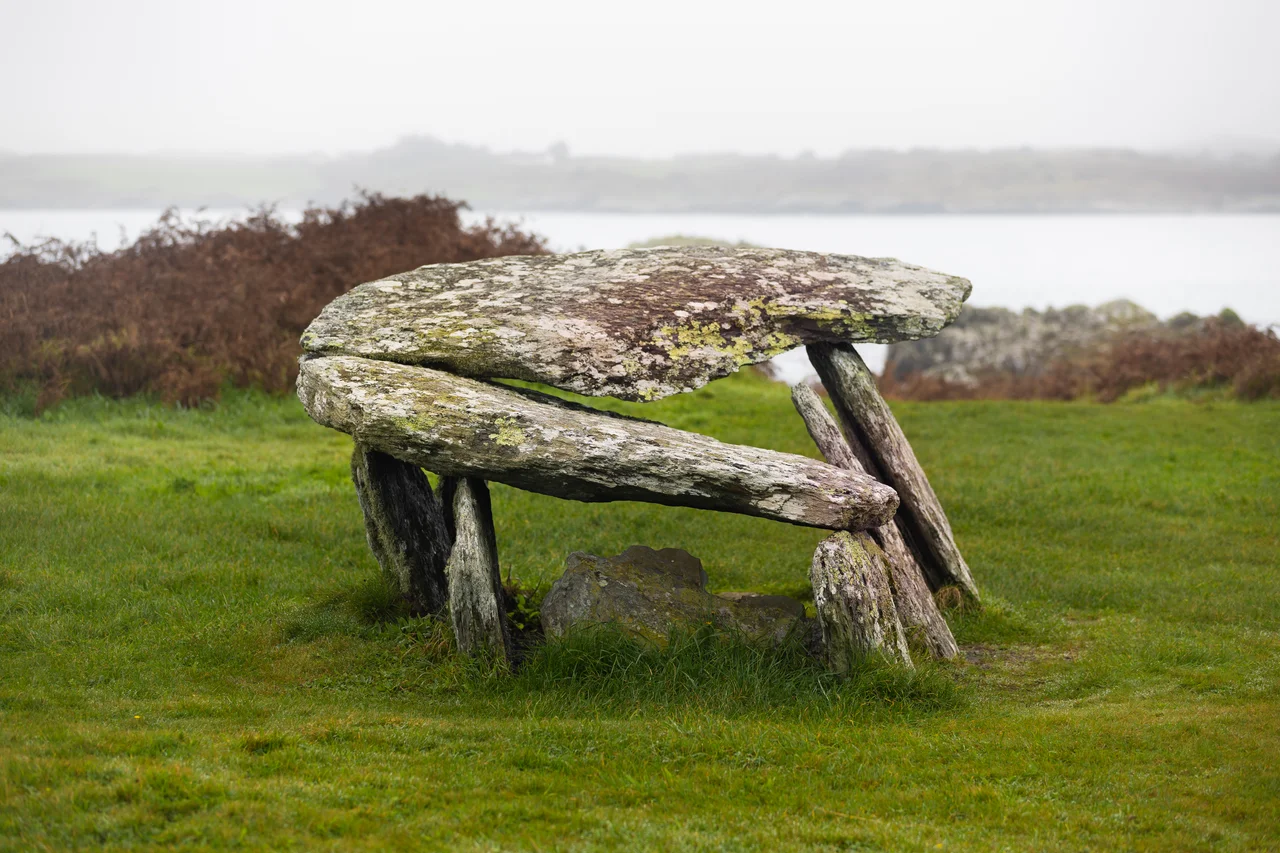

Altar Wedge Tomb
Pull a slab of stone out of the heather, line up three more, and put a roof-stone over the top - that is the basic recipe for an Irish wedge tomb, and the country has hundreds of them. The Altar Wedge Tomb is one of the smaller ones. It crouches on a cliff edge above Toormore Bay, 6.7 kilometres west-southwest of the village of Schull, its trapezoidal stone gallery just three metres long. But the Altar carries an extra story that most of its cousins do not - it became, four thousand years after it was built, a place where outlawed Catholics gathered for Mass in the woods.
Built for the Dead, c. 2500-2000 BC
Wedge tombs were the last great megalithic burial form in Ireland, built in the late Neolithic and early Bronze Age - roughly 2500 to 2000 BC. They are called wedge tombs because the gallery widens at one end and narrows at the other, like a doorstop laid on its side. The Altar's gallery is 3.42 metres long, 1.9 metres wide at the west end and 1.25 metres at the east. One large roof-stone, 2.7 metres long, still sits above the eastern end; a second roof-stone has slipped down and now leans against the side stones at the west. There is no cairn material visible and no surviving kerbstones - the loose stone that once covered the chamber was probably carried off in the 19th century to build local roads. The Altar was excavated in the summer of 1989 by Dr. William O'Brien and Madeline Duggan. They found cremated human bones, a tooth, worked flint, charcoal, periwinkles, limpets, and fish bones - food and remains and the careful work of a community that took burial seriously.
An Alignment to the Setting Sun
The entrance is aligned roughly east-northeast to west-southwest. Look out through the open gallery and the line points toward Mizen Peak, called in Irish Carn Ui Neit - the cairn of Net, a figure from Irish mythology. The same line catches the setting sun at Samhain, the festival on 1 November that marked the beginning of the Celtic winter, the gateway between halves of the year. Whether the alignment was deliberate or coincidental is the kind of question wedge-tomb archaeology cannot quite settle, but the geometry is there: a slot of light moving across the inside of the tomb on one particular evening each year, framing the death of the year and, presumably, the people whose ashes lay inside. The site was used long after the original burials. Cremated burials around 2000 BC gave way to pit burials by about 1200 BC. Then, much later still - around the year 200 - someone dug a pit at the tomb and filled it with fish, shellfish, and cetacean bones, apparently as a ritual offering. The dead were remembered, in successive idioms, for thousands of years.
Mass Rock
Then the tomb's story shifts entirely. After the English Reformation and especially during the 18th-century penal era in Ireland - the period when the Penal Laws restricted Catholic worship, property ownership, and political participation - Irish Catholics could not legally hold Mass in a church. They held it instead in the hills, at rocks and ruins remembered from older traditions, with a lookout posted to watch for English soldiers. These places became known as Mass rocks. The Altar Wedge Tomb served as one. The fact that a Bronze Age burial monument became an 18th-century Catholic altar is layered in ways the name itself preserves: locals already called the great roof-stone 'the Altar' before the tomb was excavated and identified as prehistoric. Despite the name, there is no archaeological evidence that the slab was ever used for ritual sacrifice in its original Bronze Age context. Across the road, a holy well stood, completing the inventory of a small landscape of sanctity. Two religions, separated by three thousand years, used the same stones for the same human reason.
What Remains, and What Was Carried Off
Today the Altar is a national monument, protected and kept. The cairn that once covered the chamber is gone, recycled into 19th-century road metal, and the kerbstones that would have edged it have vanished the same way. What is left is the essential armature - three slabs of orthostatic stone, a fallen roof, an alignment with the western sky. A footpath leads up from the road. The cliff drops down behind. Toormore Bay catches whatever light is going. From a distance the tomb is easy to miss; it does not loom. But the longer you stand with it, the more the small site organises the landscape around it. Mizen Peak rises in the line of the entrance. The Atlantic stretches to the southwest. Somewhere in the long unbroken history of this peninsula, a community decided this was the place where they wanted their dead to face the sun as it set.
From the Air
Located at 51.51 degrees N, 9.64 degrees W on the cliffs above Toormore Bay, about 7 kilometres west-southwest of Schull on the Mizen Peninsula in County Cork. From the air the tomb is too small to spot; the relevant landmarks are Toormore Bay itself, the bulk of Mizen Peak to the west-southwest, and the small road that runs along this coast. Cork Airport (EICK) is the nearest major airfield, about 100 kilometres east. Best visited on foot from the road, in clear daylight. The site is unfenced and exposed; the wind off the Atlantic here is real.
Nearby Stories
- Dursey Island 1 km away
- Glandore 3.2 km away
- Coolavokig ambush 8.1 km away
- Valentia Lifeboat Station 10 km away
- Battle of Callann 16 km away
- HMHS Llandovery Castle 16 km away
- RMS Lusitania 42 km away
- Sao Miguel 1926 km away