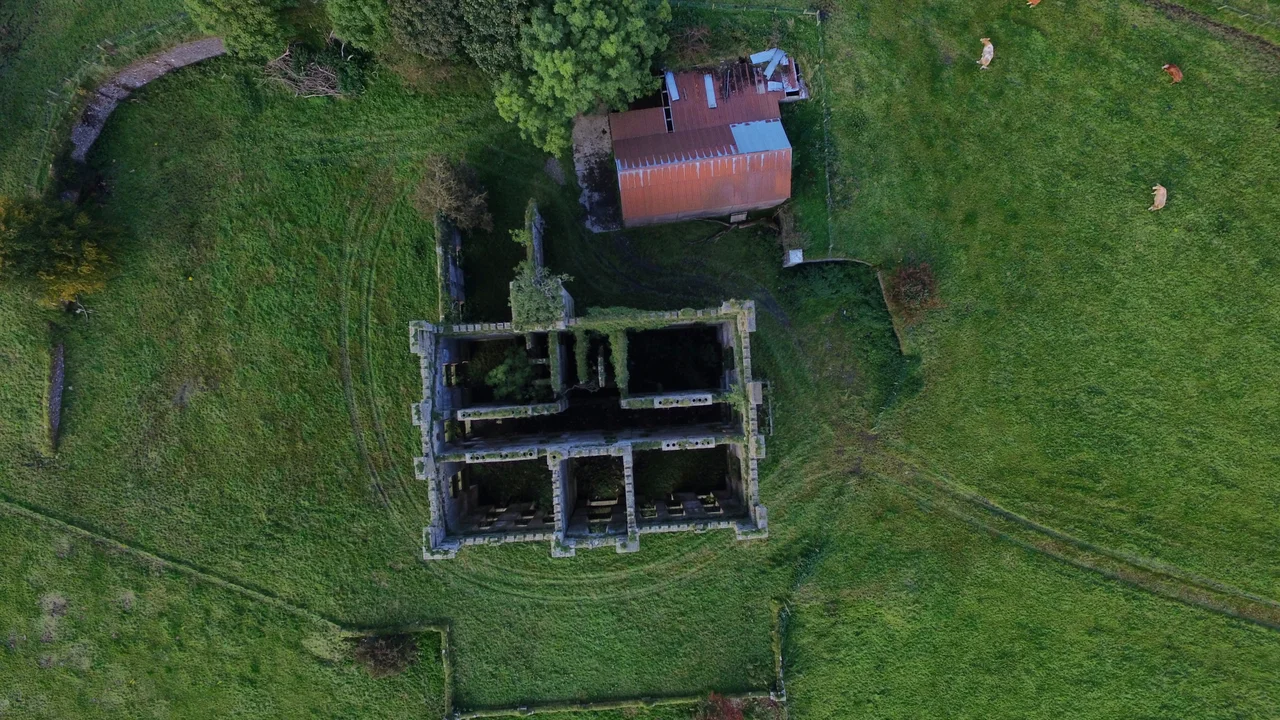

Altinaghree Castle
The locals just call it Ogilby's Castle, the way they have called it Ogilby's for over a century now, and they will tell you it was built so William Ogilby could entertain on a scale no neighbour in County Tyrone could match. The banquet room was famous before it was empty. Cut stone, carved windows, a long carriage drive winding up from the Dunamanagh-Claudy Road: in 1860, when the place went up, it was as confident a statement as a country gentleman could make. By 1885, twenty-five years later, the doors were locked and the rooms were sliding into ruin. Today you can photograph the shell from the B49. You cannot go inside. Even the roof is gone.
A Romance and a Disinheritance
The story of Altinaghree's collapse is, at its heart, a story about a son who would not be the man his father wanted. William Ogilby built the castle. He had wealth, two sons, and a clear vision of dynasty. His younger son James Douglas Ogilby fell in love with Mary Jane Jamieson, a factory seamstress, and was forbidden to marry her because she was a Catholic. James eloped with her in 1884 and the family did the only thing Victorian Protestant Tyrone could think of to do: they cut him off. He sailed for Australia. In 1885 he was appointed to the Australian Museum, where he became one of the most prolific ichthyologists of his era, naming hundreds of species of fish across the South Pacific. By the time he died in 1925, more than seventy fish carried his name in their Latin binomials. Few of them have ever swum within ten thousand miles of Tyrone.
An Heir Who Could Not Hold It
The estate passed instead to William's eldest son, Claude William Leslie Ogilby. Claude inherited the castle and the lands and the expectation of being the next country gentleman of Liscloon. He could not do it. He drank. He drank in the way that Victorian wealth made possible and Victorian respectability tried to hide. By 1875, at the age of forty-three, his kidneys had given out. Chronic alcoholism, the death certificate said, in language slightly more elaborate than that. He died ten years before the castle was abandoned and his death rendered the abandonment inevitable. The estate could not be made to pay; the heir was gone before he could even try. Bankruptcy followed, and the great banquet room hosted its last dinner sometime before the new decade began.
Where the Castle Stands Today
Altinaghree sits on private farmland a few miles outside Donemana, south of Derry in County Tyrone. The cut stone walls still rise to roughly their full height; the empty windows still hold their carved arches; ivy has done what ivy does. The small row of workmen's houses to the southeast, the Liscloon Cottages, were absorbed back into the working life of the farm and now shelter tools and feed. There is no admission, no caretaker, no plaque. You can photograph the building from the road to Claudy if you know where to look between the hedges. The B49 runs past as it always has. The Sperrin foothills rise to the south. The story this stone tells, of an Ulster Protestant patriarch who lost one son to love and the other to drink and saw the family's whole architectural ambition flicker out within a generation, is a story repeated in different keys across rural Ireland in the late nineteenth century. The castles fell because the world that had paid for them was passing. Altinaghree fell faster than most, because the wrong things happened to the wrong people at the wrong time.
The Fish Are Still Named
There is one survival from all this, and it lives in the catalogues of marine biology rather than in the stones of Tyrone. James Douglas Ogilby, the son who would not give up the seamstress, became one of the most respected ichthyologists in Australia. The Australian Museum still holds parts of his collection. His descriptive papers on the fishes of New South Wales and Queensland are still cited. Several species, including the Brisbane River blue eye, were first described by him. He is not the kind of figure who shows up in tourist brochures. But it is fair to say that William Ogilby's castle, the cut-stone monument he built to perpetuate his line, lies in ruin while the name he tried to deny his son is alive in Latin in scientific journals on three continents. There are worse legacies than that, and Altinaghree's silent walls cannot really argue with the result.
From the Air
Altinaghree Castle sits at roughly 54.88 degrees north, 7.25 degrees west, on private farmland just outside Donemana in County Tyrone, about 14 km south of Derry. From the air look for the small town of Donemana along the B49 between Strabane and Claudy; the castle ruin lies a short distance to the south of the village. The nearest controlled airport is City of Derry (EGAE) about 17 km north; Belfast International (EGAA) lies 90 km east. Donegal Airport (EIDL) is approximately 55 km west across the border. The Sperrin foothills to the south make a good visual landmark for the broader area in clear weather.
Nearby Stories
- Portrush Lifeboat Station 1.9 km away
- Main Street, Letterkenny 2.1 km away
- Inishowen 6 km away
- Rosguill 6.3 km away
- County Tyrone 7.1 km away
- St Patrick's College, Maghera 9.6 km away
- St Patrick's Purgatory 11 km away
- Coalisland Canal 17 km away