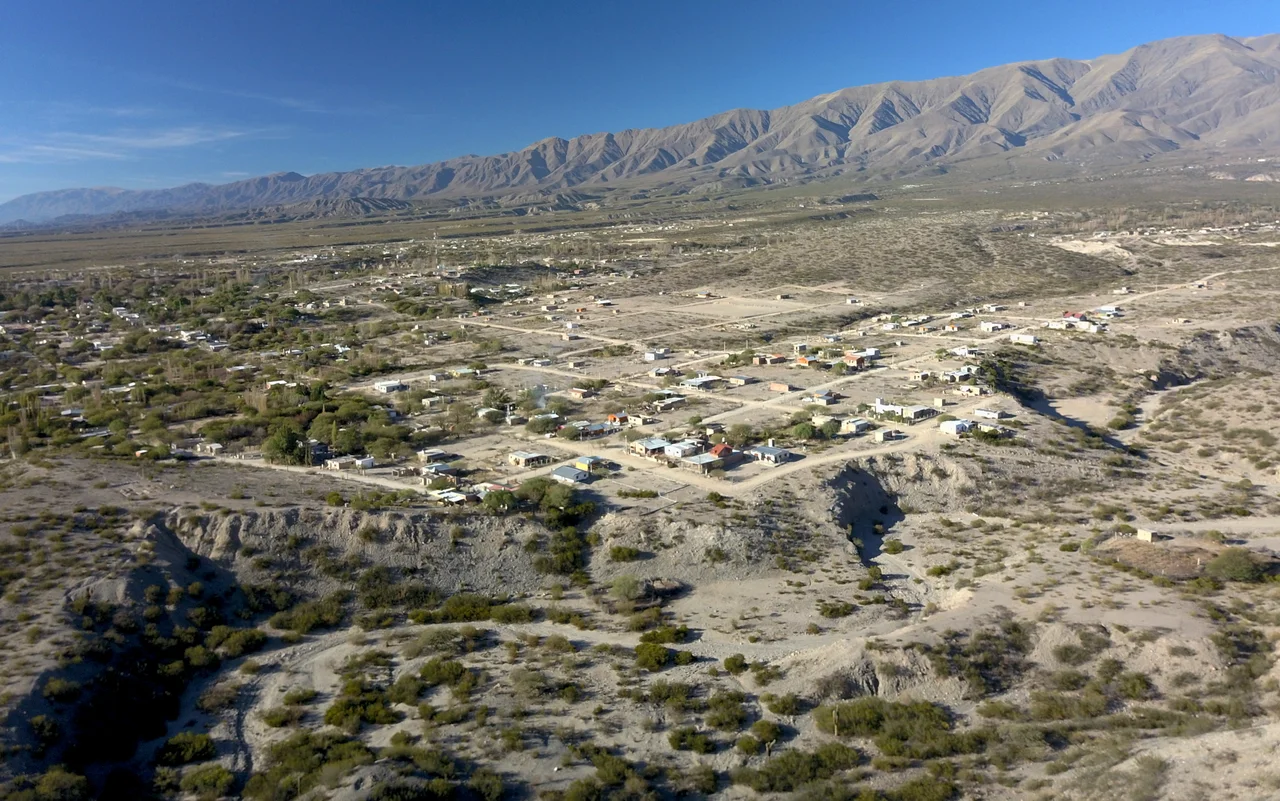

Amaicha del Valle
In 1716, the Spanish crown did something it almost never did: it gave the land back. A royal decree, the Cédula Real, recognized the Amaicha people's possession of their ancestral territory in the Calchaquí Valleys, lands their families had worked long before any European arrived. Three centuries later, the community of Amaicha del Valle still holds that title, more than fifty thousand hectares of high desert in northwestern Tucumán, governed by descendants of the Diaguita-Calchaquí who never fully surrendered it. The decree is more than a historical curiosity. It is the legal spine of a community that has survived where so many others were erased.
The People Who Stayed
The Amaicha belong to the Diaguita-Calchaquí, the peoples who held these valleys for centuries and who mounted one of the fiercest and longest resistances to Spanish conquest anywhere in the Americas, fighting on until 1650. Most communities that resisted were broken, scattered, or marched away. The Amaicha endured. Today the great majority of the area's families identify as descendants of those original inhabitants, and the community maintains a continuous tradition of self-governance that reaches back through the colonial decree to its pre-Hispanic roots. To call Amaicha del Valle simply a village in Tucumán Province undersells it. It is one of the rare places in Argentina where an Indigenous people can point to the same ground their ancestors held and say, without interruption, that it has always been theirs.
A Festival for Mother Earth
Every February, as the rest of Argentina celebrates Carnival, Amaicha del Valle holds the National Festival of the Pachamama, a celebration of Mother Earth that has run since 1947. It is a ritual of gratitude rather than spectacle: thanks given for the harvest, for water, for survival in a hard land. The festival's most resonant moment comes with the election of the Pachamama herself. Since 1949, the community has chosen an elderly woman each year to embody the wisdom and protective spirit of Mother Earth, entrusting her with caring for the land's spirit through the coming months. Folkloric musicians, dancers, and gaucho riders fill the days, but at the center stands that quiet act of honoring an elder, a reminder that here the earth is not a resource but a relative.
Where the Sun Almost Never Leaves
Amaicha sits at about 2,000 meters in the dry inland valleys, sheltered from the wet Atlantic air by the mountains that wall off the humid lowlands to the east. The result is a climate locals describe with quiet pride: the sun, they say, shines 360 days a year. That relentless light shapes everything. It is a land of weavers working wool on patio looms, of musicians and balladeers, of small-scale winemakers coaxing grapes from the arid ground. The brightness gives the valley its clean, saturated color, the ochre hills and pale sky meeting with almost no haze between them. For travelers arriving from the green, cloud-wrapped slopes near Tafí del Valle, crossing into Amaicha feels like stepping out of mist and into a place where the air itself has been wrung dry and lit from within.
The Road Through the Valleys
Amaicha lies just east of National Route 40, the legendary road that runs the length of Argentina, and it serves as a natural waypoint in the Calchaquí Valleys. From the north it is reached by a short provincial road; from the south, by Route 307 climbing up from Santa María in neighboring Catamarca. Whichever way you come, the approach is a study in contrast, the lush switchbacks giving way to open desert, the temperature and the light shifting as you crest into the valley. The community has leaned into welcoming visitors on its own terms, sharing its Pachamama traditions and its handwork without surrendering the identity that anchors them. Amaicha offers something increasingly rare: a living culture met on its own ground, by its own people, exactly where they have always been.
From the Air
Amaicha del Valle lies at approximately 26.60°S, 65.92°W in the Tafí del Valle department of Tucumán Province, in the Calchaquí Valleys at an elevation near 2,000 meters, just east of National Route 40. The nearest major airport is Martín Miguel de Güemes International at Salta (ICAO SASA / IATA SLA) to the north; Teniente General Benjamín Matienzo International (ICAO SANT) serves San Miguel de Tucumán about 164 km to the east, though reaching the valley requires crossing high mountain passes. From the air, the settlement reads as a small grid of streets and irrigated green amid arid ochre valley floor, with the Cumbres Calchaquíes rising sharply to the east. The region's famously dry, sunny climate makes for excellent visibility most of the year; recommended viewing in clear daytime light to catch the saturated desert colors.
Nearby Stories
- San Miguel de Tucuman 27 km away
- Cafayate 34 km away
- Battle of Famaillá 53 km away
- Londres, Catamarca 113 km away
- 1692 Salta Earthquake 123 km away
- Santiago del Estero 149 km away
- Ojos del Salado 215 km away
- Tolar Grande 220 km away