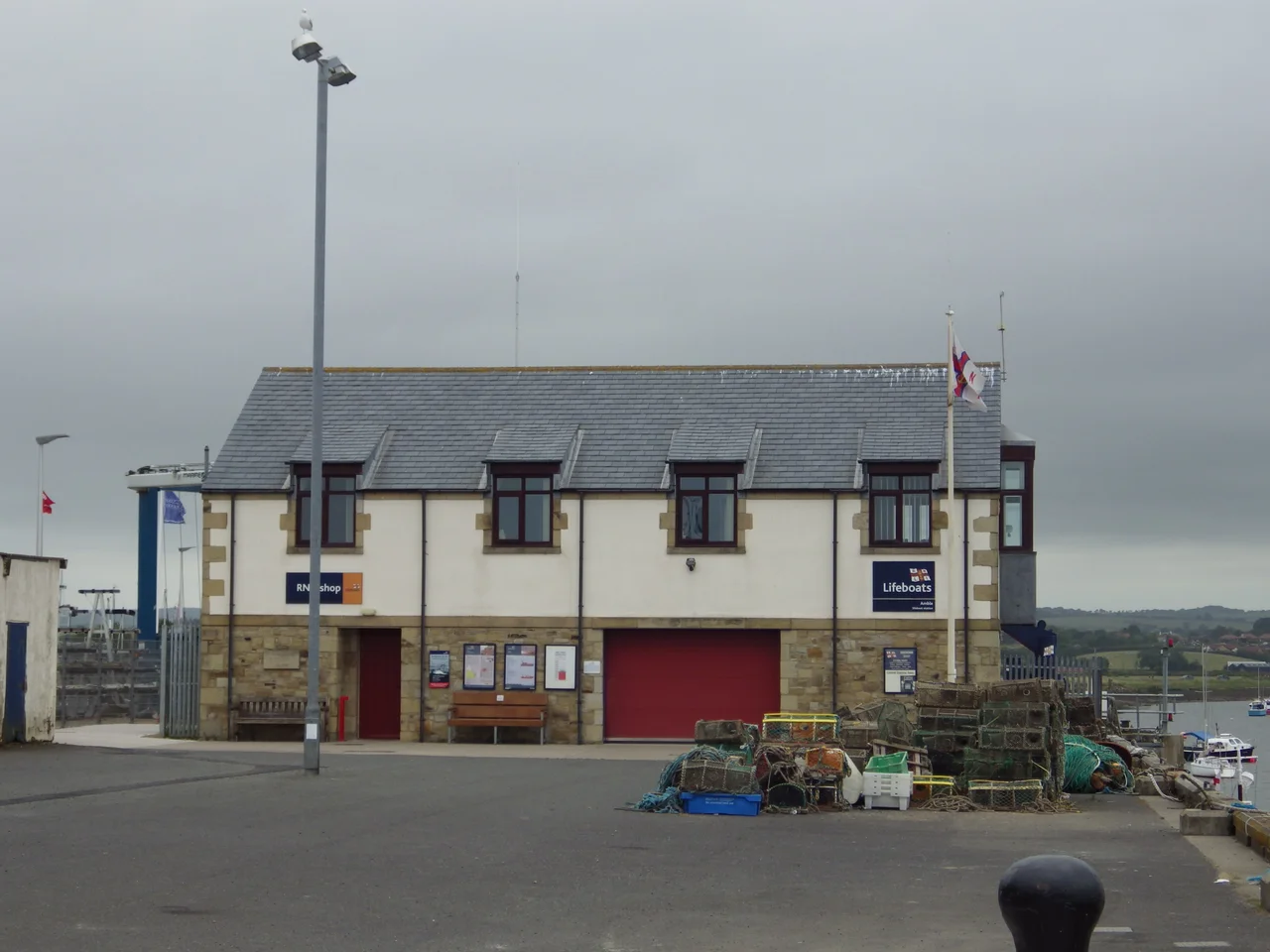

Amble Lifeboat Station
On 29 September 1969, an RAF marine pinnace called Hullat capsized off Amble's north pier with seven men aboard. The inshore lifeboat reached the scene in rough water and pulled two survivors clinging to the upturned hull. The big lifeboat Millie Watson arrived and took off a third. Then someone heard knocking from inside the hull. Local divers were ferried out. Navy divers from Rosyth eventually cut a hole through the steel and reached the fourth man, still alive. Four RNLI Bronze Medals were awarded that day - two of them the first ever given to an inshore lifeboat crew.
A Confused Beginning
The first lifeboat at Amble had already failed somewhere else. The Blythe had been stationed elsewhere on the coast and capsized in 1841, killing ten of her crew. The Royal National Institution for the Preservation of Life from Shipwreck put her up for sale in March 1843, and when nobody bought her she was transferred to Amble instead. The Harbours, Docks and Piers Clauses Act of 1847 then required harbour commissioners to provide rescue equipment, and the Port of Newcastle Shipwreck Association supplied a new boat and Manby rocket gear. Records are sparse, dates conflict, and at one point the same boat seems to have served and then been rejected, having ended up back at Amble in 1856 only for the crew to declare it 'too heavy' to launch effectively.
Closed, Re-opened, Modernised
By 1852 the lifeboat had moved to Hauxley, a couple of miles south, judged a better launching place for the Warkworth Harbour lifeboat. Amble station was closed - though the old boat lingered, like an unwelcome guest, for another four years. The station stayed dark for more than eighty years. Then in 1939 the RNLI placed a new motor-powered lifeboat at Amble. The Hauxley boathouse, designed for hand-launched boats from the beach, could not handle a motorised vessel, so Hauxley closed and Amble reopened. Today the station operates the all-weather Shannon-class lifeboat Elizabeth and Leonard, on station since 2016, and the inshore D-class Alf and Dora Whiting, on station since 2022.
The Empire Breeze
On 5 February 1941, the British cargo steamship Empire Breeze of Sunderland was on her maiden voyage from Scotland to America when she ran aground on Bondicar Rocks just south of Hauxley. The Amble lifeboat made three trips through the surf and took off all 42 crew. The ship was later refloated and repaired. She sailed again until 25 August 1942, when a German torpedo found her in the middle of the Atlantic and sent her down for good. The lifeboat crew that pulled her crew from the rocks could not have known that. They knew only that 42 men in danger had become 42 men ashore - which, on a winter night on the Northumberland coast, is the work the station exists to do.
Why a Lifeboat Here
Amble sits at the mouth of the River Coquet, a notch in a coast that runs straight and exposed for miles in either direction. Coquet Island lies just offshore, with rocks and shoals around it. Bondicar Rocks lurk south of Hauxley. The Northumberland coast has wrecked more ships than anyone has counted, and the lifeboats that work it cover ground that other stations cannot reach. When the RNLI introduced inshore lifeboats in the 1950s and '60s for the new wave of leisure boating, Amble took delivery of D-51 in 1966. Three years later, the Hullat rescue showed exactly why an inshore boat matters: small enough to get close, fast enough to make a difference in the minutes that decide who lives.
From the Air
Located at 55.34°N, 1.58°W at Radcliffe Quay, Warkworth Harbour, at the mouth of the River Coquet on the Northumberland coast. Nearest commercial airport is Newcastle (EGNT) about 28 nm south. The lifeboat station is easily spotted alongside Amble Marina, with the breakwaters of Warkworth Harbour extending north and south. Coquet Island lies 1.2 km offshore. Best viewed VFR at 1,500-2,500 ft along the coast, with Druridge Bay opening to the south and Warkworth Castle visible 1 nm inland on the bend of the Coquet.
Nearby Stories
- Beadnell 3.5 km away
- Great North Museum: Hancock 4.8 km away
- Battle of Otterburn 7.5 km away
- Battle of Flodden 10 km away
- Housesteads Roman Fort 14 km away
- Saltburn Pier 49 km away
- German submarine U-2367 74 km away
- Alexander L. Kielland (Platform) 278 km away