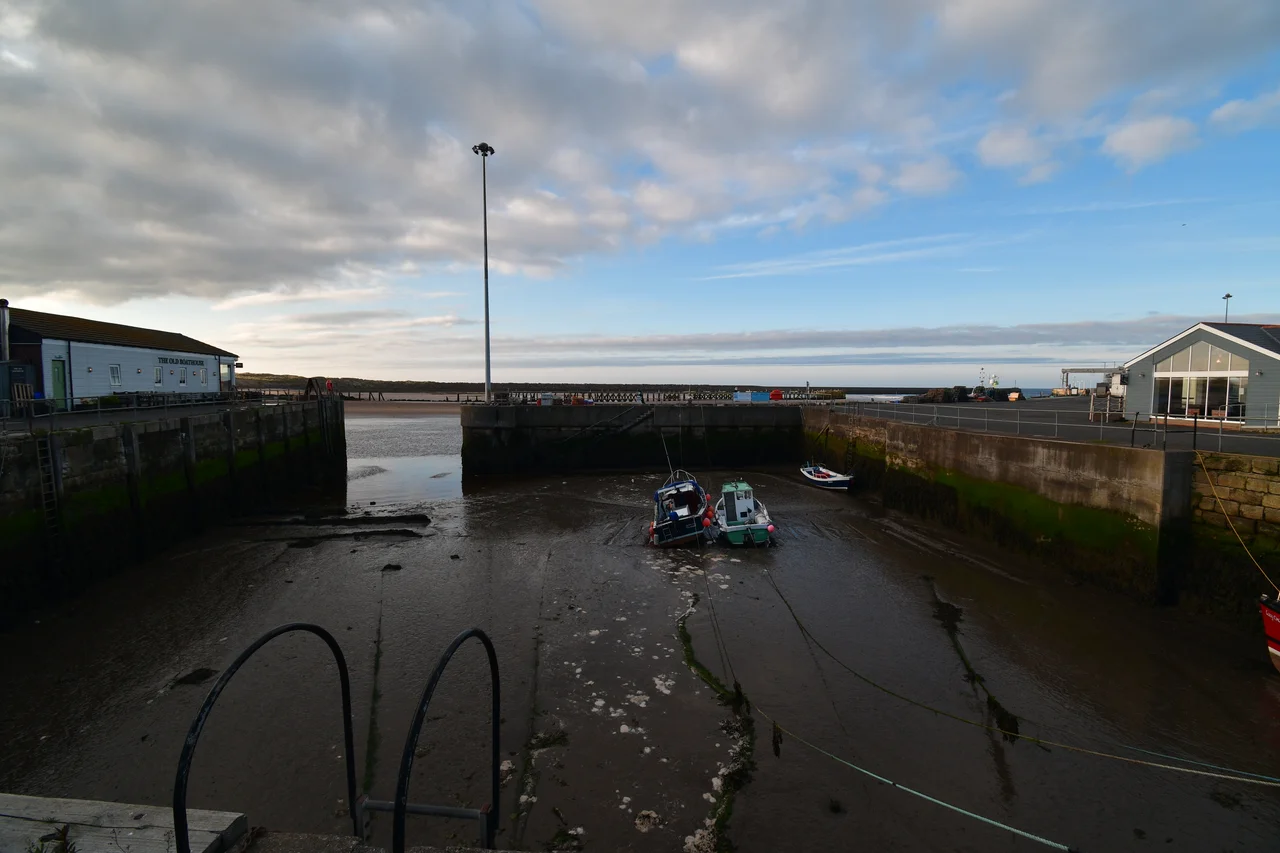

Amble
In the 1930s, as the RMS Mauretania steamed north on her last voyage to the breaker's yard at Rosyth, the town council of Amble sent her a telegram: 'Still the finest ship on the seas.' The Mauretania answered. Her message returned greetings 'to the last and kindliest port in England.' Amble has been clinging to that phrase ever since. It is a small place at the mouth of the River Coquet, never one of the great Northumberland coal ports, but the exchange with a doomed ocean liner caught something about how the town wants to see itself - and, it must be said, how it largely is.
The Smallest Coal Port
Amble grew in the nineteenth century because of coal. Collieries at Broomhill and Radcliffe sent their output here, railway links carried it to the harbour, and ships took it away. Before that the town was, in Pevsner's account, 'little more than a hamlet'. The Warkworth Harbour Commission was created in 1837 and accepted proposals from John Rennie in 1838 for breakwaters north and south. They were completed in 1849 at a total cost of £116,000. Even at its peak in 1914, Amble shipped just over 500,000 tons of coal - a modest figure compared to Blyth or the Tyne ports. The historian Robert Rennison noted that Amble served 'a small and discrete coalfield', and the prosperity it brought matched the modesty of the geology.
Cobles and Catastrophes
Before coal, fishermen sheltered here for centuries in traditional Northumbrian cobles - shallow-draught wooden boats designed to be launched off open beaches. J. & J. Harrison, founded in 1870, was building cobles in Amble as late as 1973 and was the first yard to fit them with engines. The coast around the town has wrecked more ships than the records can recover. Between 30 and 40 people died in various wrecks near Amble on 17-18 December 1872 alone. On 1 December 1943 an RAF Short Stirling returning from a mine-laying mission off Denmark crashed into Cliff House Farm at Togston in bad weather, killing six of seven crew and five children on the ground. A 1997 housing development carries their names on its streets.
After the Coal
Amble received regional development assistance from 1965, when the National Coal Board's restructuring gutted the local economy. By 1969 the Northern Economic Planning Council was proposing to close the port for leisure redevelopment, and RAF Acklington shut the same year. Unemployment exceeded 13 per cent. A proposed mushroom-farming operation that was supposed to absorb the lost jobs never materialised because the government wouldn't fund it. By 1984, when the development assistance was withdrawn, over 30 per cent of the 6,000 population were unemployed, 80 per cent of council tenants were on housing benefit, and a quarter of children received free school meals. The Amble Development Trust, founded in 1994, set about regenerating the town and won the Royal Town Planning Institute's Town Regeneration award in 2003.
Puffins and the Marina
Amble has reinvented itself as a coastal destination. The Braid - once industrial wharves - is now a marina and a designated village green. Nine hundred new houses have been built. The Amble Inn opened in 2019. The town presses for inclusion in the Northumberland Coast Area of Outstanding Natural Beauty, which currently ends at the pier. Just offshore, Coquet Island holds the largest British colony of the endangered roseate tern and around 18,000 pairs of puffins. A Puffin Festival has been held in the last two weeks of May since 2013, when puffin numbers on the island are at their peak. Visitors come for boat trips around the island and for the seabird viewing. The kindliest port in England gets by, these days, on birds and visitors rather than coal.
From the Air
Located at 55.33°N, 1.58°W at the mouth of the River Coquet on the north Northumberland coast. Nearest commercial airport is Newcastle (EGNT) about 28 nm south. Amble is unmistakable from the air - the Coquet bends sharply through the town and Warkworth Castle is clearly visible 1 nm upstream. Coquet Island lies 1.2 km offshore. The A1068 hugs the coastline to the north toward Alnmouth. Druridge Bay opens south. Excellent low-level VFR scenery 1,500-3,000 ft along this stretch of coast; watch for bird traffic around Coquet Island in late spring.
Nearby Stories
- Beadnell 3.5 km away
- Great North Museum: Hancock 4.8 km away
- Battle of Otterburn 7.5 km away
- Battle of Flodden 10 km away
- Housesteads Roman Fort 14 km away
- Saltburn Pier 49 km away
- German submarine U-2367 74 km away
- Alexander L. Kielland (Platform) 278 km away