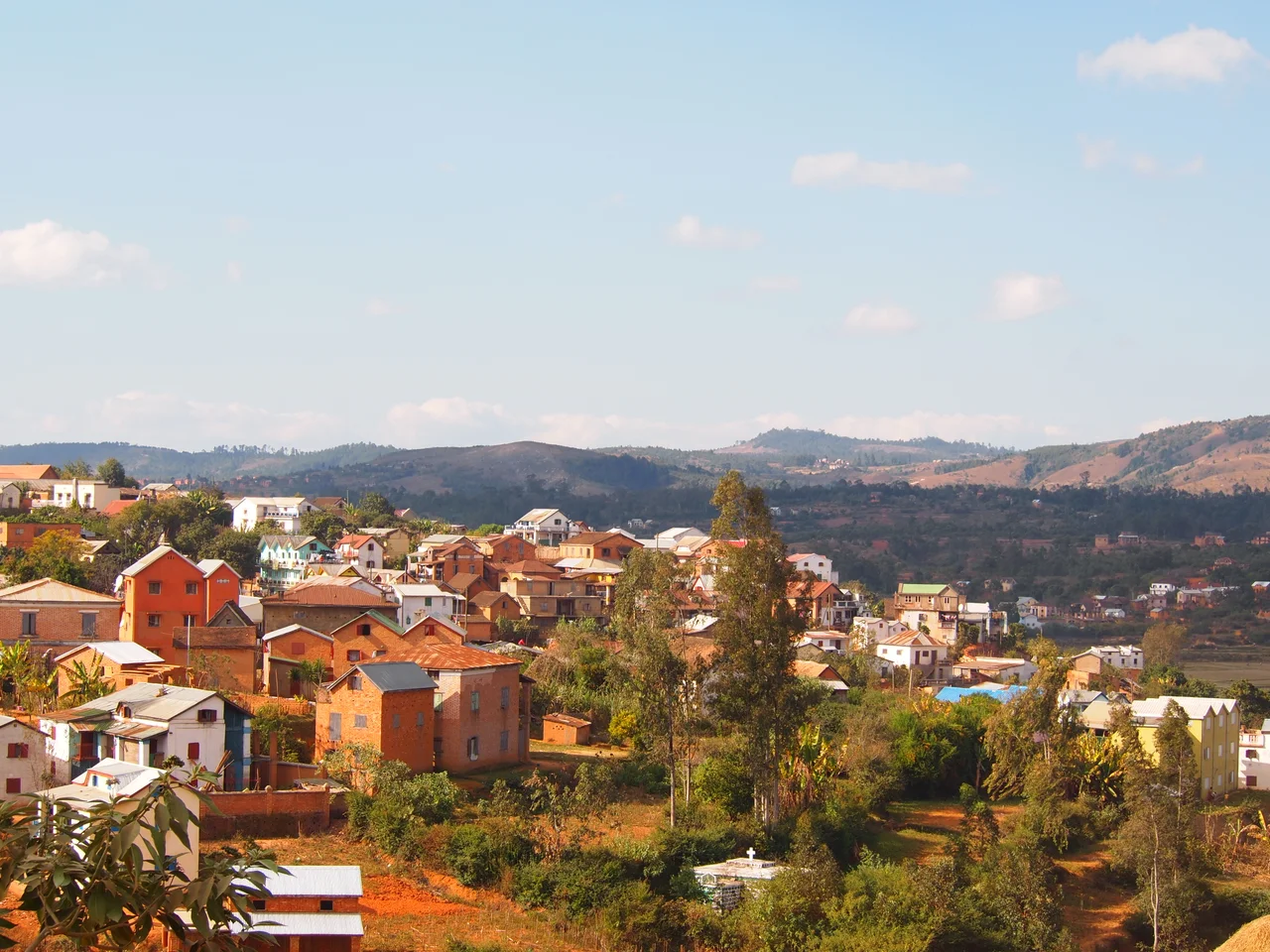

Ambositra
Run your fingers across a Zafimaniry house and you are reading a language. The spider's web carved into a shutter means family ties. The honeycomb pattern beside it stands for the bonds of community. None of it is written down, and almost none of it is held together by nails. In Ambositra, a market town strung along the RN7 at roughly 1,300 meters in Madagascar's central highlands, this is simply how the world is made: out of wood, by hand, in patterns that carry meaning the way other cultures carry alphabets. The town wears the nickname Capitale du travail sur bois, the capital of working in wood, and it has earned it.
The Carvers in the Hills
The artistry that gives Ambositra its reputation comes from the Zafimaniry, a subgroup of the Betsileo people who live in roughly a hundred villages in the forested mountains southeast of the town. There are only about twenty-five thousand of them, and they are the last community on the island still holding a woodcraft tradition that was once widespread across Madagascar. They build their homes entirely of wood without using a single nail, joining timber by notch and peg, then cover doors, posts, and furniture with geometric carving. The designs blend Austronesian and Arab influences, a reminder that the people who first settled Madagascar arrived across the Indian Ocean. In 2003 UNESCO proclaimed the woodcrafting knowledge of the Zafimaniry a Masterpiece of the Oral and Intangible Heritage of Humanity, and in 2008 it was inscribed on the Representative List.
Twenty Trees, Each With a Purpose
The Zafimaniry do not treat wood as a single material. They know around twenty endemic tree species, and each is matched to a job: one timber for the load-bearing frame, another for fine decorative panels, a third for tools or tombs. That intimacy with the forest is also the tradition's fragility. Heavy deforestation across the highlands has thinned the very species the craft depends on, and a skill that survives by being passed from one generation to the next cannot outlast the trees that feed it. Ambositra's shops, crowded with carved boxes, chessboards, and inlaid marquetry, are the visible end of a supply chain that begins with a shrinking forest and the knowledge of which tree does what.
A Town the Colonists Left Their Mark On
Ambositra is the capital of the Amoron'i Mania region, set above the Isaha River where terraced rice fields climb the surrounding slopes in green steps. Walk the Rue de Commerce and the French colonial era is still legible in the architecture: houses with carved wooden balconies, the Grand Hotel dating from 1912, and the Cathedral of the Immaculate Heart of Mary, one of the largest churches in Madagascar, raised in the first quarter of the twentieth century. At a red-brick Benedictine monastery founded in 1934, the nuns sell cheese, honey, and jam. The mix is characteristic of the highlands, where Malagasy craft, Catholic mission, and colonial commerce settled into the same few streets.
The Memorial on the Rue de Commerce
Not far from the Grand Hotel stands a memorial from 1947, dedicated to the victims of the Malagasy Uprising against French colonial rule. The rebellion that began that year was met with reprisals so severe that the death toll is still disputed, with estimates ranging from the figure France later published into the tens of thousands. The monument is small, but it places Ambositra inside one of the most painful chapters of the island's history, and it sits a short walk from the woodcarvers' shops, the cathedral, and the market, where ordinary life continues around it.
A Waypoint on the RN7
Ambositra owes part of its life to the road. The RN7, Madagascar's celebrated north-south route between Antananarivo and Tulear on the southern coast, runs straight through town, and for many travelers heading down the spine of the island the woodcarving capital is the natural place to break the journey. The country around it is classic Betsileo highland: cool, mountainous, and stitched with terraced rice fields that turn the hillsides into staircases of green and gold depending on the season. The Betsileo are renowned across Madagascar as master rice farmers, and the engineering of those terraces is its own quiet art, the agricultural cousin of the carving that fills the shops below.
From the Air
Ambositra lies at roughly 20.52 degrees south, 47.25 degrees east, in Madagascar's central highlands at about 1,300 meters elevation, about 255 km south of Antananarivo along the RN7. From the air, look for the town in a valley of terraced rice fields beside the Isaha River, with forested mountains rising to the southeast in Zafimaniry country. The nearest major airport is Ivato International (ICAO: FMMI) serving Antananarivo to the north; Antsirabe also has a regional airfield closer by. Highland weather brings cool, often clear mornings and afternoon cloud build-up; recommended viewing altitude for the valley and terraces is 3,000 to 5,000 feet AGL.
Nearby Stories
- Ranomafana National Park 56 km away
- Moramanga 92 km away
- Mantasoa 163 km away
- Makay Massif 178 km away
- Kirindy Forest 223 km away
- Canal des Pangalanes 229 km away
- Avenue of the Baobabs 245 km away