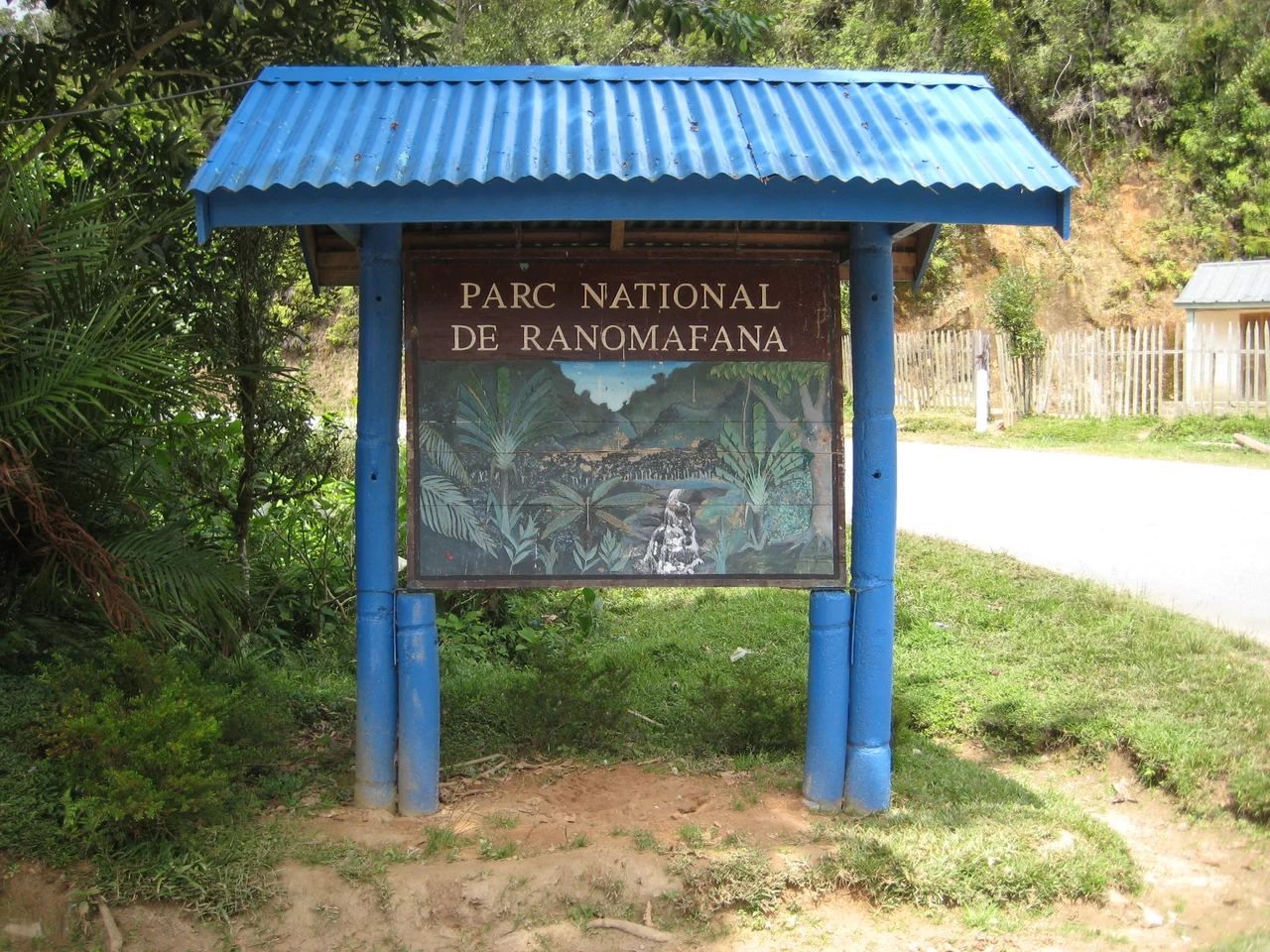

Ranomafana National Park
In 1986, a primatologist named Patricia Wright went into the forests near Ranomafana looking for a lemur thought to be extinct. She found it, the greater bamboo lemur, alive after all. And then she found something no scientist had ever recorded: a second species, golden-furred and feeding calmly on bamboo laced with enough cyanide to kill a person. The golden bamboo lemur was new to science, and its discovery changed everything. Within five years, the steaming hills around it were declared a national park, and what had been a place of hot springs and logging trails became one of the most celebrated rainforests on Earth.
The Lemur That Eats Poison
The golden bamboo lemur, Hapalemur aureus, lives on giant bamboo, and giant bamboo is laced with cyanide. The shoots this lemur prefers carry a dose that would be lethal to most mammals its size, yet the animal consumes it daily and survives by means biologists still find astonishing. It shares the forest with the greater bamboo lemur, the species Wright had come to rediscover, and with the gentler eastern lesser bamboo lemur, three bamboo specialists in one valley. Their improbable coexistence, each carving out a niche in the same plant, is part of why Ranomafana became a magnet for researchers and a living laboratory of evolution.
A Forest Born of a Discovery
Ranomafana was established in 1991, Madagascar's fourth national park, created specifically to protect the lemurs Wright had found and the rainforest that held them. It covers 41,600 hectares of dense, dripping forest threaded by paved road, which makes it one of the more accessible great parks of Madagascar. In 2007 it joined the Rainforests of the Atsinanana, the cluster of six eastern parks inscribed together on the UNESCO World Heritage List. Their forests are the last refuges of creatures that evolved in isolation after Madagascar broke from the other continents, and Ranomafana protects a rich slice of that ancient, vanishing biology.
Into the Green
You cannot wander Ranomafana alone, and that is by design. Foreigners have lost their way in this jungle and had to be searched for, so every visitor walks with a guide. The guides are worth their fee twice over: spread through the forest are spotters who track the animals from first light and radio their guides by mobile phone, so that a walk becomes a coordinated hunt for movement in the canopy. The golden bamboo lemur is only one prize among many. The park shelters around a dozen lemur species in all, from the larger diademed sifaka to mouse lemurs that could sit in a teaspoon, alongside chameleons, frogs, and birds found nowhere else. Choose a short circuit or a long one, or arrange a night inside the park to be deep in the forest at daybreak, when the cold mist still hangs and the animals stir. The name Ranomafana means "hot water," for the springs that draw visitors after a day on the trails.
The Practical Jungle
Ranomafana rewards the prepared. The park entrance sits on the RN25, an easy turn off the main highway, but the village where most lodgings cluster is a stretch down the road with no shuttle between them, so travelers without a car wait for empty seats in the shared taxis that rattle past. Bring Ariary in cash, because there is no reliable bank machine and souvenirs and guide fees alike are paid in notes. Pack proper shoes, insect repellent against the mosquitoes, and the discipline not to grab spiny branches when you slip on the wet trail. Do all this and the forest gives back generously, in glimpses of golden fur high in the bamboo and the green hush of one of the last great rainforests of the Indian Ocean. Afterward, the hot springs wait to ease the day out of tired legs.
From the Air
Ranomafana National Park lies at approximately 21.22 degrees south, 47.46 degrees east, in eastern Madagascar where the highlands tumble toward the coastal plain. From the air it appears as an expanse of dense, often cloud-wrapped rainforest cut by the RN25 and laced with rivers and the hot springs that give the area its name. A viewing altitude of 6,000 to 10,000 feet AGL works when the cloud cooperates, though this is one of the wetter, mistier regions of the island and low cloud is common. The nearest major airport is Fianarantsoa Airport (ICAO: FMSF), about 65 km to the southwest. Expect frequent rain and reduced visibility; clearer windows tend to open in the morning before the daytime cloud builds.
Nearby Stories
- Ambositra 45 km away
- Ambalavao 57 km away
- Canal des Pangalanes 151 km away
- Moramanga 160 km away
- Makay Massif 166 km away
- Teniky 177 km away
- Kirindy Forest 241 km away
- Mantasoa 241 km away