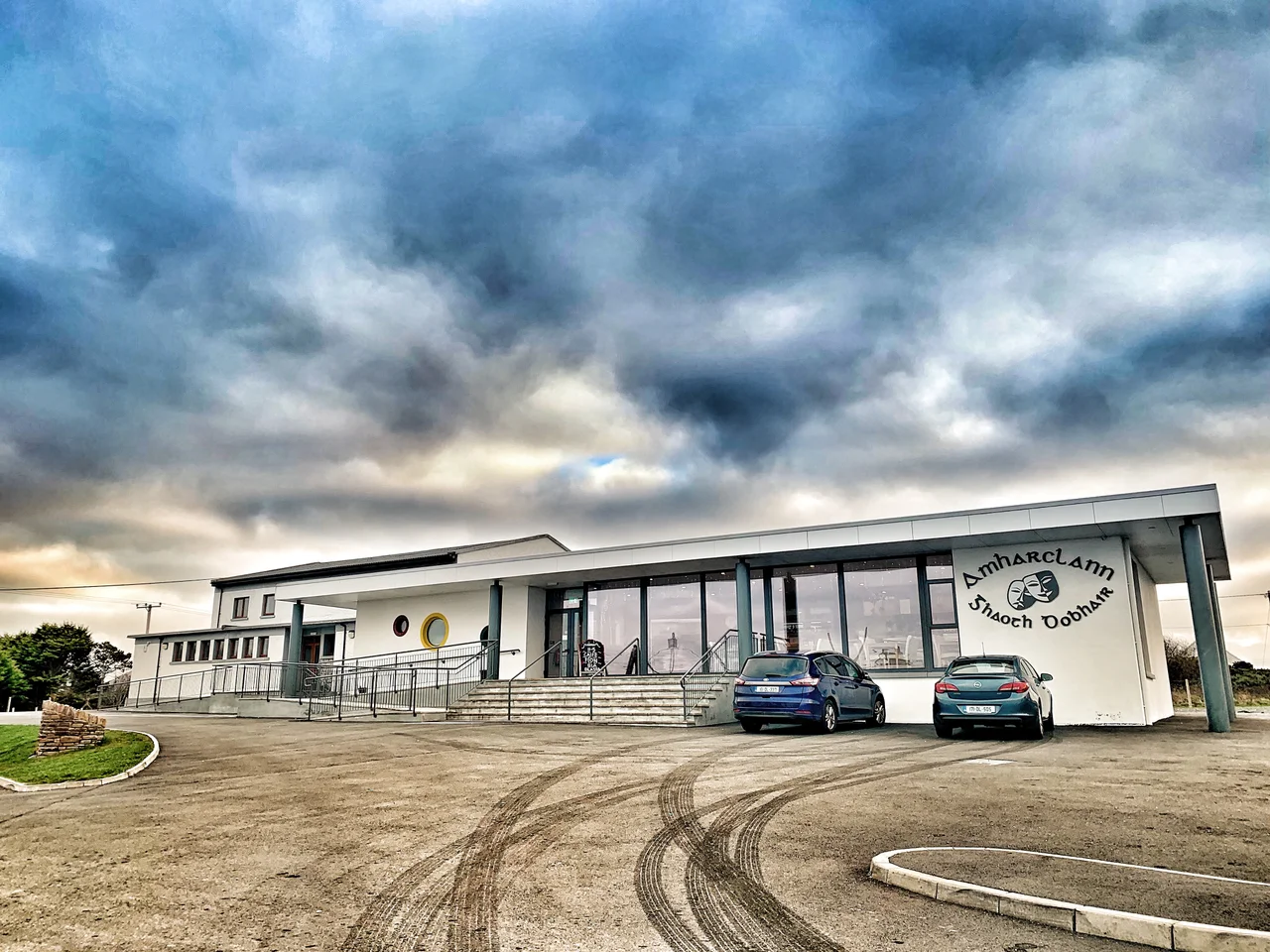

Amharclann Ghaoth Dobhair
On a winter night in 1962, in the village of Derrybeg on Ireland's Atlantic edge, the actress Siobhán McKenna - then one of the most famous performers in the Irish-speaking world - cut the ribbon on a new theatre seating just over two hundred people. The building was modest by any measure: a small civic hall in a parish few outside Donegal could pronounce. But the children who would perform on its stage in the years that followed included a girl from Dore called Eithne Ní Bhraonáin, who would later be known to the world as Enya, and her elder sister Máire, who would become Moya Brennan of Clannad. The pantomimes at Amharclann Ghaoth Dobhair were, for several of the most successful Irish musicians of the late twentieth century, the first time they ever stood in front of an audience.
Aisteoirí Ghaoth Dobhair
The theatre did not come from nowhere. Thirty years earlier, in 1932, a group of local actors had founded *Aisteoirí Ghaoth Dobhair* - the Gweedore Actors - in the small townland of Srath na Corcra in Derrybeg. They performed in Irish. They were good enough to gain critical acclaim, and during the long economic ties between Donegal and Scotland they travelled as far as Glasgow to perform for the diaspora. The founding members - Eoghan Mac Giolla Bhríghde, Áine Nic Giolla Bhríghde, Johnnie Sheáin Ó Gallchóir, Proinsias Ó Maonaigh, Máire Bn. Uí Bhraonáin and others - were schoolteachers, musicians, and parish notables who took drama seriously. Two of those names matter for what came later: Proinsias Ó Maonaigh was the father of Mairéad Ní Mhaonaigh, who would lead the traditional band Altan, and Máire Uí Bhraonáin was the grandmother of the Brennan family who would become Clannad.
The Pantos
After the theatre opened, the company began producing pantomimes - *geamaireachtaí* in Irish - every year or two, drawn from Irish mythology and folklore. *Turloch Óg na dTuath* in 1962. *Ball Dearg* in 1963. *An tSleagh Ghlas* in 1964. *Fionnán in Arabia* in 1965, which strayed cheerfully beyond Donegal. *An Gobán Saor* in 1967. *An Glas Gaibhlinn* in 1968. *Mac Rí Uladh* ("The Son of the King of Ulster") in 1970. *Iníon Rí Ailigh* in 1973. These pantos had small budgets, large casts of local children, and entirely Irish-language scripts. They drew on legends every child in the parish knew already. They were a serious training ground for performance, sung and spoken, in a language most of the audience used at home.
Before They Were Enya and Clannad
The Brennan family ran a pub a few miles up the road in Crolly. The father, Leo Brennan, was a showband musician. His children grew up singing harmonies around a kitchen piano. Three of the Brennan siblings - Máire, Pól, and Ciarán - and their twin uncles, Pádraig and Noel Duggan, would form Clannad in 1970, taking their name from *clann as Dobhar*, "family from Gweedore." Their younger sister Eithne briefly joined Clannad in 1980 before going solo as Enya. All of them learned how to stand on a stage at Amharclann Ghaoth Dobhair. So did Mairéad Ní Mhaonaigh, whose father Proinsias had been one of the founding actors of the company in 1932. So did three of the Casaidigh, who later formed the band Na Casaidigh. The Gweedore Theatre was, in effect, the Carnegie Hall of north-west Donegal.
A Language Theatre
Amharclann Ghaoth Dobhair is one of a small handful of full-time Irish-language theatres in the country. In the language map of Ireland, this corner of west Donegal is one of the strongest Gaeltacht regions - more than half the population speaks Irish daily in some electoral divisions. The theatre operates entirely in that language. Hundreds of plays have been staged here over the decades since 1962, ranging from translations of European drama to new work by local writers. The Siobhán McKenna who opened it had been the leading Irish-language stage actress of her generation. She believed Irish theatre needed buildings in Irish-speaking places, not just well-meaning Gaelic League performances in Dublin halls. The theatre in Derrybeg, sixty-three years after she cut its ribbon, is still proving her right.
From the Air
The theatre sits at 55.07°N, 8.30°W in the village of Derrybeg, parish of Gweedore, west Donegal. Donegal Airport (EIDL) is 6 nm south at Carrickfinn - the only airport in County Donegal. The Atlantic coast lies 1 nm west; Mount Errigal, Donegal's tallest peak at 751 metres, rises 5 nm east-southeast and is the most visible landmark from any altitude. Best viewed at 2,000-4,000 ft AGL, with Bloody Foreland to the north-northwest.
Nearby Stories
- Flight of the Earls 12 km away
- Lifford 16 km away
- SS Devonian (1900) 20 km away
- Donegal Castle 23 km away
- German submarine U-155 (1941) 24 km away
- German submarine U-1233 54 km away
- Easky 63 km away
- RMS Empress of Britain (1930) 69 km away